


Meditation vs. Mindfulness: Which Practice Is Right for You?
Compare meditation and mindfulness—key differences, benefits, and simple tips to choose or combine them for better focus and stress relief.

Meditation and mindfulness are often confused but serve different purposes. Meditation involves structured techniques like focusing on your breath or repeating a mantra to train your mind, improve focus, and reduce stress. Mindfulness, on the other hand, is about staying fully present in the moment during daily activities, like eating or walking, without judgment.
If you prefer a dedicated routine to build mental discipline, meditation may be your choice. If you need a quick way to manage stress throughout the day, mindfulness can fit seamlessly into your routine. Both practices can complement each other, with meditation enhancing focus and mindfulness applying that focus in real-time situations.
Quick Overview:
- Meditation: Structured, requires quiet time, builds mental clarity, and helps with long-term stress management.
- Mindfulness: Can be practiced anytime, focuses on present-moment awareness, and offers immediate stress relief.
Together, they can improve emotional balance, focus, and overall well-being. Start small - try 5 minutes of meditation or focus on one mindful activity per day to see what works best for you.
Meditation vs. Mindfulness: Key Differences
What Is Meditation?
Meditation is a deliberate practice aimed at training the mind through specific techniques. These sessions can last anywhere from a single minute to over half an hour. During meditation, you might focus on your breathing, repeat a mantra, or follow a guided exercise. It usually involves finding a quiet spot and adopting a particular posture, such as sitting upright or lying down. The purpose is to cultivate mental clarity, achieve a sense of calm, and improve focus. Meditation follows structured methods, all of which begin by calming both the body and mind [1].
What Is Mindfulness?
Mindfulness refers to being fully present in the moment, and it can be practiced anytime, anywhere. It’s about observing your surroundings, actions, and feelings without judgment - whether you’re preparing a meal, taking a walk, or having a conversation. Vishvapani Blomfield, a mindfulness teacher, describes it as:
"Mindfulness is a faculty you can use throughout your day."
Meditation teacher Yael Shy adds:
"I can be mindful while I'm cooking or tying my shoes or even when I'm talking to people. The skill of mindfulness is learning how to cut down the number of distractions in front of you so that you're really paying attention to what you're doing and how you're feeling" [1].
In essence, mindfulness is the art of reducing distractions to stay fully engaged in the present.
How Meditation and Mindfulness Connect
Think of mindfulness as a state of awareness and meditation as a tool to develop that state [5]. While meditation often incorporates mindfulness, not all meditation practices are centered around it. Some forms use techniques like visualization or repeating mantras, which don’t necessarily focus on being in the moment. On the flip side, mindfulness doesn’t require meditation - you can bring mindfulness into your daily activities without ever sitting down for a formal session. The two complement each other when meditation acts as a mental exercise to enhance mindfulness, which you can then apply throughout your day. Ready to explore how these ideas can fit into your routine? Keep reading for practical tips.
sbb-itb-3d8e4fc
How Meditation and Mindfulness Work: Techniques and Methods
Meditation Techniques
Meditation uses structured approaches to help focus your mind during dedicated sessions. Popular methods include breath awareness, where you concentrate on the rhythm of your breathing, mantra-based meditation, which involves repeating a word or phrase to maintain focus, and visualization, where you create mental images to guide your thoughts. Another common practice is the body scan, where you mentally observe sensations in different parts of your body without trying to change them.
To get started, pick a quiet, clutter-free spot with natural light, and sit with a relaxed yet upright posture to stay alert [6]. Meditation teacher Sharon Salzberg highlights the importance of this initial step:
"One of my meditation teachers said that the most important moment in your meditation practice is the moment you sit down to do it. Because right then you're saying to yourself that you believe in change, you believe in caring for yourself, and you're making it real" [6].
Research suggests that even 12 minutes of meditation, practiced 5 days a week, can enhance your ability to concentrate and maintain attention [6]. Once you’ve established a meditation routine, you can explore how mindfulness can complement it in your everyday life.
Mindfulness in Daily Life
Unlike meditation, mindfulness doesn't require a specific setting or schedule. You can practice it during everyday activities like eating, walking, or listening. For example, while eating, pay attention to the texture, flavor, and temperature of each bite. When walking, notice how your feet connect with the ground and the sounds in your surroundings. During conversations, focus entirely on the speaker's words instead of thinking about your reply.
Mindfulness transforms ordinary tasks into moments of awareness. Instead of trying to change your mental state, you simply observe the present without judgment. A Harvard University study revealed that people spend approximately 47% of their time thinking about things other than what they're doing, which often leads to unhappiness [5]. Mindfulness helps you stay grounded in the moment, reducing that mental drift.
Active vs. Passive Focus
Meditation and mindfulness share common goals but work differently. Meditation involves deliberate focus during set times, often concentrating on a specific object like your breath or a mantra. Mindfulness, on the other hand, is about maintaining continuous, real-time awareness throughout your daily activities [7].
Vishvapani Blomfield explains the effort mindfulness requires:
"Mindfulness is noticing with a degree of calm... It requires energy and some discipline to become really mindful" [1].
The benefits of these practices are well-supported. Recent studies indicate that mindfulness can reduce symptoms of anxiety and depression as effectively as antidepressants for many individuals. A 2023 meta-analysis of 142 studies confirmed these mental health benefits [5]. Think of meditation as the practice that builds your concentration "muscle", while mindfulness is how you use that strength to navigate your day [5][7].
Meditation or Mindfulness? 3 Main Differences Explained
Benefits Comparison: Choosing Based on Your Goals
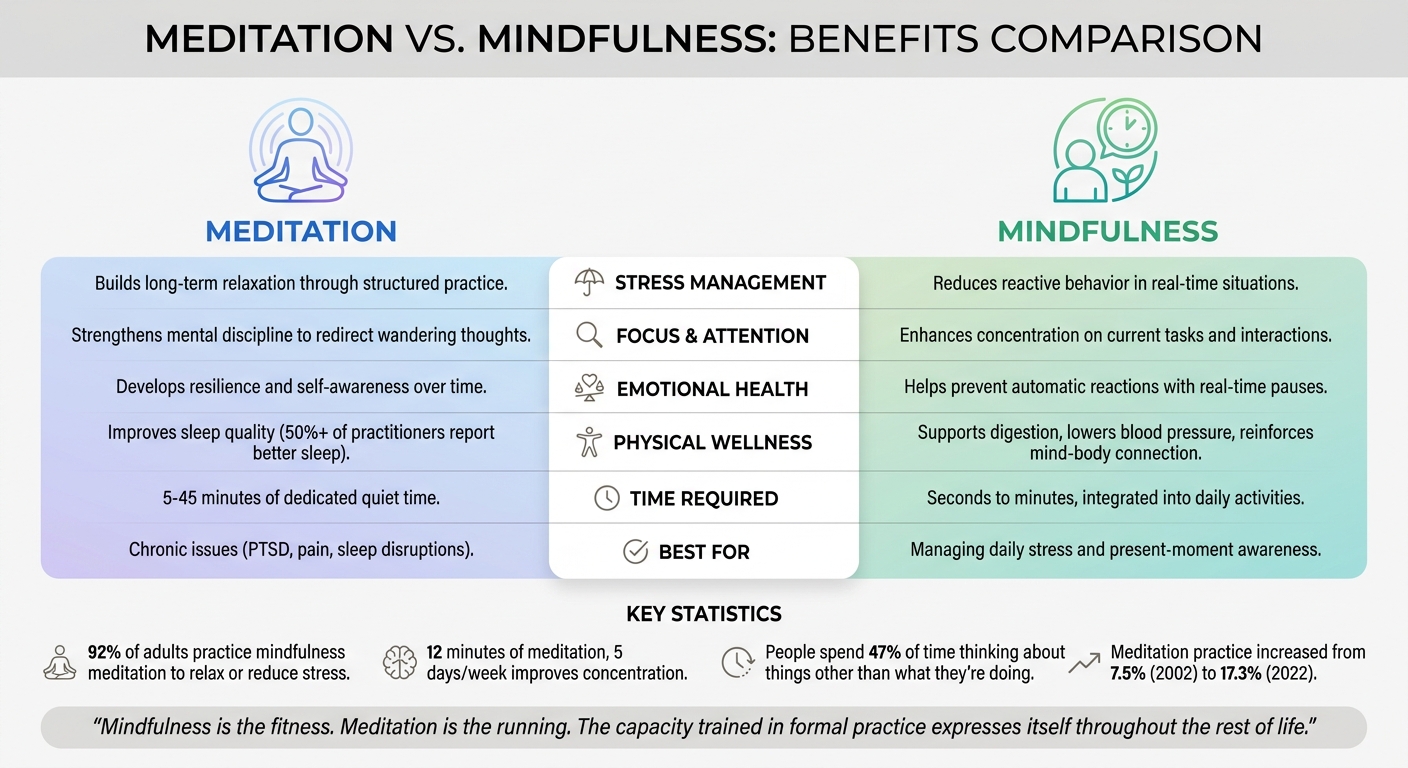
Meditation vs Mindfulness: Key Differences and Benefits Comparison
Meditation Benefits
Meditation, when practiced regularly, can significantly enhance overall well-being. It helps reduce stress by guiding your body into a relaxation state during focused sessions. Over time, this practice strengthens emotional resilience, allowing you to observe your thoughts without feeling consumed by them.
Another key advantage is better sleep - over half of meditation practitioners report improved sleep as a major benefit [8]. A study involving 203 veterans even found meditation to be as effective as prolonged exposure therapy in alleviating PTSD symptoms [8]. Additionally, meditation promotes long-term changes in the brain, enhancing focus and self-awareness. These changes empower you to better manage your reactions, providing a lasting sense of balance and clarity.
Mindfulness Benefits
Mindfulness, on the other hand, shines in its ability to offer immediate stress relief. It helps you pause and respond thoughtfully in stressful moments, whether you're stuck in traffic or navigating a tense conversation.
Mindfulness also transforms everyday activities - like eating or walking - into opportunities for deeper engagement and enjoyment. Among adults practicing mindfulness meditation, a striking 92% do so to relax or reduce stress [8]. Beyond stress management, mindfulness supports physical health by improving digestion, reducing blood pressure, and strengthening the connection between mind and body. This focus on the present moment provides practical, real-time support for managing daily challenges.
Comparison Table: Meditation vs. Mindfulness Benefits
| Benefit Area | Meditation | Mindfulness |
|---|---|---|
| Stress Management | Builds long-term relaxation through structured practice | Reduces reactive behavior in real-time situations |
| Focus & Attention | Strengthens mental discipline to redirect wandering thoughts | Enhances concentration on current tasks and interactions |
| Emotional Health | Develops resilience and self-awareness over time | Helps prevent automatic reactions with real-time pauses |
| Physical Wellness | Improves sleep quality | Supports digestion, lowers blood pressure, and reinforces the mind-body connection |
| Application | Requires dedicated quiet time (5–45 minutes) | Easily integrated into daily activities (seconds to minutes) |
| Best For | Addressing chronic issues like PTSD, pain, and sleep disruptions [8][9] | Managing daily stress and enhancing present-moment awareness [9] |
How to Decide: Finding the Right Practice for You
Factors to Consider
Each practice has its own strengths, so the key is figuring out which one fits your lifestyle and goals. Think about how much time you can realistically dedicate, your personality, and what you're hoping to achieve. For example, if your schedule is packed and you struggle to find quiet moments, mindfulness can blend effortlessly into everyday activities like your commute or lunch break. On the other hand, if you prefer a structured routine and want to develop mental endurance, meditation provides that framework[3].
Your personal wellness goals are also important. If you're looking to improve emotional regulation or reframe how you process memories, meditation offers the deep mental work to make those changes[3]. But if you need quick tools to manage stress - like staying calm during a heated meeting - mindfulness equips you with techniques you can use in the moment.
Your temperament matters, too. If sitting still makes you restless, informal mindfulness during daily tasks might be a better starting point. But if you enjoy routines and dedicated practice time, meditation could feel more rewarding[9].
Tips for Beginners
Start small and ease into it. For meditation, try just 5 minutes of focusing on your breath. You don’t need fancy equipment - just a quiet spot like a corner of your bedroom and maybe a timer.
For mindfulness, pick one daily activity to focus on fully for a week. For instance, drink your morning coffee without scrolling on your phone, or pause to take three deep breaths before opening your laptop. These brief moments of mindfulness are easy to incorporate and can have a surprisingly big impact[4].
If you feel anxious when starting out, take it slow. Begin with informal practices like mindful walking to get comfortable before transitioning to more formal seated meditation. This gradual approach can help you avoid feeling overwhelmed while building confidence in your practice[4].
Combining Both Practices
Once you’ve started with one practice, consider combining both to maximize their benefits. Together, they create a well-rounded approach to mental health. Meditation builds focus and mental clarity, while mindfulness helps you apply that clarity throughout your day.
"Mindfulness is the fitness. Meditation is the running. The capacity trained in formal practice expresses itself throughout the rest of life." - Zenify Editorial[9]
A simple routine might include 5 minutes of meditation in the morning to set a calm tone for the day, followed by a few mindful moments at lunch - like eating without screens or distractions. This combination helps you stay centered even when stress levels rise midday. Research, such as studies on Mindfulness-Based Stress Reduction (MBSR), shows that integrating these practices can significantly reduce anxiety and depression symptoms in people with generalized anxiety disorder[2][3].
Instead of choosing between the two, think of them as complementary tools. Together, they can support you in different ways throughout your day.
Getting Started: Practical Tips for Meditation and Mindfulness
Starting a Meditation Routine
Now that you're aware of the benefits, let’s dive into how to begin. The toughest step is often just sitting down to start. Begin with 5 minutes in a quiet space - this could be a cozy corner in your room or even your parked car. Studies suggest that practicing for 12 minutes, five days a week, can significantly improve your ability to focus and sustain attention over time [6].
Find a comfortable position: sit with your feet flat on the ground, your spine naturally aligned, and your hands resting on your legs [11]. When your mind inevitably wanders, gently guide your attention back to your breath without criticizing yourself. That moment of awareness - realizing your mind has drifted - is the essence of the practice [11].
While benefits may take time to fully develop, research indicates that consistent daily practice for at least eight weeks can yield noticeable improvements [10]. To stay on track, consider setting a timer on your phone or using a guided meditation app [11].
Once you've established a regular meditation habit, it becomes easier to incorporate mindfulness into your daily life.
Adding Mindfulness to Everyday Life
After building a meditation routine, mindfulness can flow naturally into your day-to-day activities. The beauty of mindfulness is that it doesn’t require extra time; it simply transforms the moments you already have. Tie mindfulness to your existing habits, like brushing your teeth or enjoying your morning coffee [11]. During these moments, engage your senses fully - feel the warmth of the coffee mug, smell the aroma, and savor the taste without distractions.
Another simple opportunity is mindful commuting. If you’re driving, turn off the music for a few minutes and focus on the sights around you or the sensation of the breeze [11]. Walking? Notice the rhythm of your steps and how your feet connect with the ground [11]. Sticky notes with reminders like “Take a breath” on your mirror or computer monitor can also help you break out of autopilot [11].
At work, mindfulness can enhance your interactions and productivity. During conversations, focus on the speaker’s tone and words without planning your response [11]. Before reacting to a stressful email or situation, take a brief pause to notice your surroundings and ground yourself [11]. Even 10 minutes of mindfulness a day has been shown to positively impact your well-being [11].
These small, intentional habits create a solid foundation for a mindfulness practice that fits seamlessly into your life.
Staying Consistent and Building Momentum
When it comes to meditation and mindfulness, consistency matters more than intensity. Start small - choose one daily activity, like eating a meal without screens, and stick with it for an entire week before adding more [9]. Tracking your progress with a calendar or journal can help keep you motivated and accountable.
Missed days are inevitable, but they’re not the end of the road. Consistency builds gradually, and it’s okay to start again. Between 2002 and 2022, the percentage of people practicing meditation rose from 7.5% to 17.3%, showing that more individuals are finding their rhythm over time [8]. If you miss a day, use it as an opportunity to reconnect with your practice. Wandering thoughts, forgotten sessions, and occasional frustration are all part of the process - it’s normal.
For additional structure and support, consider programs like Mindfulness-Based Stress Reduction (MBSR), which offer evidence-backed techniques and a sense of community [8][12]. If you’re curious about specific approaches like Transcendental Meditation, working with a certified teacher can ensure proper guidance [12].
Conclusion: Choosing Your Path to Wellness
Meditation and mindfulness work hand in hand: one strengthens your mental focus, while the other weaves that focus into your daily life. Think of meditation as the workout - structured time dedicated to building mental discipline - and mindfulness as the way you carry that strength through everyday moments, whether you're stuck in traffic or having a tough conversation. As Jon Kabat-Zinn explains:
"Mindfulness is paying attention in a particular way: on purpose, in the present moment, and non-judgmentally" [9].
Together, these practices create a powerful approach to improving mental clarity and building resilience. Even dedicating just 1–2 minutes a day to meditation can lead to noticeable benefits, like strengthening your prefrontal cortex - the part of your brain tied to focus and decision-making [7]. This "mental muscle" helps you stay grounded, even when life gets stressful. The combination of meditation and mindfulness equips you to better navigate challenges.
Getting started can be simple: take three intentional breaths or choose one mindful activity to focus on each day. If you prefer structure, try setting a timer for 5 minutes of breath-focused meditation in the morning. Both practices can be adjusted to fit your lifestyle and preferences.
The key is to make it your own. Experiment with different techniques, pay attention to what feels right, and remember that consistency matters more than perfection. The goal isn’t to achieve a completely clear mind - it’s about noticing when it wanders and gently bringing your focus back. By incorporating these practices into your routine, you can enhance both your mental clarity and your ability to handle whatever life throws your way.
Disclaimer
This article is meant for informational purposes only and does not constitute medical, health, fitness, or wellness advice. While meditation and mindfulness are often considered safe, a 2020 review of 83 studies involving 6,703 participants revealed that about 8% of individuals reported negative effects, such as heightened anxiety or depression [8]. These potential risks highlight the importance of seeking professional guidance.
Meditation and mindfulness should never replace conventional medical care or delay visits to a healthcare provider for medical concerns [8]. If you have a diagnosed psychiatric condition - like clinical anxiety, depression, or PTSD - or a physical health issue, or if you're undergoing treatment, consult a qualified healthcare professional before starting these practices. These techniques are intended to complement, not substitute, standard medical treatments.
Before starting any program, it's essential to inquire about the training and certification of meditation or mindfulness instructors [8]. Certified teachers can provide tailored feedback, ensure proper technique, and assist with managing challenges or emotional struggles during your practice [12]. If you notice a significant increase in anxiety, a drop in mood, or other distressing symptoms, pause your practice and consult a mental health professional.
Always discuss any complementary health approaches, including meditation or mindfulness, with your doctor. Sharing this information allows your healthcare team to deliver coordinated and safe care tailored to your specific needs [8]. This advice serves to enhance the wellness strategies discussed earlier.
FAQs
How do I choose between meditation and mindfulness?
Choosing between meditation and mindfulness comes down to your personal goals and daily habits. Meditation typically involves dedicated sessions where you focus on calming your mind and finding clarity. On the other hand, mindfulness is about being fully present in the moment during everyday activities, without passing judgment.
If you enjoy structured practices and scheduled time for reflection, meditation might suit you better. But if you’re looking for a way to weave awareness into your daily routine, mindfulness could be a better fit. Ultimately, the right choice depends on whether you prefer a set practice or a more flexible, moment-to-moment approach.
Can I do mindfulness if I can’t sit still to meditate?
Mindfulness is achievable even if sitting still for meditation feels difficult. You don’t need to stick to traditional meditation postures to practice it. Activities like mindful yoga, body scans, or even everyday tasks like walking or eating can help you cultivate awareness. These approaches let you integrate mindfulness into your routine in a way that feels natural and fits your comfort level - no extended stillness required.
What should I do if meditation or mindfulness makes me feel worse?
If practicing meditation or mindfulness seems to make you feel worse - whether it’s increased anxiety, depression, or emotional distress - it’s important to stop and reach out to a healthcare professional. Studies have shown that some individuals may experience these negative effects. A professional can help you navigate these challenges and explore other methods that might suit you better.


