

Top 10 Sustainable Travel Products for Packing
10 refillable, long-lasting, carry-on-friendly travel items to cut single-use waste and simplify packing.


I can cut a lot of travel waste with a small packing kit. The article’s main point is simple: start with a few reusable items that replace the stuff I throw away most often, like plastic water bottles, mini toiletries, takeaway packaging, and extra shopping bags.
On a normal travel day, one person creates about 4.4 pounds (2 kg) of waste. This guide says the best way to cut that down is to pack items that are:
- Refillable
- Long-lasting
- Light enough for carry-on travel
- Able to replace single-use items again and again
The 10 picks cover the full packing setup:
- Carry-on suitcase or backpack
- Recycled-fabric packing cubes
- Insulated reusable water bottle
- Compact water filter
- Food containers and utensils
- Reusable shopping tote or day bag
- Solid shampoo, conditioner, and soap bars
- Low-waste oral care kit
- Mineral sunscreen stick
- Compact travel laundry kit
The article also gives clear buying rules. I should look for things like recycled materials, BPA-free and PFAS-free labels, repair options, good zippers and seams, and designs that do more than one job. And one point stands out: refillable beats recyclable or compostable for most trips, because I can use it anywhere without depending on local disposal systems.
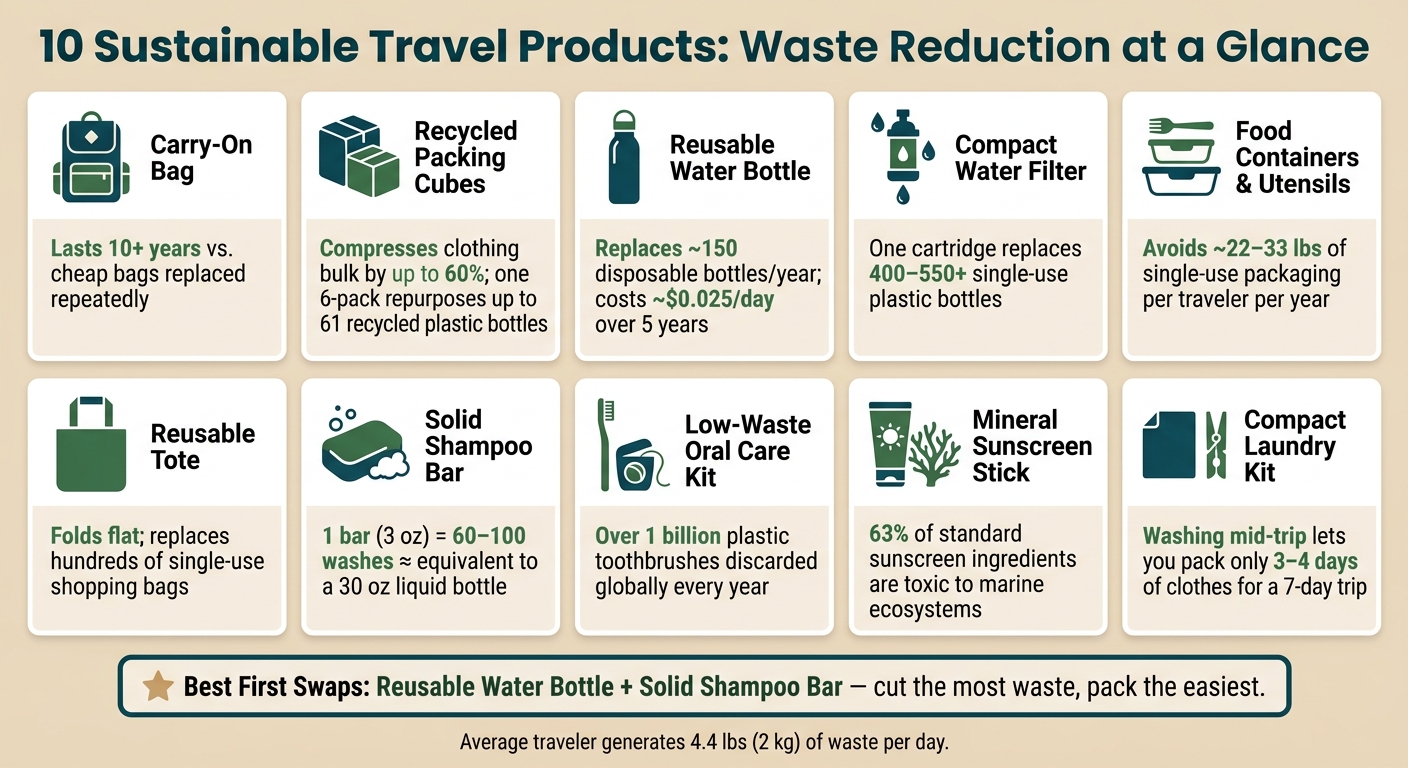
10 Sustainable Travel Products: Waste Reduction & Key Stats
10 BEST Travel Essentials for Zero Waste & Eco- Friendly Traveling| Sustainable Travel Tips
sbb-itb-3d8e4fc
Quick Comparison
| Product | Main job | What it replaces | Best thing about it | Main watchout |
|---|---|---|---|---|
| Carry-on bag | Main packing system | Cheap bags replaced often | Lasts longer if repairable | Higher upfront cost |
| Packing cubes | Organize and compress clothes | Plastic zip bags, extra luggage space | Can cut clothing bulk by up to 60% | Weak zippers can fail |
| Reusable bottle | Daily drinking water | Disposable bottles | One bottle can replace about 150 bottles a year | Needs regular cleaning |
| Water filter | Safe refills in low-trust water areas | Bottled water purchases | One filter can replace 400–550+ bottles | Filter care matters |
| Food containers & utensils | Meals and snacks on the go | Takeout packaging and cutlery | Cuts food-packaging waste | Silicone costs more up front |
| Packable tote | Shopping, day trips, overflow carry | Single-use shopping bags | Folds flat, easy to pack | Some fabrics wear out fast |
| Solid toiletries | Hair and body care | Liquid bottles and hotel minis | No leaks, no TSA liquid issue | Bars need to dry out |
| Oral care kit | Brushing and flossing | Plastic toothbrushes and tubes | Small and dry for travel | Bamboo parts must stay dry |
| Sunscreen stick | Sun protection | Liquid sunscreen bottles | Easy to pack, no spills | Some cardboard tubes get soft |
| Laundry kit | Wash clothes mid-trip | Overpacking extra clothes | Lets me pack fewer outfits | Hand-washing takes effort |
Bottom line: if I only start with two swaps, the article points to a reusable water bottle and a solid shampoo bar first. They cut waste fast, pack easily, and fix two of the most common travel purchases.
How to Pick Sustainable Travel Products
Not every product with an "eco" label deserves your money. Some items are lower-impact. Others are just dressed-up marketing. Before you pay extra for travel gear, it helps to look at a few practical things: how long it lasts, whether it replaces throwaway items, and how well it fits into a carry-on setup.
Materials to Look For
Materials shape how a product performs, how safe it is to use, and what happens when you're done with it. For bags and packing cubes, recycled polyester (rPET) and recycled nylon, such as Cordura® Ballistic Re/Cor, are strong picks. They reuse plastic waste and still hold up under regular travel wear.
For bottles, bags, and toiletries, food-grade platinum silicone works well as a swap for plastic. It's BPA-free, leak-proof, and heat-resistant up to 425°F. For personal care items, bamboo and organic cotton are renewable, and in many cases, compostable.
If a product touches your food or skin over and over, check the label. Look for BPA-free, BPS-free, phthalate-free, and PFAS/PFC-free claims on items like silicone bags, water bottles, and toiletry containers [4][6].
Durability, Repairability, and Warranty
A low-cost item made with recycled materials isn't a better choice if it breaks after a few trips. The bigger issue is how long it stays usable. A bag that lasts 10 years cuts down on repeat purchases, and that can matter more than the recycled percentage printed on the tag.
Look for signs of solid construction, such as:
- Reinforced seams
- Quality hardware like YKK® zippers
- Duraflex buckles
- A clear repair or replacement policy
Those details usually point to gear built for the long haul.
Size, Weight, and Multi-Use Design
For carry-on-only travel, small and multi-use products earn their place fast. Compression packing cubes can cut the volume of packed clothing by up to 60% [3]. That means more space in your bag and less need to check luggage.
Some packing pods come with carry straps, so they can double as a day bag [5]. That's one less tote to pack. The same idea applies to smaller items too. A silicone bag that can hold toiletries and snacks is more useful than three separate containers.
End-of-Life and Disposal
Refillable, recyclable, and compostable do not mean the same thing.
Refillable items are usually the most practical because you can keep using them without relying on local systems. Recyclable products depend on what your city actually takes at the curb. Compostable items, such as bamboo toothbrushes or compostable tubes, often need industrial composting facilities. Most U.S. cities don't offer that through normal home bins.
So the simple rule is this: start with refillable items. Recyclable and compostable options only make sense when local rules and facilities support them.
| Product Type | Common Low-Impact Materials | Main Benefit | Key Tradeoff |
|---|---|---|---|
| Luggage & Packs | Recycled polyester, Cordura® Re/Cor nylon | High durability; diverts plastic waste | Can shed microplastics during heavy cleaning |
| Packing Cubes | Recycled PET (rPET) | Lightweight; saves space | Low-quality zippers can snag |
| Food/Liquid Storage | Platinum silicone | Leak-proof; BPA-free; heat-resistant | Higher upfront cost than disposable plastic |
| Hard-Shell Cases | Recycled polycarbonate | Impact-resistant; lightweight | Recycled content is often capped for strength |
| Personal Care | Bamboo, organic cotton | Biodegradable; renewable | Requires thorough drying to prevent mold |
| Hardware/Hooks | Zinc, aluminum | Highly recyclable; strong | Heavier than plastic alternatives |
1. Eco-Friendly Carry-On Suitcase or Backpack
Start with the bag. It shapes weight, durability, and how well you can pack. And if you buy one that lasts, you won't need to replace it as often, which means less waste over time. The same basic filters apply here: keep it light, make sure it can be repaired, and pick a carry-on-friendly design.
Low-impact materials
For this category, focus on recycled shells, PFAS-free coatings, and hardware you can fix instead of toss. If you're looking at a hard-shell suitcase, recycled polycarbonate is a strong place to start. Nortvi's Essential Cabin Suitcase uses German Makrolon polycarbonate, designed to flex on impact and spring back into shape [10].
If you prefer a soft-shell backpack, look for recycled nylon or rPET with a PFAS-free finish. That's the combo that makes sense here. GOT BAG's Pro Pack is made from ocean-recovered plastic with a PFAS-free coating [8].
Durability and repairability
A lot of a backpack's lifetime emissions happen up front, during manufacturing [13]. So materials matter, but lifespan matters just as much. A bag that holds up for years usually beats one that looks good on day one and fails a year later.
Repair support is worth checking before you buy. Osprey's All Mighty Guarantee covers repairs or replacements with no receipt required [11], and Cotopaxi offers lifetime repairs and a trade-in program [7]. For any bag, take a close look at the hardware too. Check whether wheels are user-replaceable [7], and look for parts that can take a beating, like replaceable wheels, sturdy buckles, and oversized zippers [9][10][11].
Multi-use and packability
Backpacks usually weigh 1.5 to 3.5 lbs. Carry-on suitcases often come in at 7 lbs or more [8][12][14][15]. That's a pretty clear edge if you're trying to travel carry-on only and keep weight down.
If you like the neat, split-open feel of a suitcase but want the lower weight of a backpack, some designs bridge that gap. The Nomad Lane Bento opens flat for easier packing and unpacking [14]. Once you've picked the bag, the next easy win is organization.
2. Recycled-Fabric Packing Cubes
After the bag itself, packing cubes are one of the easiest ways to upgrade your carry-on setup. They keep clothes sorted, cut down bulk, and make it much less annoying to find what you need. The lower-waste options do the same thing, just with recycled fabrics.
Low-impact materials
For packing cubes, recycled nylon tends to handle compression better than recycled polyester. Both also hold up better than organic cotton when you pack and unpack them over and over. GOTS-certified organic cotton is pesticide-free and biodegradable, but it doesn’t stand up as well under heavy compression [16].
A single 6-pack compression set like the Quince Eco Compression Set ($59.90) can repurpose up to 61 recycled plastic bottles [3].
Durability and repairability
Pay attention to the small parts. Metal hardware and simple zip pulls are often easier to recycle or swap out if something breaks. Trtl Packing Pods use zinc G-hooks, and zinc retains 90% to 95% of its usability after recycling [5]. If warranty coverage matters to you, Eagle Creek backs its sets with a No Matter What guarantee [18].
Multi-use and packability
Compression zippers can reduce packed clothing height by up to 60%, which makes a big difference when you’re trying to fit a week’s worth of clothes into a carry-on [3][17]. That’s the kind of space saving you notice right away.
To help recycled synthetics last longer, wash them in cold water and let them air-dry.
With clothing sorted, the next gains come from reusable food and water gear.
3. Insulated Reusable Water Bottle
A good reusable bottle is one of the easiest swaps you can make. One bottle can replace about 150 disposable bottles per year and cost about $0.025 per day over five years [21][26]. That also helps you skip those extra airport, hotel, and transit drink purchases.
The best picks do two things at once: they use recycled material, and they’re built to stay in service for years.
Materials to Look For
Many lower-impact bottles use 90% post-consumer recycled 18/8 stainless steel. That cuts down on the cost of raw material extraction without giving up durability or flavor purity [19][20][22].
For example, the Klean Kanteen Rise Reflect is made from certified 90% post-consumer recycled stainless steel, sustainably harvested bamboo, and food-grade silicone [25]. It’s also smart to choose a bottle with a lead-free vacuum seal [20].
Durability and Repairability
A bottle works best when you don’t have to replace it every year. That’s why warranty coverage matters.
The Ocean Bottle Peak comes with a 10-year warranty and free replacement parts [22]. Hydro Flask and MiiR both offer lifetime guarantees [21][24]. MiiR also runs its Re:Claimed Takeback program, which lets you send back a dented or outdated bottle for $20 in online store credit [24].
That kind of support can make a big difference. A dented bottle shouldn’t mean starting from scratch.
Multi-Use and Packability
Day-to-day use matters just as much as specs on a product page. If a bottle feels awkward, heavy, or hard to clean, it tends to get left behind.
The MiiR 360 Traveler weighs 0.62 lb in the 12 oz size and has a 360-degree sipping lid for easy one-handed use [24]. If you want more capacity without much extra bulk, the Hydro Flask 24 oz weighs 13.2 oz, which is lighter than the Yeti Rambler 26 oz at 18.2 oz [21].
For fit, aim for a base diameter of about 2.9" to 3" so it works with standard cup holders in cars and on trains [19][20].
Some bottles, like the Ocean Bottle Peak, use a two-opening design. That makes it easier to add ice, scrub the inside by hand, and switch between a straw lid, screw cap, or brew lid based on what you’re drinking [22][23]. So one bottle can cover coffee, ice water, and all-day refills.
If you want fewer bottled-water stops, pair it with a compact filtration option.
4. Compact Water Filtration Option
For places where tap water is hit-or-miss, a small filter helps you keep refilling instead of buying bottle after bottle. If your trip includes spots with uncertain water quality, this is one of the smartest swaps you can make. One filter cartridge can replace 400 to 550+ single-use plastic bottles[27][33].
Low-Impact Materials
The LifeStraw Peak Solo is made with 50% post-consumer recycled, BPA-free plastic[30]. Water-to-Go bottles use a sugarcane-based biopolymer that is 100% recyclable[34].
Durability and Repairability
Standard filters remove bacteria, protozoa, and microplastics. Purifiers go a step further and also remove viruses such as hepatitis A and norovirus, which makes them a better fit for international travel or areas with poor sanitation[32][35].
A couple of strong options stand out:
- The Grayl GeoPress Ti ($219.95–$249.95) is a purifier made for higher-risk water, and its titanium outer cup can also be heated over a flame[31].
- The Sawyer MINI ($28.99) is a long-life squeeze filter rated for up to 100,000 gallons over its lifetime[29].
One thing you don't want to mess up: never let a wet filter freeze. Ice can damage the membrane[29].
Multi-Use and Packability
If you're trying to keep things ultralight, the LifeStraw Sip Essential weighs just 0.7 oz and costs $19.95[28]. The LifeStraw Peak Solo also screws onto standard 28 mm threaded bottles, which means you can filter water without packing extra gear[30].
Refillable, Recyclable, or Compostable End-of-Life
Epic Water Filters has a take-back program: you mail in used filters and get a free replacement[33]. The LifeStraw Sip Essential parts are also recyclable, aside from the membrane[28].
Once water is handled, the next move is cutting down food-packaging waste.
5. Silicone or Stainless-Steel Food Containers and Utensils
Once you've handled water, food storage is the next easy place to cut waste. Pack a small reusable meal kit - containers, one or two bags, and utensils - and you can avoid about 22–33 pounds of single-use packaging per traveler per year [36]. At that point, the big decision comes down to material.
Low-Impact Materials
For rigid containers, go with 18/8 stainless steel. For collapsible bags and cups, platinum-cured silicone is a safer pick for food contact. And for utensils, bamboo or titanium both make sense.
Each one has a clear upside. Bamboo is light and quieter than metal utensils. Titanium is about 45% lighter than steel and doesn't leave a metallic taste on food [37][2].
Multi-Use and Packability
A mix of materials tends to work best in practice: stainless steel for rigid containers and silicone for snack bags and collapsible cups [36].
One example is the Stasher Ultimate Travel Kit. It comes with five silicone bags and uses a patented Pinch-Loc seal that works for carry-on liquids and keeps working after thousands of uses [4]. If you want rigid containers, nesting stainless steel sets help keep the size down in a carry-on [39].
One small caution: do not repeatedly invert silicone bags, because that can weaken the seal [4].
Refillable, Recyclable, or Compostable End-of-Life
Stainless steel is 100% recyclable [38][39]. Silicone usually needs specialized recycling, so it makes more sense when you use it for a long time - aim for at least 100 uses to offset the energy cost of production [37]. Bamboo cutlery is biodegradable, but it needs to stay dry [36].
After food storage, the next place to cut waste is toiletries and laundry.
6. Reusable Shopping Tote and Lightweight Day Bag
Pack one fold-flat tote that can handle shopping runs, beach days, and extra gear. It’s the kind of bag you’ll use for errands, day trips, and overflow items without taking up much space in your main bag.
Low-Impact Materials
Look for GOTS-certified organic cotton canvas, 100% organic hemp, or recycled performance fabrics like recycled ripstop polyester and X-Pac made from recycled fishing nets [40][41][44]. Skip virgin synthetics and PFAS-based waterproofing [40][42].
Durability and Repairability
Go for strong, light fabrics such as Robic nylon or 30D/70D ripstop polyester, along with triple-stitched seams and reinforced stress points [46][45][47]. It also helps to look for 16- to 21-ounce canvas and brands that back their bags with lifetime guarantees [40][42][43][46][41].
Multi-Use and Packability
The sweet spot is a tote that folds flat when empty but still has enough structure to carry a full load. That matters in a carry-on setup, where every item needs to earn its place.
The Terra Thread Travel Tote ($49.95) is made from 100% GOTS-certified organic cotton and includes a trolley sleeve that slides over rolling luggage handles [40]. If you want something lighter, the Rumpl Packable Tote ($24.95) weighs just 0.1 lbs, packs down to 4.5" x 2.8", and uses 100% recycled 30D ripstop polyester [46].
Recyclable or Compostable End-of-Life
Natural fiber bags have a simple end-of-life route: remove any metal hardware, then compost only pure cotton or hemp fabric [40][42]. For synthetic bags, repairable designs and take-back programs make more sense.
The Day Owl Packable Tote ($15.00) is made from 7 recycled water bottles and uses a zero-waste pattern that cuts out fabric scraps during manufacturing [44].
Pair a tote like this with low-waste toiletries and laundry basics to keep the rest of your kit compact.
7. Solid Toiletries: Shampoo, Conditioner, and Soap Bars
Switching from liquid bottles to solid bars is one of the simplest low-waste packing moves you can make. It also makes carry-on packing a lot less annoying, since every ounce and every bottle counts. Solid bars are TSA-friendly, they don’t leak, and they’re far more concentrated than most liquids. In fact, one 3 oz shampoo bar can deliver 60–100 washes, which is about the same as a 30 oz bottle of liquid shampoo [48].
Low-Impact Materials
The best bars leave out sulfates, parabens, phthalates, and silicones [48][49]. It’s smart to look for Leaping Bunny or RSPO certification, along with short ingredient lists and low-fragrance formulas. The same idea applies to conditioner bars: keep it simple, skip silicones, and choose options with very little packaging.
Form matters too. Soap-based bars can leave hair feeling rough in hard water, while surfactant-based bars tend to rinse out more cleanly [50][51].
Multi-Use and Packability
Some bars work as both shampoo and body wash, which means fewer items in your bag [51][53]. That kind of two-in-one setup can save space without making your kit feel stripped down. One example is the Life Elements Hair & Body Travel Bar ($12.50), which works well enough that many users skip a separate conditioner [53].
Refillable, Recyclable, or Compostable End-of-Life
A lot of solid bar brands use packaging that can be composted or reused. When it’s empty, remove any metal parts before composting cardboard or plant-fiber wrapping. Aluminum tins are also worth keeping around - they’re handy for small items like earbuds or medications [53][54][56].
If you’re dealing with hard water, a diluted apple-cider-vinegar rinse can help remove mineral buildup. Use 1 to 4 tablespoons per 8 oz of water [48][51]. And if you’re using biodegradable soap outdoors, keep it 50 meters (164 feet) away from waterways [52].
Next, pack a low-waste oral care kit to replace toothpaste tubes and disposable brushes.
8. Low-Waste Oral Care Kit
Oral care is one of those things people often skip over when they try to pack with less waste. But the numbers are hard to ignore: over 1 billion plastic toothbrushes are thrown away worldwide every year [62]. Regular toothpaste tubes aren’t much better, since they’re tough to recycle. A low-waste oral care kit swaps the usual brush, toothpaste tube, and floss spool for small reusable items. It follows the same solid, TSA-friendly idea as shampoo bars and soap bars.
Low-Impact Materials
A simple switch is a bamboo-handled toothbrush with nylon bristles. For floss, look for 100% silk or plant-based PLA coated in candelilla wax. Both are compostable options compared with standard floss [60][61][62]. To keep everything together, store the kit in a reusable glass or stainless steel tin.
Multi-Use and Packability
Toothpaste tablets are dry, small, and not subject to TSA 3-1-1 liquid limits [58][59]. To use them, chew one tablet until it forms a paste, then brush for two minutes [58][61]. Mouthwash tablets work in much the same way. Drop one in water, let it dissolve, and you’ve got a substitute for a bulky liquid bottle [61][55].
Refillable, Recyclable, or Compostable End-of-Life
When a bamboo toothbrush wears out, use pliers to pull out the bristles. Recycle them if your local facility accepts them, then place the handle in compost [61]. Floss containers made from glass or stainless steel can be reused again and again with compostable refills [62]. Keep toothpaste tablets dry in an airtight tin or glass jar so they don’t clump [63]. The Dental Lace Travel Kit ($20.00) covers the basics in a reusable tin [62].
Next: reef-safe mineral sunscreen sticks, another compact swap that cuts plastic.
9. Reef-Safe Mineral Sunscreen Stick
After toiletries, sunscreen is the last low-waste travel item you don't want to skip. Standard sunscreen comes with a real tradeoff: 63% of ingredients in standard sunscreens are considered toxic to marine ecosystems, human health, or both [64].
Low-Impact Materials
Go with non-nano zinc oxide, ideally 20% or more. It has the strongest backing as a mineral filter for reef-conscious travel [64][65]. It also helps to check for "Hawaii Act 104 Compliant" on the label and choose a broad-spectrum SPF 30 to 50. If you'll be swimming, surfing, or doing sports, a stick with water resistance up to 80 minutes makes more sense [64][67].
Multi-Use and Packability
Sunscreen sticks are solid, which makes them easy to pack. They won't leak, and they won't burst in your bag after a flight. That's a small thing until you're cleaning sunscreen off half your clothes.
They're also handy for active days. If you're snorkeling or climbing, you can swipe it on without making your hands slick.
Tinted versions can pull double duty too. The Utu SPF 50 Tinted Mineral Stick ($40.00) can work as a light foundation or concealer, which means one less item in your bag [65][68].
Packaging matters too, since sunscreen sticks differ a lot in what can actually be recycled or composted.
Refillable, Recyclable, or Compostable End-of-Life
Cardboard tubes are compostable and plastic-free, but they don't hold up well around moisture [64][69]. Aluminum packaging is endlessly recyclable and better suited for rougher trips, and some brands sell refillable formats [65]. If you're checking the fine print, look for mono-material packaging such as 100% PP. That gives recycling centers a better shot at accepting it [68].
For use, apply it 15 minutes before sun exposure, make four passes per area, and reapply every two hours [66][67].
10. Compact Travel Laundry Kit
A compact laundry kit can shrink how many clothes you need on trips longer than five days. If you plan to wash once during the trip, you can often cut your clothing count in half. That means a lighter bag, less stuff to organize, and fewer items to buy or bring in the first place [72].
The best setup is pretty simple: dry detergent, a compact wash bag, and a small system for storage.
Low-Impact Materials
One of the easiest swaps is moving from liquid detergent to plant-based detergent sheets. They take up less space, skip the bulky bottle, and usually come with less packaging.
Kind Laundry costs $4.50 for 6 loads and ships in 100% recyclable cardboard envelopes [73]. Zero Trace, priced at $22.99, is another dry-sheet option [70][73].
For washing, the Scrubba Wash Bag stands out. It uses an internal washboard to clean clothes in about 3 minutes with minimal water. The full kit also includes a clothesline, foldable hangers, and a microfiber towel [71].
Multi-Use and Packability
Packability matters just as much as cleaning power. A good laundry bag should hold dirty clothes during the trip, then collapse into unused packing space when it's empty. That clean/dirty split isn't just nice to have. It's a core part of a low-waste packing system.
The Matador Packable Laundry Bag costs $30.00, uses PFAS-free 50D nylon, and is rated 4.93/5 from 56 reviews [75].
If you want one product to handle more than laundry, WildBatch All-in-One Powder is a strong option. It costs $39.99 for a 4-pack and can clean hair, body, dishes, and laundry. A 1.1 oz capsule provides 15–20 washes [57].
Refillable, Recyclable, or Compostable End-of-Life
Blueland's Laundry Essentials Kit costs $40.80 and uses a steel Forever Tin with compostable refill pouches, which removes single-use plastic from the kit [74]. According to the brand, that setup can save 3.99 lbs of plastic and 909 g of CO2e annually [74].
There is a tradeoff. Hand-washing takes more effort, and drying heavier items like pants can be tough when you're on the road [71].
The table below compares the top options by weight, packability, and waste reduction.
Product Comparison Tables
Use these tables to pick the lightest, longest-lasting swap for each packing need.
They’re built to help you compare the tradeoffs that matter most: weight, TSA rules, cleaning, durability, and waste. Start with the category that saves the most space or cuts down the most disposables on your trip.
Luggage and Organization Comparisons
The main tradeoff here is structure vs. mobility.
| Brand | Material | Warranty / Repair | Best For | Price (USD) |
|---|---|---|---|---|
| Quince | Recycled polycarbonate | 5-Year Warranty | Budget-conscious travelers | $120–$199 |
| Osprey | Recycled Nylon (Bluesign) | Lifetime "All Mighty" Guarantee | Adventure / Hybrid travel | $249 |
| Solgaard | Ocean-bound Plastic | Lifetime Repair Program | Built-in organization features | $325–$395 |
| Cotopaxi | Deadstock / Recycled | Lifetime Warranty | Carry-on-only, multi-stop trips | $145–$350 |
A hard-shell case can give you more shape and protection. A softer bag usually moves better, especially if your trip includes trains, uneven sidewalks, or a lot of stop-and-go travel.
Food and Water Comparisons
Use insulation when water is safe. Use filtration when it isn’t.
| Product Type | Best Use Case | Weight | Cleaning Needs | Price (USD) |
|---|---|---|---|---|
| Insulated Stainless Bottle | Daily use, road trips | 10–15 oz | Bottle brush / soap | $30–$60 |
| Filter Bottle (e.g., Grayl) | International travel and backcountry trips | 7–10 oz | Replace filter annually | $28–$100+ |
| Bamboo Utensil Set | Street food, meals on the go | 4 oz | Hand wash / dry | $15–$25 |
This one is pretty simple. If you trust the tap, insulation makes day-to-day use easier. If you don’t, a filter bottle earns its spot fast.
Toiletries and Personal Care Comparisons
Solid formats tend to win on the travel-specific basics - no liquid limits, no leaks, and no bulky bottles. The main tradeoff is drying time between uses, plus a short adjustment period if you’re switching from liquid shampoo.
| Product | Format | TSA | Waste Reduction | Price (USD) |
|---|---|---|---|---|
| Ethique / Lush Bars | Solid Bar | No liquid limit | Plastic-free | $10–$20 |
| Plaine Products | Liquid (Refillable Aluminum) | Must fit 3-1-1 | Refillable aluminum | $8–$25 |
| Bite Toothpaste Tablets | Solid Tablet | No liquid limit | Compostable / Glass | ~$54/kit |
| Mineral SPF Stick / Tin | Stick / Tin | No liquid limit | Reef-safe / Plastic-free | $11–$30 |
If you fly often, solid options make packing easier. You skip the leak risk and avoid playing Tetris with a quart-size bag.
Laundry and Clothing Strategy Comparisons
Laundry choices also shape how many clothes you need to pack.
| Method | Weight | Space Saved | Best For | Price (USD) |
|---|---|---|---|---|
| Detergent Sheets (e.g., Kind Laundry) | Under 1 oz | High (Replaces extra outfits) | 7+ day trips | $20–$30 |
| Solid Soap Bar | 2–3 oz | Medium | Sink washing | $5–$10 |
| Merino Wool Clothing | N/A | High (Wear 5+ days) | Minimalist packing | $50–$150 |
This is where packing gets lighter in a sneaky way. Wash on the road, or wear items longer between washes, and you can pack fewer backups without much hassle.
Building a Complete Low-Waste Packing System
These products do their best work when you use them together. The goal is simple: cover the biggest sources of travel waste with one setup you can pack again and again. Put it all in one kit, and carry-on-only travel gets a lot easier to handle.
A Carry-On-Only Setup for a One-Week Trip
A 22-inch carry-on and one personal item are enough for a week’s worth of stuff. Here’s a simple way to divide everything:
| Bag | What Goes In | Why |
|---|---|---|
| 22-inch carry-on | Recycled packing cubes (3–5 tops, 2 bottoms), compact laundry kit, extra shoes | Main clothing storage; cubes compress and keep things sorted |
| Personal item (daypack/tote) | Bottle for refilling after security, filter system for uncertain water, reusable tote, nesting food containers, bamboo utensils | Easy-grab items for transit and daily use |
| Small toiletry pouch | Liquid-free toiletries: solid shampoo/conditioner bars, toothpaste tablets, bamboo toothbrush, mineral sunscreen stick | All solids - no liquid limits, no leaks |
Put your transit gear in the personal item so you’re not digging through your carry-on at the gate. Refill your bottle after security [76]. Keep your food containers ready from day one, especially if you plan to grab takeout or save leftovers.
How This Setup Cuts Single-Use Purchases
This kit goes after the usual travel waste: bottled water, hotel minis, throwaway cutlery, and shopping bags. A filter bottle lets you get through security and refill at hydration stations instead of buying airport bottled water [76]. Solid toiletries replace single-use hotel bathroom items. The reusable tote covers grocery runs, souvenirs, and day-to-day errands without needing extra bags.
The laundry kit matters more than it may seem. If you wash clothes mid-week, you can pack only 3–4 days of clothing for a 7-day trip [77]. That means less weight in your bag and fewer last-minute purchases because you ran short on something.
Tradeoffs to Expect
There is a catch: lower-waste travel takes more planning up front. The full kit can cost $650–$850 [13]. That’s a lot to spend at once, even if the cost spreads out over multiple trips.
A few small issues come with the setup too. Solid bars need airflow to dry, so a mesh bag or FlatPak case helps keep them from turning mushy [2][1]. Bottles and food containers need regular washing so smells don’t build up. And if solid shampoo is new to you, give it a little time. There’s often a short adjustment period while you figure out which formula works for your hair or skin type [1].
Conclusion
The best travel products with a lower waste footprint do one job well and keep working for years. That’s why the first two swaps are such easy picks.
Start with two high-impact changes: a reusable water bottle and a solid shampoo bar. Together, they cut bottled-water use, get rid of leaky liquid packaging, and deal with two of the most common sources of travel waste.
From there, add durable, multi-use basics as needed, and replace gear only when it wears out. Build a kit that lasts, then make small upgrades over time. The best kit is the one you’ll use on every trip.
FAQs
Which sustainable travel swaps save the most waste?
Start with swaps that replace high-use single-use items. A reusable water bottle is often the biggest win, because it can replace a lot of plastic bottles over one trip.
Other easy swaps include solid shampoo, conditioner, and soap bars. They help you skip hotel mini-bottles and cut down on plastic packaging. A reusable dining kit also helps trim airport and takeout waste.
How do I choose durable eco-friendly travel gear?
Prioritize quality over quantity so your gear lasts for years, not just one season. Look for sturdy construction, including reinforced materials, dependable zippers, and high-quality components.
It also helps to check for lifetime warranties, repair programs, transparent manufacturing, and certifications like B-Corp or Fair Wear. Those details can help you spot brands that back up their claims instead of just sounding green on paper.
The most sustainable item is the one you don’t need to replace.
Are refillable products better than recyclable ones for travel?
Generally, yes. Refillable and reusable products tend to be the better pick for travel because they stop waste before it starts.
Recycled materials still have a place, especially for durable gear like luggage or packing cubes. But for items you use up or refill on the go, like water bottles or toiletry containers, refillable options help cut down on single-use plastic and make disposal less of a hassle.


