

Omega-3s and Alzheimer's: Protective Benefits
Omega-3s support brain health and may lower dementia risk if used early, but show little benefit once Alzheimer’s is established.


If you want the short answer: omega-3s look more useful for lowering risk early than for helping after Alzheimer's disease is already diagnosed.
From what I see in this article, the pattern is pretty clear:
- Fish-rich diets are linked with slower cognitive decline
- Fish oil use in large population studies is linked with lower risk for some dementia outcomes
- But supplement trials in diagnosed Alzheimer's usually show little or no clear cognitive gain
- The best signal appears in midlife prevention, mild cognitive impairment (MCI), and very early decline
A few numbers stand out:
- In a 211,094-person UK Biobank study, fish oil use was linked with lower risk of all-cause dementia (HR 0.91) and vascular dementia (HR 0.83), but not Alzheimer's disease (HR 1.00)
- A Cochrane review of 632 people with mild-to-moderate Alzheimer's found no clear benefit for cognition or quality of life over 6 months
- A meta-analysis found that around 2,000 mg/day of omega-3s was tied to gains in some thinking skills, mainly in earlier stages
My takeaway: omega-3s may help support brain health before major damage is in place, but they do not look like a stand-alone fix for established Alzheimer's.
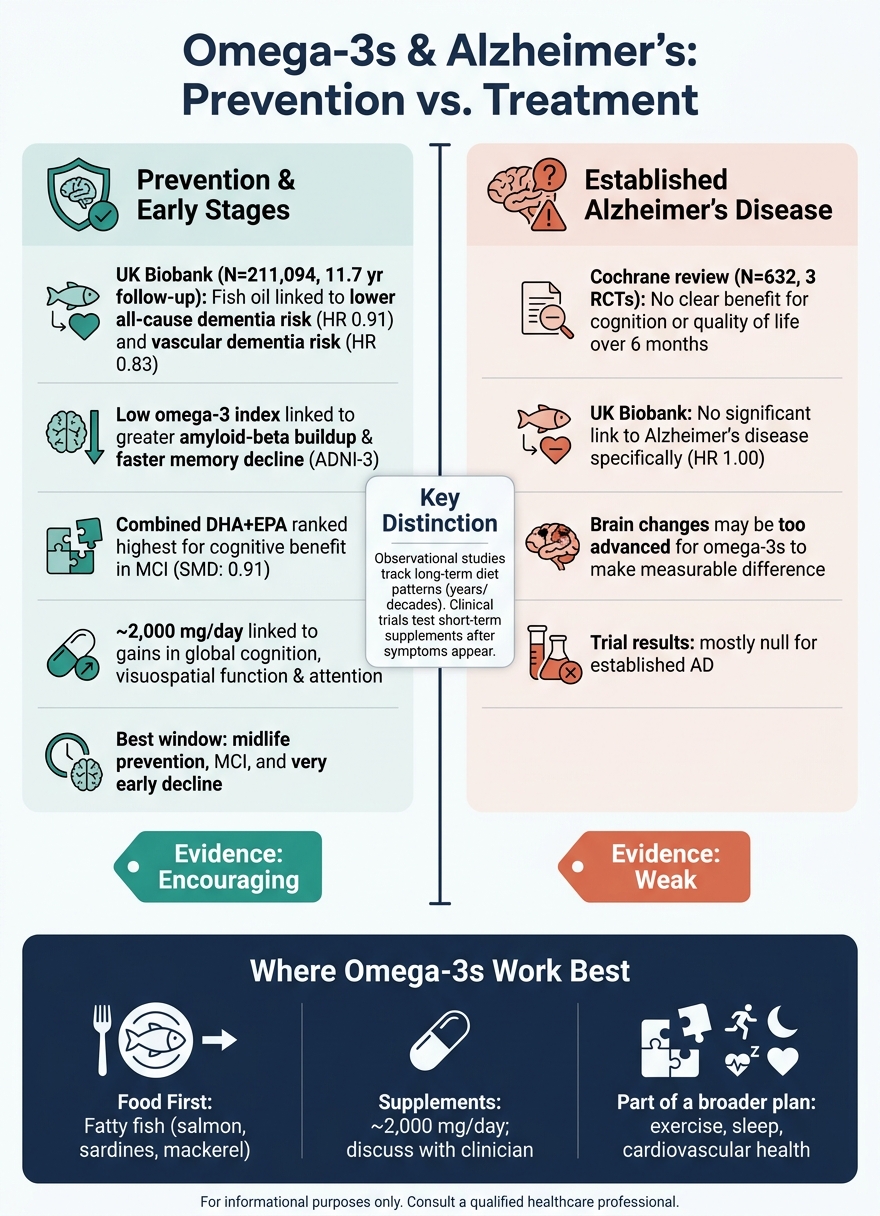
Omega-3s & Alzheimer's: Prevention vs. Treatment Evidence at a Glance
Fish Oil Supplements May Be a Bust for Alzheimer’s Prevention
sbb-itb-3d8e4fc
Quick comparison
| Question | What the article shows |
|---|---|
| Do omega-3s lower Alzheimer's risk? | Maybe in earlier life, but the link is stronger for overall cognitive decline than for Alzheimer's alone |
| Do supplements help after Alzheimer's diagnosis? | Usually no clear effect in trials |
| Are DHA and EPA both relevant? | Yes - DHA is tied to brain cell structure; EPA is tied more to inflammation and blood vessel health |
| Where do omega-3s look most useful? | Prevention, MCI, and very early decline |
| Best source? | Fatty fish first; supplements may be worth discussing with a clinician |
So if you're looking at omega-3s for Alzheimer's, I’d sum it up like this: good for long-term brain support, weak as treatment once the disease is established.
Observational Studies: Associations With Lower Cognitive Decline Risk
Large cohort studies often connect higher omega-3 intake with slower cognitive decline. But they don’t consistently show a lower risk of Alzheimer's disease.
What Cohort Studies Tend to Find
A UK Biobank study of 211,094 adults, followed for a median of 11.7 years, found that regular fish oil users had lower risks for several dementia outcomes [4].
| Dementia Type | Hazard Ratio (HR) | 95% Confidence Interval | P-value |
|---|---|---|---|
| All-cause Dementia | 0.91 | 0.84–0.97 | 0.007 |
| Vascular Dementia | 0.83 | 0.71–0.97 | 0.019 |
| Alzheimer's Disease | 1.00 | 0.89–1.12 | 0.977 |
Data from the UK Biobank cohort study (N=211,094) [4]. Frontotemporal dementia also showed a significant association (HR 0.43; 95% CI 0.26–0.72), but is not a primary focus of this article.
That sounds promising at first glance. But when researchers zoom in on Alzheimer's disease itself, the pattern gets much less convincing.
Blood-based omega-3 measures point in a similar direction. In ADNI-3, a low omega-3 index was linked to greater amyloid-beta buildup and faster memory decline [5].
Why These Findings Have Limits
Here’s the catch: people who eat more omega-3s or take fish oil often have healthier habits across the board [4][5]. They may eat better, exercise more, and stay more engaged with their health. Even after researchers adjust for those differences, the link can weaken [6].
This is the classic healthy-user bias problem. Reverse causality can muddy things too [7]. Put simply, early changes tied to disease might affect diet or supplement use, instead of the other way around.
Genetics adds one more layer. APOE ε4 may reduce the apparent effect of omega-3s on cognition [5][8].
So the big picture is pretty simple: observational studies hint at a protective pattern, especially before diagnosis, but they can’t prove cause and effect. That’s why trial data in people with established Alzheimer's disease matters so much in the next section.
This article is for informational purposes only and is not medical, health, fitness, or wellness advice. Always consult a qualified healthcare, medical, fitness, or wellness professional before making decisions, starting a new routine, changing your diet, using supplements, or acting on any health-related information.
Clinical Trials: What Supplement Studies Found in Alzheimer's Disease
Once researchers moved from observational research to controlled trials, the story changed quite a bit. That makes sense. These studies ask a different question: can omega-3 supplements help after cognitive decline has already started? For Alzheimer's disease, that is the test that matters most.
Results in Diagnosed Alzheimer's Disease
In people with diagnosed Alzheimer's disease, clinical trials have mostly not found a clear upside for cognition, daily function, or quality of life. A Cochrane review of three high-quality trials with 632 participants found no benefit for cognition or quality of life in mild-to-moderate AD over 6 months [10].
One likely reason is timing. By the time Alzheimer's is diagnosed, brain changes may already be too far along for omega-3s to make a measurable difference.
The picture looks a bit different earlier in the process.
Possible Signs of Benefit in Mild Cognitive Impairment or Early Decline
The evidence is more encouraging in earlier stages. A 2026 network meta-analysis found that combined DHA and EPA ranked highest among the supplements studied for cognitive benefit in MCI, with a standardized mean difference of 0.91 in favor of combined DHA and EPA [9].
Another meta-analysis that looked at dose-response found that each 2,000 mg/day increase in omega-3 supplementation was linked to gains in global cognitive abilities, visuospatial function, and attention [2]. Those gains did not keep rising at the same pace forever. Benefits leveled off at higher doses [2].
Taken together, these findings suggest omega-3s may matter most before Alzheimer's disease is established, or very early on.
Observational Studies vs. Randomized Trials: A Side-by-Side Comparison
The gap between observational research and trial results is not a contradiction. It mostly comes down to what each type of study is built to measure.
| Feature | Observational (Cohort) Studies | Randomized Controlled Trials (RCTs) |
|---|---|---|
| Typical Population | General public, healthy older adults | Specific groups (healthy older adults, MCI, or AD) |
| Duration | Years or decades of dietary habits | 4 months to 2 years of supplementation |
| Main Outcome | Reduced risk of developing dementia | Improvement or slowing of existing symptoms |
| Overall Direction | Generally positive/protective | Mixed; often null for established AD |
Observational studies follow long-term eating patterns. Trials test shorter-term supplement use, often after symptoms have appeared. That difference helps explain why omega-3s may show more promise earlier than later.
This article is for informational purposes only and is not medical, health, fitness, or wellness advice. Always consult a qualified healthcare, medical, fitness, or wellness professional before making decisions, starting a new routine, changing your diet, using supplements, or acting on any health-related information.
How Omega-3s May Protect the Brain: Mechanisms From the Research
The gap in trial results puts the biology front and center. If omega-3s help the brain, how might they do it? The research points to a few main paths, and they help explain why omega-3s seem to make more sense before Alzheimer's is far along.
Inflammation, Cell Membranes, and Neuronal Signaling
DHA makes up most of the omega-3 fat found in the brain. It sits inside neuronal membranes and helps keep them fluid, which supports how receptors and ion channels work [11][12].
DHA and EPA also help produce specialized pro-resolving mediators. These compounds help shut down inflammation and calm microglial activation, which matters because microglia are the brain's immune cells. Research also links this process to lower levels of cytokines such as TNF-α, IL-1β, and IL-6 [1][11].
Amyloid Processing, Vascular Health, and Oxidative Stress
DHA may also push amyloid precursor protein processing away from amyloid formation, though human evidence is still limited [1][11]. Omega-3s may support antioxidant defenses as well and may help the brain clear amyloid-beta [1].
Put together, these pathways help explain why omega-3s may be a better fit for prevention than for reversing established Alzheimer's disease.
These mechanisms also point in the same direction: omega-3s seem most relevant before the disease is established.
This article is for informational purposes only and is not medical, health, fitness, or wellness advice. Always consult a qualified healthcare, medical, fitness, or wellness professional before making decisions, starting a new routine, changing your diet, using supplements, or acting on any health-related information.
Bottom Line: Where Omega-3s May Be Most Useful
Key Points Readers Should Take From the Evidence
Taken together, the evidence suggests that omega-3s are more useful for prevention than for treatment. Regular fatty-fish intake is linked with a lower risk of Alzheimer's, while supplement trials in people who already have the disease remain weak. Studies in established Alzheimer's disease have not shown a clear cognitive benefit. Omega-3s may help protect brain cells earlier on, but they do not reverse damage that is already in place. The strongest support points to midlife prevention and very early cognitive decline.
A Responsible Final Takeaway
That is why experts describe omega-3s as one part of a broader brain-health plan, not a standalone treatment.
"Getting more DHA into the brain does not automatically mean that it will prevent memory loss or dementia, at least not when taken as a supplement by itself." - Hussein N. Yassine, MD, Professor of Neurology and Director at the Center for Personalized Brain Health, USC [3]
For most readers, the practical takeaway is pretty simple. Omega-3s seem to work best as part of a broader pattern, alongside regular physical activity, good sleep, and management of cardiovascular risk factors such as blood pressure and cholesterol. If someone has elevated risk, it makes sense to talk with a clinician before using omega-3s.
A food-first approach makes a lot of sense here. Fatty fish like salmon, sardines, and mackerel provide EPA and DHA directly. For people thinking about fish oil or algal oil supplements, evidence from meta-analyses suggests that doses around 2,000 mg/day may be needed to see clear cognitive benefits [2]. Still, dosing should be discussed with a clinician.
This article is for informational purposes only and is not medical, health, fitness, or wellness advice. Always consult a qualified healthcare, medical, fitness, or wellness professional before making decisions, starting a new routine, changing your diet, using supplements, or acting on any health-related information.
FAQs
Can omega-3s help prevent Alzheimer’s?
Research suggests omega-3s, especially DHA and EPA, may help lower the risk of Alzheimer’s. The main idea is pretty simple: these fats support brain health, may reduce neuroinflammation, and may help the brain clear amyloid-beta plaques.
That said, the research doesn't point in one direction every time. Study results are mixed, so omega-3s shouldn't be framed as a proven cure or a set treatment for Alzheimer’s.
Still, they may be a cost-effective option for lowering risk, which is why they keep coming up in conversations about brain health.
Why do omega-3s work better before diagnosis?
Omega-3 fatty acids seem to work best as a preventive step, or during the early stages of cognitive decline.
They may help lower neuroinflammation, support synaptic plasticity, and help with amyloid-beta clearance. But they usually do not reverse the complex damage already present in established Alzheimer’s disease.
Should I get omega-3s from fish or supplements?
Research points to whole foods first. Fatty fish, nuts, and seeds don’t just give you omega-3s. They also come with other nutrients that pills leave out.
Recent clinical trials paint a pretty clear picture: supplements often don’t improve memory, cognition, or brain structure in older adults. That doesn’t mean they have no place at all. It means they may help only when they’re part of a bigger picture that includes a solid diet and regular physical activity.
So if you’re thinking about omega-3 supplements, treat them as one small piece, not a stand-in for good food or movement. And before you start taking them, talk with a physician about your specific needs.


