

The Science of Exercise and Stress Reduction
Regular moderate exercise (about 150 min/week) lowers cortisol, improves HRV and mood, and trains the body to recover from stress in 8–12 weeks.


Exercise can help lower stress if you do it often, keep it moderate, and give your body time to recover. The article’s main point is simple: about 150 minutes a week of movement, often split into 30–60 minutes, 3–5 days a week, is linked to lower cortisol, better heart rate control, better sleep, and a calmer mood.
Here’s the short version:
- Stress changes the body and brain. Long-term stress can keep cortisol, heart rate, blood pressure, and inflammation too high.
- Exercise trains recovery. It turns the stress system on in a controlled way, then helps your body return to normal more easily.
- Mood can improve too. Movement affects endorphins, endocannabinoids, serotonin, dopamine, and BDNF, which supports brain function tied to mood and emotion control.
- Different exercise types help in different ways.
- Time matters. A single workout may help mood that day, but stress-system changes often take 8–12 weeks of steady training.
If I had to boil the whole article down to one line, it would be this: consistent, moderate exercise helps the body get better at coming down from stress.
A few numbers stand out:
- 150 minutes/week of moderate activity lines up with better stress control
- ~530 MET-minutes/week is near the point where gains often peak
- 85.1% probability: aerobic exercise ranked highest for perceived stress
- 93% probability: yoga ranked highest for cortisol reduction
| Type | Main stress effect | Best use |
|---|---|---|
| Aerobic exercise | Lowers perceived stress | When you want to feel less stressed day to day |
| Yoga | Lowers cortisol | When you want more calm and hormone-related stress relief |
| Tai chi / qigong | Helps HRV and parasympathetic activity | When you want gentler movement with nervous system support |
| Resistance training | Helps mood symptoms | When stress comes with low mood or anxiety |
So if you want a simple plan, I’d start here: brisk walking, cycling, or similar moderate movement for 30–60 minutes, 3–5 times per week, and keep going for at least 2–3 months. That’s the core message of the article.
Exercise, Stress, and the Brain
sbb-itb-3d8e4fc
How Exercise Changes the Stress Response
Chronic stress can leave the body stuck in high alert. Exercise helps because it turns on many of those same stress-response systems in a controlled way, then gives the body a chance to return to baseline. Over time, that repeated cycle trains recovery. The long-term effect is a durable shift in how the body handles stress from day to day.
HPA Axis, Autonomic Balance, and Recovery After Stress
Regular training helps the brain shut the stress response off more efficiently. Exercise supports hippocampal function and glucocorticoid receptor (GR) signaling, which strengthens the negative feedback loop that tells the HPA axis to stand down after a stressor. That helps the body get back to baseline faster after stress [1]. Under chronic stress, that braking system can weaken, so cortisol stays high longer than it should.
On the autonomic side, steady training shifts the body away from heavier sympathetic drive and toward stronger parasympathetic, or vagal, activity [2]. In plain terms, the body spends less time stuck in “go mode” and gets better at settling down. That shows up as a lower resting heart rate, higher heart rate variability (HRV), and faster blood pressure recovery after a stressful event.
People who train often also tend to build a larger adrenal response. They can release more epinephrine during acute challenges while keeping lower basal stress hormone levels the rest of the time [5]. The system gets more responsive when it's needed and quieter when it's not.
Inflammation, Oxidative Stress, and Allostatic Load
A single workout does more than burn energy. During exercise, IL-6 released from working muscles starts an anti-inflammatory cascade that, with steady training, lowers systemic low-grade inflammation over time [3]. Resting levels of pro-inflammatory markers such as C-reactive protein (CRP) and TNF-α often fall as well. That directly lowers allostatic load, which is the cumulative wear on the body from repeated stress. In practice, this means a lower resting stress burden and faster recovery after strain.
| Marker | Chronic Stress | Regularly Active Adult |
|---|---|---|
| Cortisol | Blunted diurnal slope; elevated evening levels | Robust morning peak; faster post-stress recovery |
| Heart Rate | Elevated (more sympathetic drive) | Lower (stronger parasympathetic activity) |
| Heart Rate Variability | Low (reduced adaptive capacity) | High (greater physiological resilience) |
| Blood Pressure | Chronically elevated; slow recovery | Lower resting BP; rapid return to baseline |
| CRP / Inflammation | Elevated pro-inflammatory markers | Lower basal CRP, TNF-α, and IL-1β |
| Wear and Tear | High (cumulative strain across body systems) | Lower (enhanced systemic resilience) |
There is one catch: more exercise is not always better. Benefits often peak at around 530 MET-minutes per week, which is about 150 minutes of moderate activity, and may fall if training volume gets too high without enough recovery [2][3].
This article is for informational purposes only and is not medical, health, fitness, or wellness advice. Always consult a qualified healthcare, medical, fitness, or wellness professional before making decisions, starting a new routine, changing your diet, using supplements, or acting on any health-related information.
Brain and Mood Mechanisms Behind Stress Relief
Stress relief from exercise isn't just about lower cortisol or a slower heart rate. It also shows up in the brain.
When you move on a regular basis, exercise changes brain chemistry and plasticity. That's a big part of why the stress-relief effect can stick around instead of fading the moment a workout ends.
Endorphins, Endocannabinoids, and Mood-Related Neurotransmitters
Exercise triggers the release of endorphins, which can ease symptoms of anxiety and depression [6][4]. It also increases endocannabinoids, which go up during movement and can reduce anxiety while improving well-being [6].
You can think of these as part of the brain's built-in reset system. They help shift how you feel in the moment, and they also make the brain more able to adjust.
On top of that, exercise increases signaling tied to serotonin, dopamine, and norepinephrine. Those chemicals play a big role in mood regulation and stress recovery [1][6].
BDNF, Brain Plasticity, and Emotion Regulation
Exercise also boosts Brain-Derived Neurotrophic Factor (BDNF) [6]. BDNF helps support synaptic growth and strengthens the prefrontal cortex's control over the amygdala [6].
That matters because chronic stress can weaken the prefrontal cortex's ability to regulate the amygdala. In plain English, stress can make the brain's alarm system louder and its braking system weaker. Exercise helps restore that top-down control [1].
These effects work through several routes:
- Neurochemical pathways
- Neurotrophic pathways
- Structural pathways
- Psychological pathways
Sleep, Self-Efficacy, and Perceived Control
Not every stress-relief effect comes from brain chemicals. Some of it comes from experience.
Regular exercise builds confidence, and repeated exposure to faster breathing and a higher heart rate can make those sensations feel less threatening over time [6][9]. That's a big deal for people whose stress response gets triggered by the body itself. As workouts pile up, that sense of mastery can carry over into other stressful parts of life [1][6].
Exercise also improves sleep, which helps the brain deal with elevated stress hormones and lowers tension [8]. Put together, better sleep, stronger confidence, and less reactivity to physical stress cues can lower perceived stress in a meaningful way.
These brain-level effects help explain why different types of exercise can ease stress through overlapping pathways.
Which Types of Exercise Reduce Stress Most Reliably
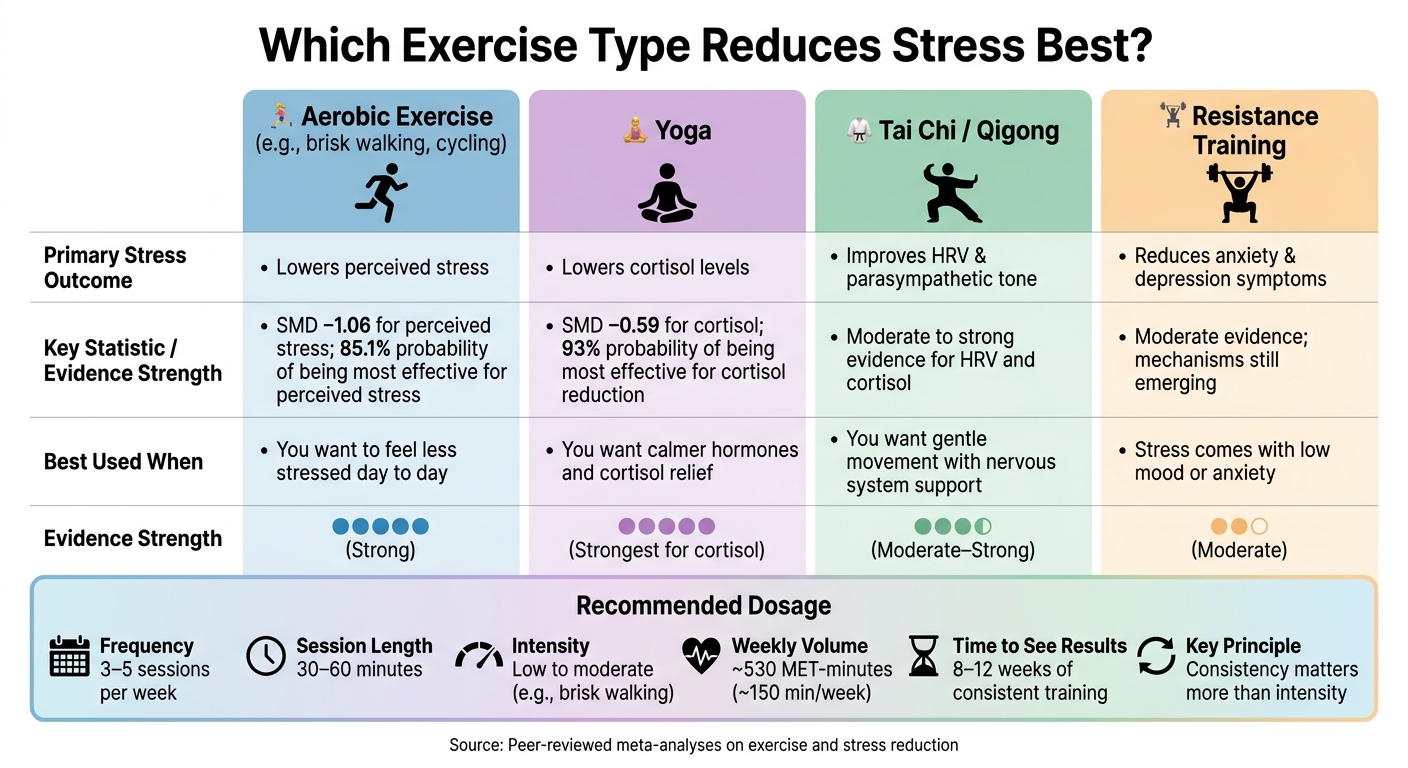
Best Exercise Types for Stress Relief: Effects, Evidence & Dosage
Not all exercise changes stress in the same way. That’s because stress isn’t just one thing. It shows up in how stressed you feel, how your body handles cortisol, how your nervous system recovers, and how your mood shifts over time. So while movement helps in general, some types tend to work better for certain stress outcomes than others.
The next step is looking at which styles of movement most often improve perceived stress, hormones, and autonomic recovery.
Aerobic Exercise and Resistance Training
Aerobic exercise has the strongest head-to-head effect on perceived stress. In studies of university students, it produced a standardized mean difference (SMD) of -1.06 for perceived stress reduction [7]. It also had an 85.1% probability of being the most effective exercise type for that outcome [7].
Resistance training can help with anxiety and depressive symptoms, but the evidence tied specifically to stress is less settled than it is for aerobic exercise or mind-body movement [1][12].
Very high-intensity training may also be less steady when the goal is stress relief [2].
Yoga, Tai Chi, Qigong, and Other Mind-Body Movement
When the focus moves from perceived stress to biological stress markers, especially cortisol, mind-body practices tend to stand out.
Yoga has a 93% probability (SUCRA ranking) of being the most effective intervention for lowering cortisol levels [2], with an effect size (SMD) of -0.59 [2].
Yoga’s stress-related effects also seem to grow with age, which makes it especially relevant for older adults [11].
Tai chi and qigong are close behind. They support cortisol reduction and may improve heart rate variability (HRV) through vagal activation and parasympathetic tone [2][6][11].
Here’s the simple breakdown:
| Exercise Type | Main effect | Evidence strength |
|---|---|---|
| Aerobic Exercise | Perceived stress, cardiovascular recovery [7][6] | Strong for perceived stress [7] |
| Yoga | Cortisol reduction, anxiety, depression [2][10] | Strongest for cortisol reduction [2] |
| Tai Chi / Qigong | HRV, vagal tone, cortisol [2][6][11] | Moderate to strong [2][10] |
| Resistance Training | Anxiety and depression [1][12] | Moderate; mechanisms emerging [1][2] |
| Combined Programs | Broader anxiety and depression relief [10][12] | Moderate [2][12] |
So the pattern is pretty clear: aerobic exercise seems to do the most for how stressed people feel, while yoga, tai chi, and qigong show stronger effects on cortisol and nervous system recovery. Resistance training still has a place, especially for mood symptoms, even if the stress-specific picture is less settled [1][12].
This article is for informational purposes only and is not medical, health, fitness, or wellness advice. Always consult a qualified healthcare, medical, fitness, or wellness professional before making decisions, starting a new routine, changing your diet, using supplements, or acting on any health-related information.
Practical Takeaways and Conclusion
Dosage and Time Frames Most Often Supported by Studies
Taken together, the research points to a pretty clear prescription. The dose range is narrow: 30 to 60 minutes per session, done more than 3 times per week, is the pattern most often linked with significant drops in cortisol and other stress markers [2][7]. Hitting about 150 minutes of moderate activity per week also lines up with better cortisol control [2]. That amount seems to work because it challenges the stress system without pushing recovery too far.
A single workout can lift your mood. But the deeper stress effects take time. Changes in the HPA axis usually show up after 8 to 12 weeks of steady exercise [2][7]. In a year-long study, people who met the standard guideline of 150 minutes of moderate-to-vigorous aerobic activity per week showed a significant drop in accumulated hair cortisol, which is used as a marker of long-term chronic stress [13].
There’s also a clear inverted-U pattern here: moderate doses help most. More is not always better. High-intensity training shouldn’t be your main stress-relief plan [2].
Put simply: consistency matters more than intensity.
| Exercise Parameter | Research-Supported Range |
|---|---|
| Weekly Frequency | 3–5 sessions per week [2][7] |
| Session Length | 30–60 minutes [2][7] |
| Intensity | Low to moderate (<6 METs); e.g., brisk walking [2] |
| Total Weekly Volume | ~530 MET-minutes per week [2] |
| Time to Physiological Benefit | 8–12 weeks for stable HPA-axis adaptation [2][7] |
Key Points to Remember
Exercise works best for stress when it’s regular, moderate, and recoverable. Aerobic exercise, yoga, tai chi, and resistance training all have support behind them. If you’re choosing between going all-out once in a while or moving at a steady pace week after week, the steady pace is more likely to help your stress response.
A moderate walk three to five times a week, kept up over months, is more likely to help than occasional sessions that leave you wiped out. Recovery matters just as much as the workout itself. Exercise only builds resilience when your body gets enough time, sleep, and nutrition to lock in the adaptation [1]. Regular exercise lowers stress by improving recovery, not by shutting off stress signals.
FAQs
What counts as moderate exercise?
Moderate exercise is activity that’s hard enough to help your mood in a clear way, especially when stress is running high or your emotions feel a bit all over the place. Research suggests it may work better than light activity or very hard exercise for this purpose.
In many studies, 15 minutes of moderate-intensity activity is enough to improve mood and cognitive function. That short burst can also serve as a controlled, time-limited challenge, which helps train the body’s stress-response systems.
How soon will I notice less stress?
You may feel less stressed almost right away. Even 10 to 15 minutes of moderate-intensity exercise can lift your mood and help you relax.
For many people, the effects stand out more after 20 minutes. And if you stick with it, the longer-term drop in stress hormones like cortisol tends to show up after eight weeks or more of regular activity.
Can too much exercise raise stress?
Yes. Moderate physical activity often helps lower stress. But exercise is also a form of physical stress. It turns on the sympathetic nervous system and increases cortisol.
The response tends to follow a U-shaped pattern. Moderate exercise helps the body adjust in a healthy way. Push the intensity or duration too far, though, and the effects can swing the other direction.
That can lead to maladaptive effects, including overtraining and worse mental health outcomes, such as increased anxiety or depressive symptoms.


