

Ultimate Guide to Values-Based Decision Frameworks
Judge choices by your top values: pick 3-5 core values, use simple rules or weighted scoring for big decisions, and review outcomes.


I make better decisions when I judge choices by my top values first, not by mood, pressure, or a long pros-and-cons list. This article shows a simple way to do that: pick 3 to 5 core values, turn them into decision filters, and use the lightest framework that fits the stakes. It also covers when to use a simple rules-based approach, when to score options, and how to review choices so I make fewer repeat mistakes.
A few points stand out fast:
- People make about 35,000 decisions a day
- In one 2022 study, values reflection was linked to 23% higher life satisfaction and 17% less regret over 6 months
- For major choices, many people spot only about 50% of the values involved
- Decision fatigue is real: in one study of 1,112 parole decisions, approval rates fell from 65% early in a session to near 0% later on
Here’s the short version of what this guide covers:
- How I separate values, principles, and decision criteria
- Why ranking values helps when two good things clash
- 5 framework types:
- Principles-Based
- Competing Values
- Decision Quality
- Values-Rules-Knowledge
- Multi-Criteria Decision Analysis
- How I build a personal system:
- narrow a long values list to 10–15
- choose my top 5
- turn each one into a test question
- score options when the choice is big
- How I use the system for:
- health
- work and money
- relationships and lifestyle choices
- Daily habits that make the process stick, like a 2-minute review and pre-set rules for repeat decisions
Values-Based Decision-Making: An Introduction
sbb-itb-3d8e4fc
Quick Comparison
| Framework | Best for | Main use |
|---|---|---|
| Principles-Based | Personal life, leadership | Follow set rules tied to what matters most |
| Competing Values | Value clashes | See trade-offs more clearly |
| Decision Quality | High-stakes choices | Check if the decision process is sound |
| Values-Rules-Knowledge | Health and professional choices | Mix values, rules, and facts |
| MCDA | Complex life choices | Score options across many criteria |
If I want a simple takeaway, it’s this: the best decision system is one I will use. That might be a short values checklist for small choices or a weighted scorecard for life-changing ones.
Core Concepts and Main Framework Types
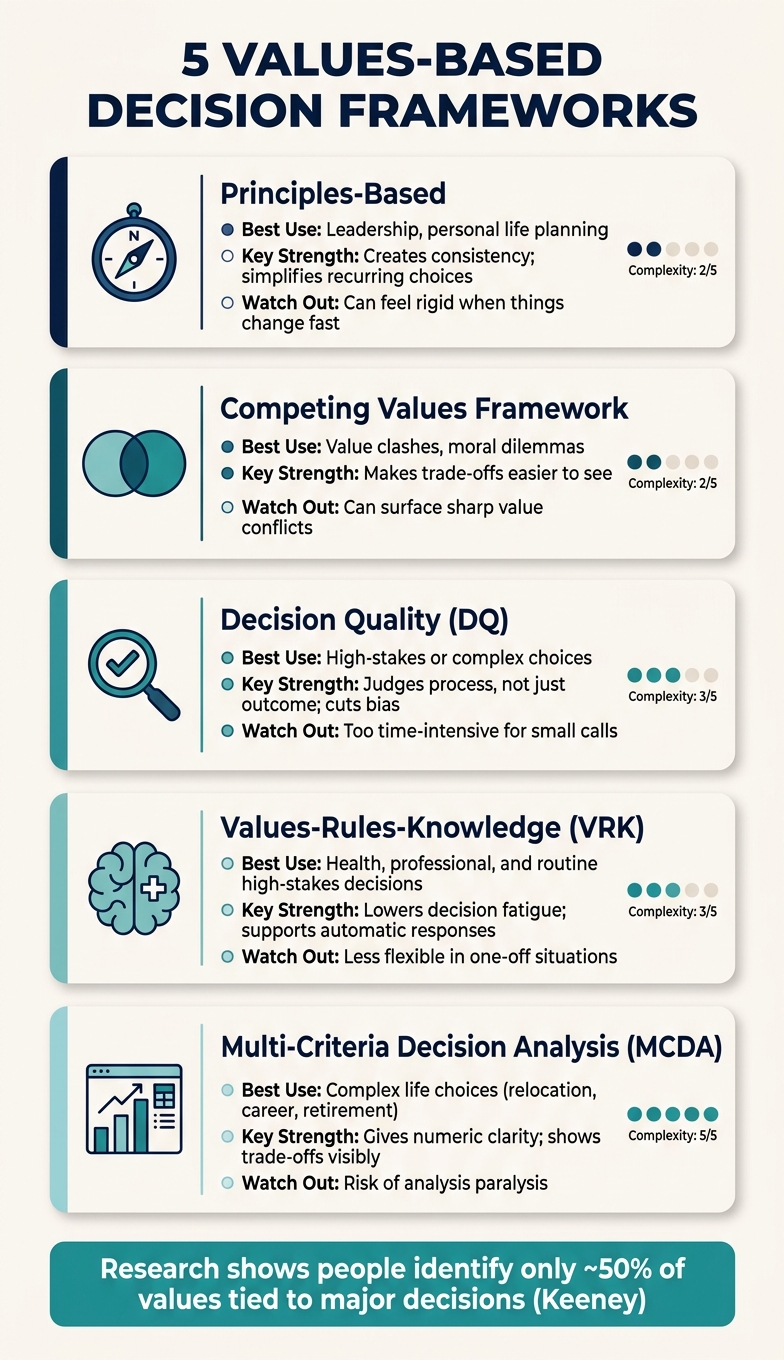
5 Values-Based Decision Frameworks: When & How to Use Each
Once your values are clear, the next step is simple: turn them into a decision method you can actually use.
Core Values, Principles, and Trade-Offs
Before you pick a framework, it helps to separate values, principles, and criteria.
Values are the outcomes you care about most, like freedom, security, health, or honesty. Principles are rules you decide on ahead of time. Criteria are what happen when you turn values into filters for a choice. So if one of your values is health, a matching criterion might be "nourish my body."
It also helps to separate tools from destinations. Means values are tools, like wealth or efficiency. End values are the outcomes behind them, like freedom or peace. When you rank your values, put the focus on end values.
That matters most when two values collide. If you already know which value comes first, you can handle the trade-off without second-guessing yourself in the heat of the moment. Philip Tetlock's research breaks these conflicts into three types: routine (money vs. convenience), taboo (integrity vs. financial gain), and tragic (honesty vs. loyalty) [8]. Tragic trade-offs are the hardest because both values can feel non-negotiable.
This isn't just theory. In real life, decisions often need quick trade-offs.
With that groundwork in place, the next step is choosing a framework that fits the decision.
5 Frameworks Worth Knowing
Here are five frameworks that come up again and again:
| Framework | Best Use Case | Key Strength |
|---|---|---|
| Principles-Based | Leadership, personal life planning | Creates consistency |
| Competing Values Framework | Organizational or team decisions | Balances structural tensions |
| Decision Quality (DQ) | High-stakes or complex choices | Judges process, not just outcome |
| Values-Rules-Knowledge (VRK) | Medical or professional decisions | Integrates values with facts |
| Multi-Criteria Decision Analysis (MCDA) | Relocation, retirement, career changes | Scores and compares complex options |
Research by Ralph Keeney found that people usually identify only about 50% of the values tied to major decisions [9].
How to Choose the Right Level of Structure
The stakes should shape the level of structure you use.
For everyday choices, a simple check against your top 3 to 5 values, plus a quick gut-level or physical response to the options, is often enough.
For bigger decisions, especially ones tied to money, health, relationships, or major life changes, more structure helps. A simple way to do that is to list your top five values, weight them from 5 to 1, score each option, and total the results.
Use more structure when the choice is high-stakes or shared. Clear values usually make the decision faster, not slower.
Next, those values need to turn into a simple decision process.
How to Build a Personal Values-Based Decision Framework
Use the values you picked earlier to build a process you can come back to again and again.
Clarify Your Values and Frame the Decision
Start with a simple exercise. Look through a broad values list, cut it down to 10–15 that matter most, then pick your top 5 nonnegotiables [10]. For each one, write a one-sentence definition in your own words. That part matters more than it seems. If your stated values don’t match how you act, you’re more likely to run into burnout and career dissatisfaction [10][7].
Then tighten up the decision itself. Instead of saying, “I need to figure out my work situation,” make the question specific: “Should I step back from this commitment to protect my time?” A clear question is easier to work with. It also makes it much simpler to check each option against your top values.
From there, turn each value into something you can test in daily life.
Turn Values into Criteria and Compare Options
Take each value and make it practical. If you value health, ask: “Does this choice protect my energy and sleep?” If you value family time, ask: “Does this leave my evenings free?” These kinds of filters help a lot when you’re stuck between two or three options.
For bigger calls, use a weighted matrix to compare each option against your top values [4]. Give each option a score from 1 to 5 based on how well it supports each value. Then multiply that score by the weight you gave the value and add up the totals. It’s simple math, but it can show trade-offs that are easy to miss when everything is swirling around in your head.
Another useful tool is the 10-10-10 lens. Ask how the choice will feel in 10 days, 10 months, and 10 years. Something that feels uncomfortable now can look very different when you stretch the timeline out [5].
Decide, Act, and Review the Outcome
Make the choice, act on it, and then look back at what happened. After you decide, write down what you chose, which value it served, and what you’d do differently next time [5].
It also helps to review your decisions on a daily, weekly, and monthly basis so the framework stays current. And when life shifts in a big way, go back and re-rank your values so the framework still matches your priorities [2].
Applying Values-Based Frameworks in Real Life
Once values turn into decision criteria, the next move is using them where choices get messy. And that usually happens under pressure. Health, work, and relationships are good examples because the pattern stays the same: values turn into rules, scorecards, and tie-breakers for hard calls.
Health, Mental Wellness, and Healthy Aging
Health choices get simpler when values become plain rules. Most people drift toward comfort and familiar habits, so values like vitality or resilience can help counter that pull [1]. Choices around therapy, food, and rest already say a lot about what you value.
One useful shift is to treat health as the goal, not just the thing that helps you do other things. When vitality becomes the destination itself - instead of just a way to work more - sleep and exercise are much easier to put first [1]. A rule like "I always prioritize 8 hours of sleep over late-night work" saves you from replaying the same debate every time it comes up [8]. That’s when values-based choices start to run on autopilot.
Burnout recovery adds another layer. A common trap is trying to honor too many values at once. Limiting your focus to just 2–4 values for your current season - like rest over ambition - helps keep the framework from turning into one more source of stress [6].
If a health choice feels emotionally loaded, try a physical response check. Notice what happens in your body with each option. One path may feel grounded, while another brings tension. That tension can point to resistance, while ease can point to fit [6] [3].
Work, Productivity, and Money Decisions
Career and money choices tend to reveal values conflict fast. Picking between a higher-paying job and one with more flexibility isn’t just about numbers. It’s about what matters more to you. Research found that people who reflected on their values before making decisions reported a 23% boost in life satisfaction and a 17% drop in decision-related regret over a six-month period [2].
It helps to separate tools from goals. Wealth, status, and discipline are tools. Freedom, security, and peace are goals. When a tool value starts pushing a goal value off the table, that’s the conflict to name.
At work, the trade-offs are often plain. Corporate roles usually trade flexibility for stability. Freelancing usually trades stability for autonomy. For major career calls, a weighted matrix can help make those trade-offs visible [8].
Relationships, Community, and Lifestyle Design
Relationship choices often need a clear tie-breaker when two good values collide. That’s why ranking your values matters. If conflict shows up, the hierarchy gives you a default way to decide [12].
This shows up most in painful trade-offs, where two things you care about are pulling in opposite directions. Moving for a career opening while aging parents need more support isn’t a case of one path being good and the other bad. It’s two values in direct conflict. A values-based framework doesn’t erase that tension. What it does is give you a steady way to choose when conflict can’t be avoided, and a pre-set hierarchy helps keep you from getting stuck [8].
A simple filter works well here: ask yourself, "Six months from now, which choice will I be glad I made?" [6] [11] That question cuts through short-term discomfort and puts your identity back in view.
These examples show why the next move is picking the lightest framework that fits the decision.
Choosing a Framework and Using It Daily
Framework Comparison: Strengths, Limits, and Best Use Cases
Now that the main framework types are clear, pick the simplest one that still fits the decision in front of you.
| Framework | Ideal Use Cases | Strengths | Limitations |
|---|---|---|---|
| Principles-Based | Leadership, personal integrity, and character building | Keeps you grounded; simplifies recurring choices | Can feel rigid when things change fast |
| Competing Values | Moral dilemmas; balancing growth vs. stability | Makes trade-offs easier to see; helps you sit with tension | Can surface sharp value clashes |
| Decision Quality | Fast-paced environments; high uncertainty | Cuts bias; helps spot weak points in a choice | Can take too much time for small calls |
| Values-Rules-Knowledge | Routine high-stakes decisions, health choices, and major life transitions | Lowers decision fatigue; supports automatic responses | Less flexible in one-off situations |
| MCDA | Complex trade-offs with multiple variables | Gives numeric clarity; shows trade-offs in plain sight | Can lead to analysis paralysis; may feel too mechanical |
Use the lightest framework that still covers the decision's stakes, variables, and consequences. Bring in scoring only when the comparison needs numbers.
Once you've picked a framework, the next step is to make it part of daily life.
Simple Habits That Make Better Decisions Automatic
Small habits do most of the heavy lifting here. That's how values-based thinking moves from a nice idea to something you use without much friction.
A good place to start is keeping your 3–5 core values visible at all times - on your phone lock screen or on a card in your wallet [3][5]. When a choice pops up, that quick glance can work like an instant filter.
A two-minute review after a major choice helps train your judgment over time. Ask: What did I choose, which value did it serve, and what would I change next time? [5] Do that often enough, and separate choices start to form a feedback loop.
For decisions that come up again and again, turn them into policies instead of fresh judgment calls. That kind of pre-commitment cuts mental drain and makes steady action easier when pressure kicks in. Research on 1,112 judicial parole decisions found that approval rates fell from 65% at the start of a session to near zero by the end as decision fatigue set in [4].
For bigger choices, reuse the 10-10-10 lens [5].
The aim isn't more analysis. It's judgment you can repeat.
Conclusion: Key Points to Remember
Values-based frameworks work because they move decisions from reactive to intentional. They make trade-offs harder to dodge, ease the mental load of recurring choices, and give you a steady way to act when two good options pull in opposite directions.
The structure can be as simple as a short list of core values or as detailed as a weighted scoring matrix. What matters most is using it - and coming back to it. The framework doesn't need to be perfect. It needs to be usable and yours.
FAQs
How do I choose my top five values?
Start by writing down 10 to 20 values that matter to you right now - not the ones you think are supposed to matter.
Then group similar ideas together. For example, honesty and integrity may belong in the same bucket. That helps trim the list without losing what you mean.
Once you’re down to 5 to 7 values, put them head-to-head, two at a time. In a hard moment, which one would you pick? That simple comparison makes your top priorities easier to spot.
Keep doing that until you land on a clear top five.
When should I use scoring instead of simple rules?
Start with simple rules. In values-based frameworks, they help you make decisions faster, avoid analysis paralysis, and keep your attention on what matters most.
That matters even more when things are uncertain. At that point, extra data can muddy the waters instead of helping.
Use scoring or more structured mapping mainly for complex, high-stakes decisions. Those tools are most useful when you need to make hidden trade-offs or ethical issues easier to see.
What if two core values conflict?
When two core values pull in different directions, go back to the value hierarchy you set up ahead of time. That ranking gives you a way to choose the path that lines up with your top priority, even if a lower-ranked value takes a hit.
That doesn’t make the trade-off easy. It just gives you a clear way forward, so you can make the call instead of treating every value the same and freezing up.


