

Ultimate Guide To Eco-Friendly Travel Apps
Cut trip emissions and waste with a small set of apps for transport, offline maps, and food/water refills.


Travel creates about 8% of global CO2 emissions, yet 76% of travelers say they want lower-impact trips. My takeaway is simple: a small set of travel apps can help you cut emissions, avoid waste, and make day-to-day travel easier without adding more work.
Here’s the short version:
- I’d use one app for booking or route planning
- One app for local navigation
- One app for food, water, or waste
- I’d skip everything else unless the trip calls for it
This article covers the main app types and the top picks in each group:
- Carbon and transit apps: Rome2Rio, Omio, Citymapper, Joro, TravelRite
- Offline and route apps: Organic Maps, Komoot, Bikemap
- Food, refill, and waste apps: Refill, Tap, Too Good To Go, OLIO, HappyCow
- Shared rides and stays: BlaBlaCar, FairTrip
- Air quality tools: Plume Labs
A few fast takeaways stood out to me:
- Flights aren’t always the best default. Apps that compare rail, bus, ferry, and flight options make lower-CO2 choices easier to spot.
- Single-use plastic is one of the easiest things to cut. Refill and Tap help you find water stations fast.
- Food waste is easier to avoid than most people think. Too Good To Go and OLIO can help you find surplus food instead of buying more new items.
- Offline maps matter. Organic Maps is useful when service drops on road trips or abroad.
- Less is better. In most cases, two or three apps are enough.
A look at eco-friendly travel with Google's Chief Sustainability Officer
sbb-itb-3d8e4fc
Quick Comparison
| App | Best Use | Main Focus | Watch For |
|---|---|---|---|
| Rome2Rio | Comparing trip options | Multi-mode transport | Results depend on route coverage |
| Omio | Booking trains and buses | Lower-impact intercity travel | Best in places with strong rail/bus networks |
| Citymapper | Getting around cities | Transit, walking, cycling | Best in supported cities |
| Joro | Tracking your footprint | Automatic CO2 estimates | Needs linked financial data |
| TravelRite | Picking lower-CO2 routes | Route emissions | Estimate-based only |
| Organic Maps | Offline navigation | Hiking, cycling, offline maps | Fewer business listings |
| BlaBlaCar | Sharing rides between cities | Filling empty car seats | Not available everywhere |
| Refill | Finding water stations | Plastic bottle reduction | Works best with saved spots |
| Tap | Water refill backup | Plastic bottle reduction | Coverage varies |
| Too Good To Go | Buying surplus meals | Food waste reduction | Availability varies by city |
| OLIO | Sharing extra food/items | Waste reduction | Depends on local users |
| HappyCow | Finding veg-friendly food | Lower-impact dining | Paid app; offline use is limited |
| Plume Labs | Checking air quality | Pollution tracking | More useful in some places than others |
| FairTrip | Finding places that support locals | Lodging and activities | Smaller listing base |
If I wanted the simplest setup, I’d do this:
- Weekend in NYC: Omio, Citymapper, Too Good To Go
- Southwest road trip: Rome2Rio, Organic Maps, Refill
- Trip abroad: Rome2Rio, Organic Maps, HappyCow or Refill
The main point is simple: you do not need a big stack of apps. You just need a few that help you get there, get around, and cut waste while you travel.
The Main Benefits of Using Eco-Friendly Travel Apps
Lower Carbon Emissions Through Better Transportation Choices
Apps like Skyscanner and PocketPlanit show CO2 data right next to price and travel time, so you can compare impact before you book, not after [2][5]. That side-by-side view makes lower-impact picks much easier. It also saves time during planning, which is half the battle.
Tools like Rome2Rio and Citymapper push this even further by showing train, bus, ferry, and cycling routes in one place [3][4]. Once you factor in airport check-in, security, and waiting around, surface travel can be just as fast in many cases [4][2]. Seeing those options up front makes it easier to pause before defaulting to a flight.
Automatic tracking helps too, because most people aren't going to log emissions by hand. Platforms like Joro and IMPT connect to your transactions or bookings and estimate your travel footprint without extra work on your end [1][2].
Transportation is only one piece of the puzzle. Waste from food and water adds up fast too.
Less Waste and Better Resource Use on the Road
Single-use plastic bottles are one of the easiest things to cut while traveling. Refill maps free water refill stations, so you can skip buying another bottle from a convenience store [6].
Food waste is a bigger deal than many travelers think. Too Good To Go sells discounted "surprise bags" made from surplus food [6][2]. HappyCow adds another layer by listing more than 180,000 vegetarian and vegan dining options around the world [3], which can help lower food-related emissions.
These same tools also chip away at the small daily waste that builds up over a trip. TripIt, for example, cuts down on paper maps and printed confirmations by keeping your tickets, confirmations, and itineraries in one spot [3].
Simpler Decisions and Less Friction During Travel
The day-to-day payoff is simple: planning gets easier. A small stack of apps can cut down on last-minute decisions [4]. In most cases, one app for transport, one for local food, and one for navigation handles most of what you need without turning your phone into a mess.
Keep the setup small. A few targeted tools usually work better than a cluttered phone.
These benefits fit into a handful of app categories, which the next section breaks down.
The Main Types of Eco-Friendly Travel Apps
These apps line up with the big choices travelers make every day: how to get around, how to cut down on waste, and where to stay.
Carbon, Transit, and Route Planning Apps
These tools help you compare transport options in one spot. Rome2Rio and Omio show train, bus, ferry, and flight routes side by side. For city travel, Citymapper and Moovit pull together subway, bus, bike, and walking directions. If you want to skip car-heavy roads, Komoot and Bikemap map bike and hiking routes that take you off the main traffic corridors.
After transportation, a lot of the next wins come from apps built around refill, food-sharing, and cutting waste.
Water, Food, and Waste Reduction Apps
These apps help cut bottle waste, food waste, and extra packaging. Refill and Tap show nearby water refill stations, which makes it easier to avoid buying single-use plastic bottles. OLIO lets travelers and locals share extra food and household items for free. Too Good To Go offers discounted surplus-food bags from restaurants and cafes. And HappyCow lists more than 220,000 vegan and vegetarian options across over 180 countries [7].
Air Quality and Sustainable Lodging Tools
This group focuses on pollution exposure and lodging choices. Plume Labs gives real-time air quality forecasts, which can help travelers plan around poor air conditions. Apps and directories that show certifications such as Green Globe, Green Key, or EarthCheck make it easier to check lodging claims instead of taking them at face value. FairTrip lists more than 3,000 curated places that support local communities [7].
| Category | What It Solves | Example Tools |
|---|---|---|
| Carbon & Transit | High transport emissions; comparing travel modes | Rome2Rio, Omio, Citymapper, Komoot, Bikemap |
| Water, Food & Waste | Single-use plastic; food waste; plant-based dining | Refill, Tap, Too Good To Go, OLIO, HappyCow |
| Air Quality & Sustainable Lodging | Pollution exposure; identifying certified green lodging | Plume Labs, FairTrip, Green Globe |
Top Eco-Friendly Travel Apps Worth Using
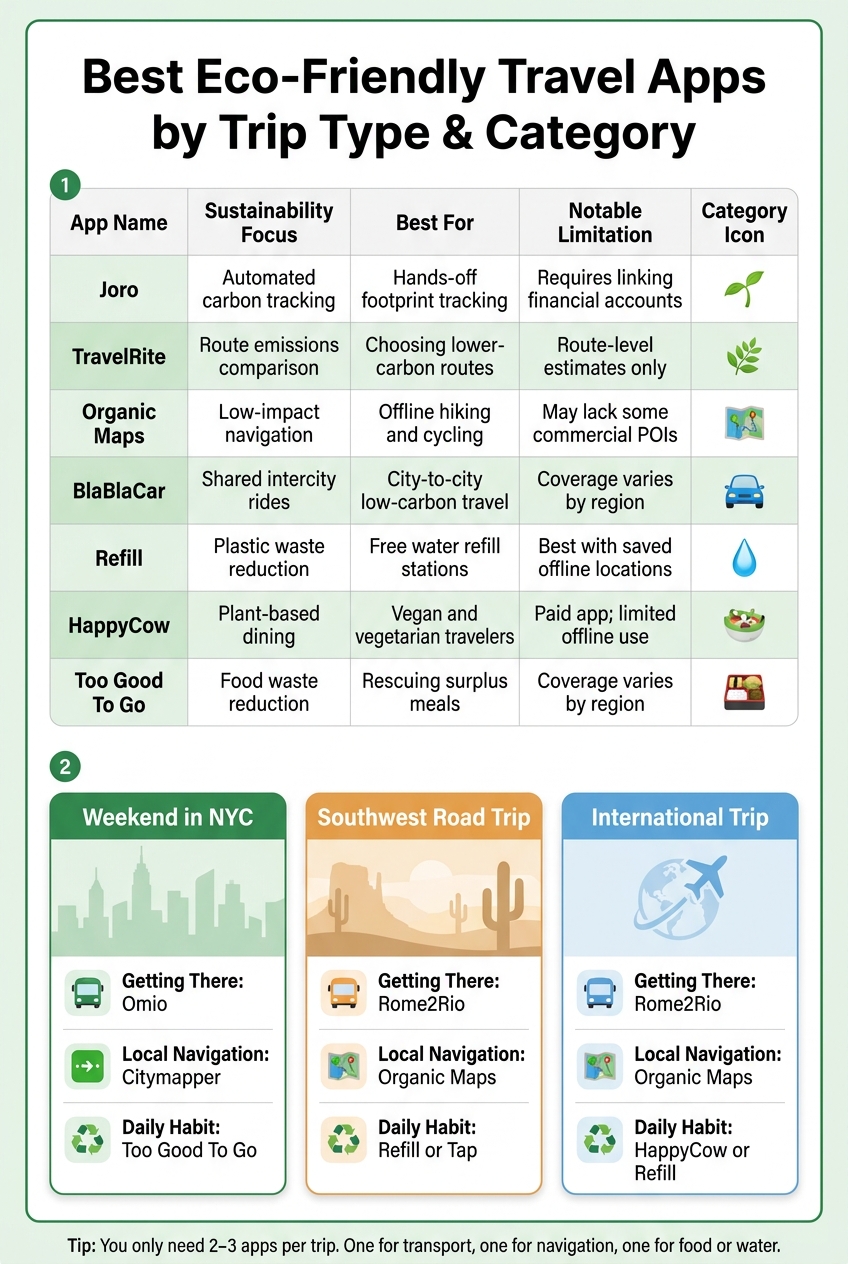
Best Eco-Friendly Travel Apps by Trip Type & Category
Here are the most practical picks from the categories above. Think of this as a simple app stack you can build around your trip.
Best Apps for Carbon Tracking and Low-Carbon Transportation
Joro estimates your travel footprint automatically. That makes it a good fit if you want hands-off tracking and don't want to log every trip yourself.
TravelRite compares route emissions for walking, cycling, driving, and transit. It's handy when you're trying to pick the lower-carbon option before you head out.
Organic Maps is a privacy-focused, open-source offline map app for hiking and cycling. It works without an internet connection and doesn't require ads or tracking [8].
BlaBlaCar connects drivers who have empty seats with passengers traveling between cities. Just note that coverage depends on the region [6].
Best Apps for Water Refills, Plant-Based Dining, and Food Sharing
Refill shows free water refill stations on a map. It's smart to save locations ahead of time so you can still use them offline [6].
HappyCow is a paid app for finding vegan, vegetarian, and veg-friendly places to eat. It works best when you have data access or when you've already saved spots [6].
Too Good To Go lets you buy surplus food at a discount. The app is free to download, but the food bags cost extra, and coverage depends on where you are [6].
Scan the table below if you want the fastest way to narrow your choices.
Side-by-Side App Comparison Table
| App | Main Sustainability Focus | Best For | Notable Limitation |
|---|---|---|---|
| Joro | Automated carbon tracking | Hands-off footprint tracking | Requires linking financial accounts |
| TravelRite | Route emissions comparison | Choosing lower-carbon routes | Route-level estimates only |
| Organic Maps | Low-impact navigation | Offline hiking and cycling | May lack some commercial POIs |
| BlaBlaCar | Shared intercity rides | City-to-city low-carbon travel | Coverage varies by region |
| Refill | Plastic waste reduction | Free water refill stations | Best with saved offline locations |
| HappyCow | Plant-based dining | Vegan and vegetarian travelers | Paid app; limited offline use |
| Too Good To Go | Food waste reduction | Rescuing surplus meals | Coverage varies by region |
Use only the apps that fit your trip. The next section shows how to keep that list lean.
How to Use Eco-Friendly Travel Apps Without Overcomplicating Your Trip
Build a Simple App Setup for Different Trip Types
Once you've picked from the app categories above, keep it simple. You usually only need two or three apps for the whole trip.
A good rule of thumb:
- one app for transport
- one for local navigation
- one for food or water
That’s it. No need to turn your phone into a travel control center.
| Trip Type | Getting There | Local Navigation | Daily Habit |
|---|---|---|---|
| Weekend in NYC | Omio | Citymapper | Too Good To Go |
| Southwest Road Trip | Rome2Rio | Organic Maps | Refill or Tap |
| International Trip | Rome2Rio | Organic Maps | HappyCow or Refill |
Use the table as a quick filter, then keep only the apps that cover your route, your local transit, and your day-to-day needs.
For a weekend in New York City, Citymapper can handle transit and walking, while Too Good To Go helps you find discounted surplus food. On a Southwest road trip, Organic Maps is handy offline when cell service drops, and Refill or Tap can help with daily water stops. For international trips, Rome2Rio works well for comparing routes before booking, and Organic Maps helps once you're on the ground and offline.
Use Apps Mindfully: Privacy, Notifications, and Screen Time
After your app stack is set, keep the setup light.
Limit location access to "While Using the App," mute alerts you don't need, and download offline maps before you leave. It also helps to store boarding passes and reservations in your phone's wallet so you don't have to print them.
The goal is simple: let the apps do the useful work without pulling your attention away from the trip.
Conclusion: A Few Good Apps Can Make Travel More Intentional
Eco-friendly travel apps do their best work when they make the better choice easier, not when they give you one more thing to manage.
A small, well-chosen stack can help you cut emissions through smarter routing, reduce waste with water refills and surplus food, and keep your trip organized without carrying a stack of paper. Small, steady choices matter more than perfect ones. A few good apps can make eco-friendly travel much easier to stick with.
FAQs
Which eco-friendly travel apps do I actually need?
You don’t need every app. You just need the ones that fit your sustainability goals.
A small, focused set is often better than a crowded home screen you never use. If your main goal is cutting food waste, start there. If you want lower-impact transport or places to stay, pick apps that help with that.
- Food and dining: Too Good To Go, HappyCow
- Lower-impact transit: Trainline, Omio, Google Maps eco-friendly routing
- Sustainable lodging: EcoBnb, BookDifferent
- Waste reduction: Refill
Do these apps work offline?
It depends on the app.
Some apps, like TrekCrumbs, PuffinPilot, and Journeybot, are built to work offline for itineraries, packing lists, and trip details. Maps.me also lets you download maps for offline use.
That said, many carbon tracking, booking, and food-waste apps still need an internet connection. Before you head out, test the offline features and save key documents, addresses, and maps while you're still connected.
How can I verify if a travel option is truly lower impact?
Start with a carbon calculator to set a baseline for your whole trip. Tools like Atmosfair or My Climate can help you compare travel modes and routes before you book.
For places to stay, look for third-party certifications like Green Key or LEED. When it comes to getting around, use platforms that show emissions data so you can spot direct flights or lower-carbon picks like rail.


