

Burnout vs. Stress: Key Differences and What to Do
Learn how stress and burnout differ, how to spot each, and practical steps to recover and rebuild energy.


Feeling overwhelmed or drained? Stress and burnout may seem similar, but they affect you in very different ways. Stress feels like juggling too much - racing thoughts, tension, and urgency. Burnout, on the other hand, leaves you emotionally numb, detached, and completely drained.
Key Takeaways:
- Stress is your body's short-term response to challenges, often fading after rest.
- Burnout is prolonged exhaustion, often lingering even after taking breaks.
- Stress makes you feel over-engaged; burnout feels like total disengagement.
- Common causes of stress: deadlines, financial troubles, or relationship issues.
- Burnout stems from chronic stress, unmanageable workloads, or lack of recognition.
Quick Comparison:
| Feature | Stress | Burnout |
|---|---|---|
| Engagement | Over-engaged, hyperactive | Disengaged, emotionally numb |
| Emotions | Anxiety, urgency | Helplessness, apathy |
| Energy | "Running on low" | "Completely drained" |
| Recovery | Rest and relaxation help | Requires deeper lifestyle changes |
What to do?
- For stress: Try quick relief techniques like deep breathing or better time management.
- For burnout: Set boundaries, seek support, and focus on restoring energy through meaningful changes.
Recognizing the difference is the first step to protecting your mental health.
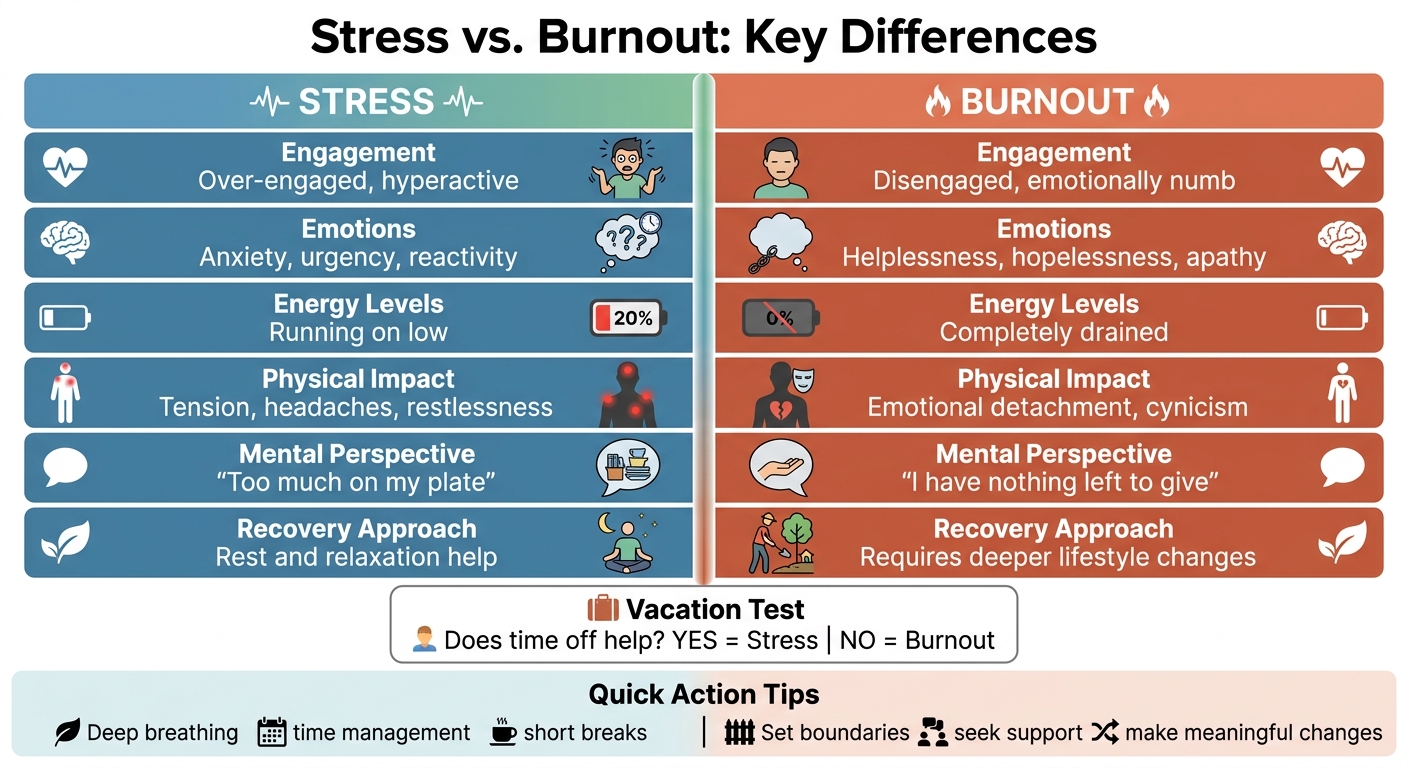
Stress vs Burnout: Key Differences Comparison Chart
Burnout vs. Stress: Key Differences & How to Recover
sbb-itb-3d8e4fc
What Is Stress?
The National Institute of Mental Health explains stress as the brain and body’s natural reaction to challenges or demands [7]. When you sense a threat - whether it’s an approaching deadline or financial strain - your hypothalamus activates an alarm system. This triggers your adrenal glands to release hormones like adrenaline and cortisol [5].
Adrenaline increases your heart rate and blood pressure, while cortisol raises blood sugar levels, improves brain function, and temporarily shuts down non-essential processes like digestion [5]. This response, often called the "fight-or-flight" reaction, equips your body to tackle immediate challenges.
Short bursts of stress can actually help by sharpening focus and motivation [6]. However, when stress becomes constant and relief is hard to find, it can push your body into a prolonged state of overdrive. Over time, this takes a toll on both mental and physical health.
Common Symptoms of Stress
Stress doesn’t go unnoticed - your body and mind let you know when something’s off. Physically, you might deal with headaches, trouble sleeping, or a racing heart. Emotionally, you could feel anxious, irritable, or perpetually on edge. The good news? These symptoms usually ease up once the pressure subsides.
What Causes Stress
Stress often stems from external pressures and immediate demands. Some common triggers include tight work deadlines, financial concerns, relationship issues, or caregiving responsibilities [4][3]. Even minor annoyances, like being stuck in traffic or spilling coffee on your shirt, can spark a stress response. As Licensed Professional Counselor Julianne Schroeder puts it:
the general experience of physical, mental, emotional [and] relational factors that cause the person and nervous system to feel overwhelmed [3].
Sometimes, stressors pile up - what experts call "death by a thousand tiny cuts" - making everything feel overwhelming. How stressful a situation feels often depends on your perspective, emotional resilience, and the support system you have in place [1].
Recognizing these triggers and understanding your body’s response is key to differentiating stress from burnout, which we’ll dive into next.
This article is for informational purposes only and is not medical, health, fitness, or wellness advice. Always consult a qualified professional before making health-related decisions.
What Is Burnout?
Stress is your body's way of dealing with immediate challenges, but burnout is different - it's what happens when stress goes unrelieved for too long. According to the American Psychological Association, burnout is "physical, emotional or mental exhaustion, accompanied by decreased motivation, lowered performance and negative attitudes toward oneself and others" [2]. Picture it as your body and mind hitting a wall after running on empty for too long.
Burnout doesn’t happen overnight. It often starts with a high-energy "honeymoon phase" before sliding into chronic fatigue and emotional exhaustion [8]. Licensed Professional Counselor Julianne Schroeder explains it well: "Our bodies are not meant to stay in hyperactivation or fight-or-flight long term. If it does, then the body... goes into protection mode - aka burnout" [3].
Here’s a simple way to tell the difference: stress makes you feel like there’s too much - too many tasks, too much responsibility. Burnout feels like there’s too little - too little energy, too little motivation, too little care [8]. It’s not just about being tired; it’s about feeling completely drained. And unlike stress, which can fade once the pressure eases, burnout tends to linger, even after you rest. This distinction is critical for understanding its symptoms and causes.
Symptoms of Burnout
Burnout doesn’t look like regular stress. Instead of feeling anxious or overwhelmed, you might feel detached, numb, or hopeless. Rest doesn’t seem to help, and your energy levels stay low [9].
Physically, burnout might show up as headaches, muscle pain, backaches, or digestive problems like stomach cramps or constipation [9]. Emotionally, you could feel disconnected and cynical - not just about work, but about life in general. Tasks that once felt meaningful may now seem pointless. Some people even experience depersonalization, where they feel disconnected from their own identity, seeing themselves more as a task-doing machine [8].
Your work performance may also take a hit. Tasks might take longer to complete, and mistakes can become more frequent [9]. Dr. Adam Borland, a psychologist at Cleveland Clinic, describes it like this: "If you're used to going 100 miles an hour and then suddenly take your foot off the gas, you're still going 85. But you may feel like that's not good enough - precisely because you're so used to going 100" [2].
If left untreated, burnout can lead to serious health problems like Type 2 diabetes, heart disease, and high cholesterol [8]. Even before the COVID-19 pandemic, burnout was widespread - over 54% of nurses and doctors, and about 60% of medical students and residents, reported experiencing it [8]. These ongoing symptoms highlight how burnout is more than just stress - it’s a deeper, more persistent issue.
What Causes Burnout
Burnout doesn’t come from one bad day or even a tough week. It builds over time, fueled by constant pressures. Some of the most common triggers include unmanageable workloads, feeling undervalued, having little control over your schedule, or working in environments where your efforts go unnoticed [8].
There are also different types of burnout. Overload burnout happens when you push yourself too hard, sacrificing your health in the process. Under-challenged burnout comes from boredom and feeling unappreciated, often leading to cynicism. Then there’s neglect burnout, where feelings of helplessness or incompetence - sometimes tied to imposter syndrome - take over [8].
Burnout is usually tied to a specific setting or role, like your job or long-term caregiving responsibilities [9]. Unlike general stress, which can come from various sources, burnout is often tied to a particular environment. Stepping away from that environment - like taking a vacation - can help. However, if your symptoms persist even when you’re away, it might be worth considering whether depression, rather than burnout, is at play [9].
This article is for informational purposes only and is not medical, health, fitness, or wellness advice. Always consult a qualified healthcare professional before making any health-related decisions.
Burnout vs. Stress: How to Tell the Difference
Key Differences in Symptoms and Impact
Stress and burnout might seem similar at first glance, but they impact you in very different ways. Stress is like running on a low battery - you're over-engaged, anxious, and feel like you're juggling too many responsibilities. Burnout, on the other hand, is like a completely dead battery. It leaves you emotionally drained, detached, and often questioning your purpose [1].
The emotional contrast is stark. Stress can make you feel tense and "wired but tired", while burnout feels like your system has shut down entirely. Burnout often brings apathy, cynicism, and a sense of hopelessness, stripping away energy and motivation [4].
Here’s a side-by-side comparison of the two:
| Feature | Stress | Burnout |
|---|---|---|
| Engagement | Over-engaged; hyperactive | Disengaged; emotionally numb |
| Emotions | Anxiety, urgency, reactivity | Helplessness, hopelessness, apathy |
| Energy | "Running on low" | "Completely drained" |
| Physical Impact | Tension, headaches, restlessness | Emotional detachment, cynicism |
| Perspective | "Too much on my plate" | "I have nothing left to give" |
| Recovery | Rest and relaxation | Requires deeper changes and rebuilding energy |
One way to differentiate between the two is the "Vacation Test." If a weekend off or a short vacation recharges you, you're likely dealing with stress. However, if you still feel exhausted and hopeless even after taking time away, this could indicate burnout - or even depression [2][4]. Understanding these differences is an important step before choosing the right recovery approach.
Why Mislabeling Delays Recovery
Confusing stress with burnout - or vice versa - can slow down recovery and lead to ineffective coping strategies. For example, treating burnout as if it’s just stress might lead you to take a short break or push through the exhaustion, which only masks deeper issues. As Dr. Mary Ann V. Mercer, a psychologist, explains:
It's like a snowball rolling downhill, picking up more snow and velocity until it finally smacks into a tree at the bottom of the hill [1].
Ignoring systemic causes - like overwhelming workloads or a mismatch between your values and your environment - can worsen the problem [4].
Biologically, the two conditions also differ. Chronic stress elevates cortisol levels, while burnout disrupts the body's HPA axis, leading to irregular cortisol rhythms and affecting melatonin production [4]. Mislabeling burnout as stress might normalize the constant pressure, creating a harmful cycle that prolongs the issue. Stress can often be managed with quick interventions like deep breathing or grounding exercises. Burnout, however, requires more fundamental changes, such as reducing demands or reevaluating priorities.
Licensed Professional Counselor Keri Riggs paints a vivid picture of burnout:
death by a thousand tiny cuts [3]
- a reminder that burnout is often the result of many small, accumulated stressors. Recognizing these differences is critical to finding the right path to recovery.
This article is for informational purposes only and is not medical, health, fitness, or wellness advice. Always consult a qualified healthcare, medical, fitness, or wellness professional before making decisions, starting a new routine, changing your diet, using supplements, or acting on any health-related information.
How to Manage Stress
Quick Stress-Relief Techniques
When stress hits, having a few quick strategies on hand can make all the difference. Deep breathing is a go-to option. By taking slow, deep breaths from your belly, you can calm racing thoughts and activate your body’s relaxation response[10]. Even a short pause - just 1–2 minutes of quiet or a quick 30-second stretch - can help reset your stress levels[9].
Simple actions like unclenching your jaw or relaxing your shoulders can instantly release tension[9]. A body scan, where you focus on each muscle group while breathing deeply, can work wonders in just 3–5 minutes[10].
If stepping away isn’t possible, try setting boundaries within your routine. For example, dedicate 15 minutes to quiet time - like eating lunch without distractions - or incorporate deep breathing into everyday tasks, such as washing dishes or showering[9]. Dr. Ann Webster, a health psychologist at the Benson-Henry Institute for Mind Body Medicine, offers this advice:
"If you know what pushes your buttons, then avoid it. But there are stresses we have to accept, so we must change our reactions to them." [11]
These techniques are great for quick relief, but lasting stress management requires adopting habits that build resilience over time.
Building Long-Term Resilience
While short-term fixes are helpful, long-term resilience comes from making intentional lifestyle changes. For instance, improving time management can significantly reduce stress. Giving yourself an extra 15 minutes for travel can remove the anxiety of running late[12]. Similarly, structuring your day by scheduling specific times for tasks like returning calls or writing reports can help you feel more in control[12].
Regular self-check-ins are another powerful tool. Take a moment to ask yourself, "How am I doing emotionally and physically?" This simple practice can help you catch stress early before it escalates[2]. Psychologist Adam Borland from Cleveland Clinic emphasizes the importance of self-care:
"I often remind my patients that to be the best friend, spouse, parent or child, they have to attend to their self-care. If your tank is empty, you can't be the type of person you want to be for the others in your life." [2]
Make time for activities that recharge you - whether it’s exercise (150 minutes per week is recommended for boosting mood), a favorite hobby, or simply relaxing[13]. Treat these moments as essential maintenance rather than optional luxuries. Developing these habits now can help keep stress from spiraling into larger problems.
This article is for informational purposes only and is not medical, health, fitness, or wellness advice. Always consult a qualified healthcare, medical, fitness, or wellness professional before making decisions, starting a new routine, changing your diet, using supplements, or acting on any health-related information.
How to Recover from Burnout
Setting Boundaries and Getting Support
Recovering from burnout means making significant adjustments to how you balance work and life. Start by consulting a healthcare provider to rule out any medical conditions that could mimic burnout symptoms. Once burnout is confirmed, identify its root causes - these might include an overwhelming workload, lack of control, inadequate rewards, strained workplace relationships, unfair treatment, or conflicts with your personal values.
One way to start is by setting clear boundaries. If taking extended time off isn’t an option, try disconnecting digitally after work hours. Use your paid time off to fully step away from work-related stress, and practice saying "no" to commitments that drain your energy but aren’t essential.
Seeking professional support can also make a big difference. A therapist can help you determine whether depression may also be at play and create a structured recovery plan, possibly using Cognitive Behavioral Therapy. Natacha Duke, a Registered Psychotherapist, emphasizes the value of sharing your struggles:
"There's a belief in psychology that when you talk about your problems, you sort of cut them in half."
Lean on your support network - friends, family, or even colleagues - by asking for help with responsibilities while you recover. External support complements the internal work needed to heal. It’s important to remember that burnout isn’t a personal failing. Christina Maslach, Professor Emerita of Psychology at UC Berkeley, explains:
"Burnout is not a problem of too little resilience or too little self-care. It is primarily a problem of too much chronic stress without sufficient recovery, and that stress usually originates in systemic conditions, not individual inadequacy."
Once you’ve started addressing the sources of burnout, the next step is to focus on regaining your energy and motivation.
Rebuilding Energy and Motivation
Recovering from burnout is not just about reducing stress - it’s about actively restoring your energy. One of the most effective ways to do this is through psychological detachment, which means mentally unplugging from work during your off-hours. It’s not enough to simply leave the office; your mind needs to let go of work-related thoughts.
Physical activity, social interactions, laughter, crying, or creative outlets can help your body complete the stress cycle. Even small hobbies like reading, painting, or building with Legos can help you reconnect with yourself outside of work. These activities can restore your sense of accomplishment and effectiveness, which are essential for rebuilding motivation.
On particularly tough days, focus on simple self-care tasks - drink water, stretch, and relax your jaw. Keeping a journal to track your stress levels and daily patterns can also offer valuable insights. For further guidance, you might explore Burnout: The Secret to Unlocking the Stress Cycle by Emily and Amelia Nagoski.
Recovery takes time, and it’s important to be patient with yourself. Psychologist Adam Borland from Cleveland Clinic explains:
"If you're used to going 100 miles an hour and then suddenly take your foot off the gas, you're still going 85. But you may feel like that's not good enough - precisely because you're so used to going 100."
Allow yourself the grace to heal gradually, and focus on rediscovering what brings you joy and purpose beyond just getting through each day.
This article is for informational purposes only and is not intended as medical, health, fitness, or wellness advice. Always consult a qualified healthcare professional before making any changes to your routine.
Conclusion
Recognizing the difference between stress and burnout is crucial for maintaining both mental and physical well-being. Stress often leads to feelings of over-engagement, while burnout creates a sense of emotional emptiness. These differences are key to understanding how to recover effectively.
Each condition requires a different approach. Stress can often be managed with quick solutions like relaxation techniques and improved time management. Burnout, on the other hand, calls for more profound changes - such as setting clear boundaries, seeking support, and rethinking your work-life balance. As Dr. Siobhan Flowers puts it:
"Stress makes people feel that they have too much on their plate, but burnout makes people feel depleted, like they have nothing else left to give."
This highlights the importance of combining immediate relief with long-term adjustments.
Here's a quick way to assess your situation: If taking a weekend off helps you feel recharged, you're likely dealing with stress. If it doesn’t, it might be burnout. Acting early can prevent the problem from worsening [2].
Taking care of your mental health is non-negotiable. Whether you're navigating everyday stress or recovering from burnout, remember to set boundaries, reach out for help, and allow yourself the time and space to heal. Your well-being supports every other part of your life, so make it a priority.
This article is for informational purposes only and does not provide medical, health, fitness, or wellness advice. Always consult a qualified healthcare, fitness, or wellness professional before making any changes to your routine, diet, or health-related decisions.
FAQs
Can burnout happen outside of work?
Burnout isn’t limited to the workplace - it can stem from personal relationships, caregiving roles, or even ongoing life challenges. Recognizing the signs early is key. Whether it’s emotional exhaustion, feeling detached, or a sense of overwhelm, addressing these feelings with strategies like self-care, setting boundaries, and practicing stress management can make a big difference in supporting your mental well-being.
How do I know if it’s burnout or depression?
Burnout and depression can look similar, with overlapping symptoms such as fatigue and trouble focusing. However, the two have distinct differences. Burnout is tied to work and is characterized by feelings of exhaustion, growing cynicism, and a noticeable drop in productivity. It often gets better with changes in the workplace or workload. On the other hand, depression is a clinical condition that impacts every part of life. It comes with persistent feelings of sadness, hopelessness, and may stem from biological factors. If your challenges seem tied specifically to work, burnout might be the issue. But if your struggles feel all-encompassing, it’s important to consider reaching out to a professional for help with depression.
How long does it take to recover from burnout?
Recovery from burnout can vary widely, lasting anywhere from a few weeks to several months. How long it takes often depends on how severe the burnout is and how long it’s been building up. In more serious cases, professional help and major adjustments to daily habits may be necessary. Focusing on self-care, learning to set boundaries, and reaching out for support are all key steps in the healing process.


