

How Emotions Drive Procrastination
Procrastination often starts with fear, shame, or overwhelm; use tiny steps, timers, and self-compassion to break the cycle.


Procrastination usually starts with a feeling, not a calendar problem. When I put something off, it’s often because the task brings up fear, shame, self-doubt, boredom, or overwhelm. Avoiding it gives my brain short-term relief, so the habit keeps repeating.
Here’s the short version:
- Fear of failure can make a normal task feel risky
- Perfectionism can make starting feel impossible
- Guilt and shame can make delayed tasks feel even heavier
- Frustration and overwhelm can make my brain freeze
- Avoidance feels good for a moment, which trains the delay pattern
- Small steps, short timers, and self-compassion can help break the loop
- If procrastination spreads into work, health, relationships, and daily life, it may point to anxiety, depression, burnout, or ADHD
A few facts stand out:
- One self-compassion exercise was linked to a 30% drop in procrastination
- If-then plans can make follow-through 2 to 3 times more likely
- The relief from avoidance may last about 30 seconds, while the stress can last much longer
So the core idea is simple: if I want to procrastinate less, I need to deal with the feeling tied to the task, not just try to plan harder.
Here's the real reason you procrastinate | Fuschia Sirois | TEDxNewcastle

sbb-itb-3d8e4fc
What Procrastination Looks Like When Emotions Are Running the Show
When emotions are behind the delay, procrastination usually doesn’t look like doing nothing. It looks like staying busy with the wrong things.
You reorganize a closet. You clean the kitchen. You answer low-stakes emails. Meanwhile, the task that matters most just sits there. That’s productive procrastination: busywork steps in while the main task waits. And that inner friction? That’s often the first sign that emotion - not lack of time - is running the show.
The body signals can be easy to brush off. You think about starting a hard task - writing a report, filing taxes, or scheduling a medical appointment - and suddenly your chest feels tight, your stomach knots up, or you get that restless urge to do literally anything else. In that moment, the brain reads the task like a threat. Once that happens, avoidance feels like relief.
Why Avoidance Feels Good in the Moment
Avoidance brings instant relief, so the brain starts to learn that pattern.
"You procrastinate because your brain learned that avoiding the task feels better than doing the task." - Dr. Judson Brewer, MD, PhD, Brown University [1]
That’s the heart of it. The brain leans toward what feels better right now, not what will cost less later. This pattern comes from the brain’s pull toward immediate relief over future costs - when the short-term comfort of avoidance feels more important than the later price of delay [5]. Skipping a medical appointment to avoid bad news can feel better today, even if the worry shows up again later.
How Emotional Procrastination Differs From Laziness
People mix these up all the time, but they’re not the same. Laziness is more about not caring much. Emotional procrastination is different: you do want to act, but dread, overwhelm, anxiety, or fear of failure gets in the way [5][3]. It’s not indifference. It’s a stuck response that makes getting started feel much harder than it should [1].
"Procrastination isn't a character flaw; it's a deeply ingrained, maladaptive coping mechanism for dealing with negative emotions around tasks." - Dr. Piers Steel, University of Calgary [3]
And there’s the trap: the task stays unfinished, keeps pulling at your attention, and piles on guilt. That mix of fear, guilt, and frustration is what keeps the delay going.
How Fear, Guilt, and Frustration Lead to Delay
These feelings don’t just slow you down. They change the way the task feels.
A task that should feel routine can start to feel loaded, risky, or flat-out miserable. And once that happens, delay starts to make sense. Fear, guilt, and frustration each push you toward procrastination in their own way. When anxiety spikes, getting started becomes much harder. Anxiety limits access to the brain’s planning system, so willpower fades fast. That’s why “just push through it” often doesn’t work.
Fear of Failure, Self-Doubt, and Perfectionism
Fear makes the task feel risky instead of normal.
Fear of failure can turn even a simple task into a threat. The inner voice starts saying things like "What if I mess this up and everyone sees?" or "I'm not sure I'm good enough to handle this." Once that thought kicks in, procrastination becomes a form of self-protection. If you avoid the task, you also avoid the chance of being judged [6].
Perfectionism runs on a similar pattern, just with a different script: "If I can't do this perfectly, there's no point in starting." So you wait for the right mood, the right plan, the right moment. It never shows up. At that point, the task no longer feels unfinished. It feels dangerous.
Guilt, Shame, and the Weight of Past Delays
Once delay begins, guilt turns the task into proof of past failure.
After a task has been pushed off for a few days - or a few weeks - guilt usually shows up. Now the task carries the weight of every missed try [4]. The self-talk often shifts into something harsher, like "I've already wasted so much time; I'm so lazy."
That shame adds a second layer of threat on top of the first. It’s not just the task anymore. It’s the task plus the bad feelings attached to it. Over time, each round of shame teaches the brain to link that task with even more distress, which makes the next attempt feel worse before it even begins [4]. Research ties procrastination to emotional avoidance, not bad time management [4].
Frustration, Overwhelm, and Mental Resistance
When a task feels too big or too dull, resistance climbs fast.
Large, vague, or tedious tasks create a different kind of block. If the task feels huge or unclear, the brain can read it as a threat and trigger a freeze-or-avoid response [3]. The thought usually sounds like "There's too much here - I don't even know where to start." And from there, the easiest move is to do something else.
Boredom makes this worse. When a task feels repetitive or pointless, the brain starts hunting for a faster payoff somewhere else - social media, snacks, or some other quick reward [1][6]. Different emotions pull procrastination in different directions, but the pattern is the same: the task starts to feel bad, so the mind looks for escape.
How Emotional Procrastination Becomes a Self-Reinforcing Cycle
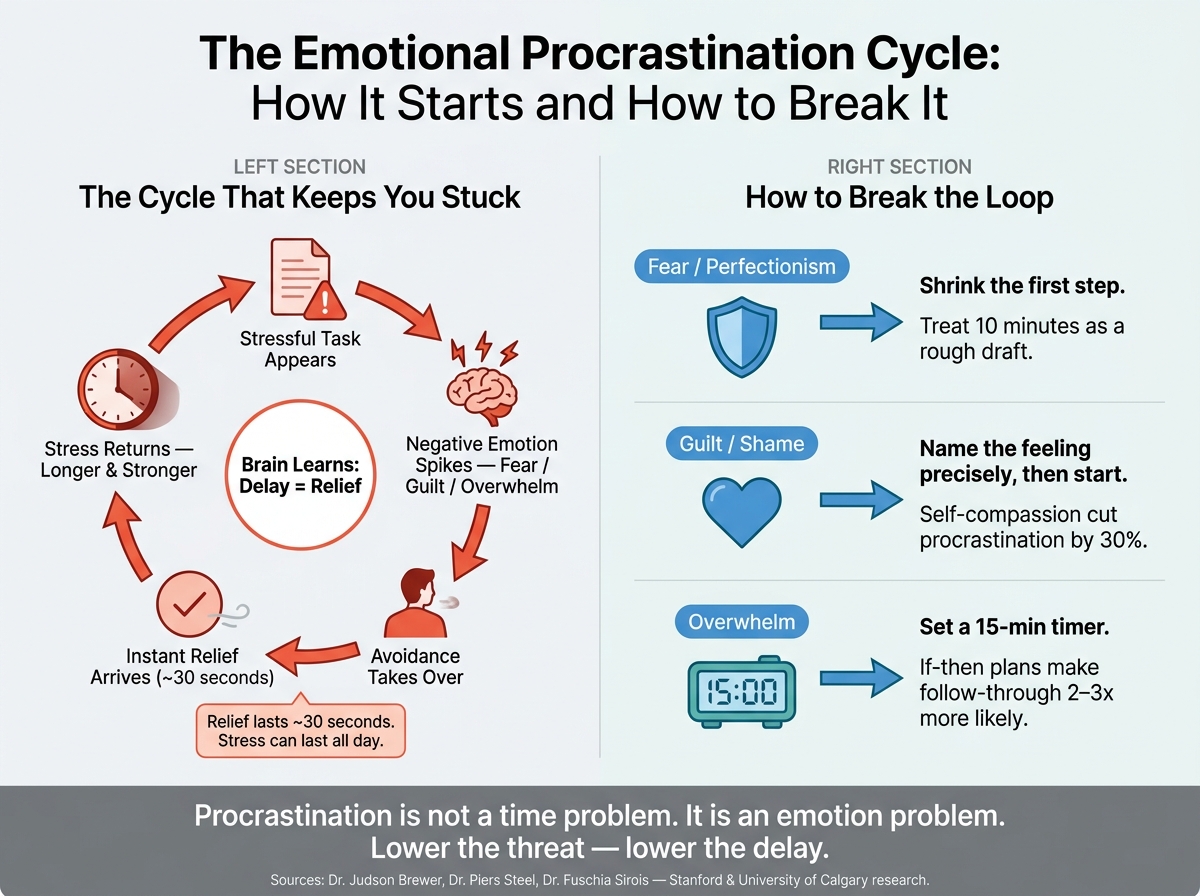
The Emotional Procrastination Cycle: How It Starts and How to Break It
Fear, guilt, and overwhelm don’t just lead to delay. They train the brain to do it again.
Every time you avoid something hard, your brain learns a simple lesson: delay brings relief from discomfort [1]. A one-off escape can slowly turn into your go-to response when a task feels stressful, awkward, or heavy.
The Short-Term Relief That Keeps the Habit Going
The pattern is usually pretty simple. A stressful task shows up, a negative feeling spikes, avoidance takes over, and relief lands almost right away. That relief feels rewarding because, for a moment, the discomfort is gone.
But here’s the catch: that relief usually lasts only about 30 seconds, while the fallout can stick around all day [1]. And the brain often picks immediate relief over future cost [7]. So even when delay makes life harder later, the short-term payoff can still win.
That’s how the habit gets stronger. With each repeat, the brain starts to store avoidance as a learned response. Over time, the urge to put things off can show up faster and feel more automatic when a similar task appears [1][7].
Where This Cycle Commonly Shows Up
This pattern often shows up around:
Part of what makes this loop stick is that it doesn’t feel like a problem in the moment. It feels like a fix. Little by little, delay can start to seem normal whenever fear, frustration, or self-doubt kicks in. Breaking that loop starts with lowering the sense of threat, not piling on more pressure.
How to Break the Emotional Procrastination Loop
You break this loop by lowering the emotional threat tied to the task. Match the move to the feeling: make fear smaller, put overwhelm in a short time box, and settle guilt before you begin.
- Fear / perfectionism: Shrink the first step. Treat the first 10 minutes like a rough draft.
- Guilt / shame: Name the feeling first, then start.
- Overwhelm: Set a 15-minute timer and begin.
Make the Task Feel Safer and Smaller
Fear and perfectionism usually ease up when the stakes feel lower.
So make the first step almost laughably small. Open the file. Write one sentence. Put the document title on the page. That’s enough to get moving.
Then give yourself 10 minutes to make a mess on purpose. Think of it as a rough draft, not a final judgment on your ability. That shift matters. It takes some of the pressure out of the room.
If you’ve already cut the task down as far as possible and still can’t start, that’s a clue. The problem probably isn’t logistics. It’s emotion.
Use Time Limits to Lower Resistance
When a task feels huge, a timer can make the start feel less heavy.
A fixed block of time - 10, 15, or 25 minutes - changes the question from "Can I finish this?" to "Can I do this for 15 minutes?" That’s a much easier ask.
It also helps to pair the timer with an if-then plan. Studies show this can make follow-through 2 to 3 times more likely [3]. A simple version looks like this: "If it's 9:00 AM and I have my coffee, then I will work on the report for exactly 15 minutes." The choice is made ahead of time, so there’s less room for inner bargaining.
Address the Emotion Before Pushing for Productivity
When emotion is the thing blocking you, deal with that part first.
If guilt or frustration is high, name the feeling with some precision before you start. Not just "I'm stressed," but "I feel anxious that this won't meet expectations." Putting clear words to the feeling can reduce amygdala activity and make clear thinking easier [4].
That’s not just a nice idea. In a Stanford study of students over one month, a brief self-compassion exercise cut procrastination by 30% [3]. As Dr. Fuschia Sirois puts it:
"Self-compassion was a significant, unique predictor of less procrastination, over and above self-esteem and other relevant variables." - Dr. Fuschia Sirois [4]
When you respond to a delay with understanding instead of self-criticism, the task feels less punishing to return to. And that makes starting easier.
When Procrastination Points to a Deeper Issue
Most procrastination sticks to a small set of tasks. But when avoidance starts spilling into work, health, relationships, and even basic routines, it may point to something deeper than simple task discomfort.
Ordinary procrastination is usually task-specific. You put off the hard report, the awkward email, or the workout you don't want to do. A deeper pattern looks different. It can show up even with easy, enjoyable, or low-pressure tasks, and it can start interfering with day-to-day life.
That distinction matters because the fix depends on the cause. Chronic anxiety, depression, burnout, and ADHD can all include procrastination as a symptom [1].
If timers, smaller steps, and other basic tactics keep falling flat, the problem may not be habit alone. At that point, this stops being about “trying harder” and starts looking more like something that needs a different kind of help.
"Most procrastination advice relies on willpower. And willpower doesn't work for anxiety-driven habits." [2]
If procrastination is hurting your job, relationships, health, or daily self-care, it’s a good idea to talk with a therapist, especially someone trained in cognitive behavioral therapy. Procrastination often begins as emotional avoidance. When it turns broad, persistent, and disruptive, professional support may make more sense than another productivity hack.
FAQs
How do I know if my procrastination is emotional?
Your procrastination may be emotional when it’s driven by feelings like anxiety, fear of failure, overwhelm, or harsh self-talk.
One of the clearest signs is simple: putting the task off feels better in the moment. But later, that relief wears off, and the guilt, stress, or frustration hits even harder.
Why does avoiding a task feel so good at first?
Avoiding a task can feel good at first because it gives your brain a bit of short-term relief from uncomfortable feelings like anxiety, fear, or frustration.
And that relief can teach your brain a simple lesson: do this again. That’s why procrastination often gets easier to repeat over time.
When should I get help for chronic procrastination?
Seek professional help if chronic procrastination is hurting your career, relationships, health, or day-to-day well-being.
It’s even more important to reach out if it comes with persistent anxiety, depression, or self-worth issues. Those struggles can sometimes point to underlying conditions like ADHD or anxiety disorders.


