

Self-Awareness in Career Decision-Making
Make better career choices by clarifying values, strengths, and emotions; use journaling, feedback, and decision tools to test options.


Self-awareness is a critical factor in making career decisions that genuinely align with your strengths, values, and goals. Yet, research shows only 10–15% of people truly understand themselves, despite 95% believing they do. This disconnect often leads to career choices based on external factors like salary or prestige, which don't guarantee long-term satisfaction.
Key takeaways:
- Internal self-awareness: Knowing your values, strengths, and emotional triggers.
- External self-awareness: Understanding how others perceive you.
- Lack of self-awareness leads to poor job fits, impulsive decisions, and misaligned career paths.
- Tools like reflective journaling, guided self-inquiry, and decision frameworks (e.g., Ladder of Inference) can improve self-awareness.
- Align career decisions with values, strengths, and work preferences while validating insights with external feedback.
The Psychology of Career Decisions | Sharon Belden Castonguay | TEDxWesleyanU
sbb-itb-3d8e4fc
The Problem: How Low Self-Awareness Gets in the Way of Career Decisions
Making thoughtful career decisions requires a deep understanding of yourself. Without it, choices often lean on surface-level factors like prestige or salary, which rarely guarantee long-term satisfaction. Research highlights this disconnect: person-job fit strongly correlates with job satisfaction (r = 0.56), as well as organizational commitment (r = 0.47) and a reduced intent to quit (r = -0.46) [9]. When self-awareness is lacking, it becomes nearly impossible to assess whether a role truly aligns with your needs and values. Let’s take a closer look at how neglecting personal insights can lead to career missteps.
Unclear Values Lead to Misaligned Career Choices
When you don't fully understand your core values, your career decisions can feel off-track. For instance, you might prioritize a high salary when what you truly crave is meaningful work. Or you might pick a "safe" job when your real passion lies in creative independence. Psychologist Shalom Schwartz’s research explains this tension well: values like Achievement (personal success) and Benevolence (helping others) often pull in opposite directions [6]. Without clarity on which values matter most, internal conflict can derail decision-making.
"You cannot choose well what you cannot see clearly." - Elizabeth Sena, Career Coach, Yale School of Management [8]
The numbers back this up: when personal values align with the work environment, job satisfaction improves (r = 0.44), and employees are less likely to consider leaving (r = -0.35) [6]. Ignoring your values doesn't just lead to a poor fit - it creates a cycle of repeatedly landing in roles that don’t suit you.
Overlooking Strengths and Interests
Another common pitfall is undervaluing your natural strengths and interests. When these factors go unexamined, career decisions are often guided by external markers like prestigious employers or flashy job titles. Career and Leadership Coach Kathy Caprino captures this challenge:
"When we don't fully understand the internal forces influencing our decisions... even well-intentioned choices can lead us back into situations that feel just as limiting or misaligned as the ones we're trying to leave behind." [4]
This oversight is costly. Nearly 40% of senior hires leave their roles within 18 months, often due to a poor fit that even rigorous hiring processes fail to detect [7]. Skipping the self-reflection phase doesn’t save time - it just delays the inevitable fallout.
And when emotions come into play, the risks grow even larger.
Emotional Triggers and Impulsive Career Moves
Stress, fear of falling behind, or industry upheavals can pressure people into making rushed career decisions. These reactions often stem from "Protection" patterns - automatic behaviors designed to avoid discomfort or risk [4]. While such moves may feel decisive in the moment, they’re often more about escaping a bad situation than choosing a good fit.
Research supports this: in a study of 317 strategic decisions, managers who considered multiple alternatives had more successful outcomes and felt less regret compared to those who framed decisions as binary "yes or no" choices [5]. Reactive decision-making narrows your options - and low self-awareness is often the root cause of these hasty choices.
Signs of Self-Awareness in Career Decision-Making
Being highly self-aware in career choices often shows through specific behaviors that reflect a deep understanding of oneself and guide decisions accordingly.
Knowing Your Values and Work Preferences
People with strong self-awareness evaluate career opportunities based on how well they align with their core values and work preferences, rather than just focusing on external factors like prestige or compensation.
One practical tool for this is energy mapping - identifying tasks and environments that either energize or exhaust you. For example, you might notice that collaborative brainstorming sessions leave you feeling motivated, while repetitive solo tasks like data entry drain your energy. This insight can serve as a reliable guide when considering job roles or workplace settings [8][3].
Understanding these patterns not only helps you choose roles that fit but also strengthens your ability to make career decisions that feel authentic and fulfilling.
Recognizing Emotional Patterns and Confidence Levels
Self-awareness also involves paying attention to your emotional responses, which can provide valuable clues for better decision-making. Emotions play a significant role in guiding career choices.
Organizational psychologist Tasha Eurich captures this concept well:
"Self-awareness is the will and skills to see ourselves clearly." - Tasha Eurich [10]
A critical aspect of emotional awareness is learning to separate integral emotions - those directly tied to a decision - from incidental ones, which might arise from unrelated stressors like a frustrating commute or a bad news headline. Asking yourself, "Was I feeling this way before considering this decision?" can help distinguish between emotions that matter and those that don’t.
Confidence, or lack thereof, is another important indicator. For instance, constantly deferring decisions to a manager - known as decision hesitation - might point to low self-awareness or self-efficacy [2]. On the other hand, individuals with strong self-efficacy are more likely to approach career transitions with confidence, showcasing their abilities without hesitation. Understanding where you fall on this spectrum can pave the way for meaningful growth and better career outcomes.
This article is for informational purposes only and does not constitute medical, health, fitness, or wellness advice. Always consult a qualified professional before making any decisions or changes to your routine.
Mindfulness-Based Ways to Build Self-Awareness
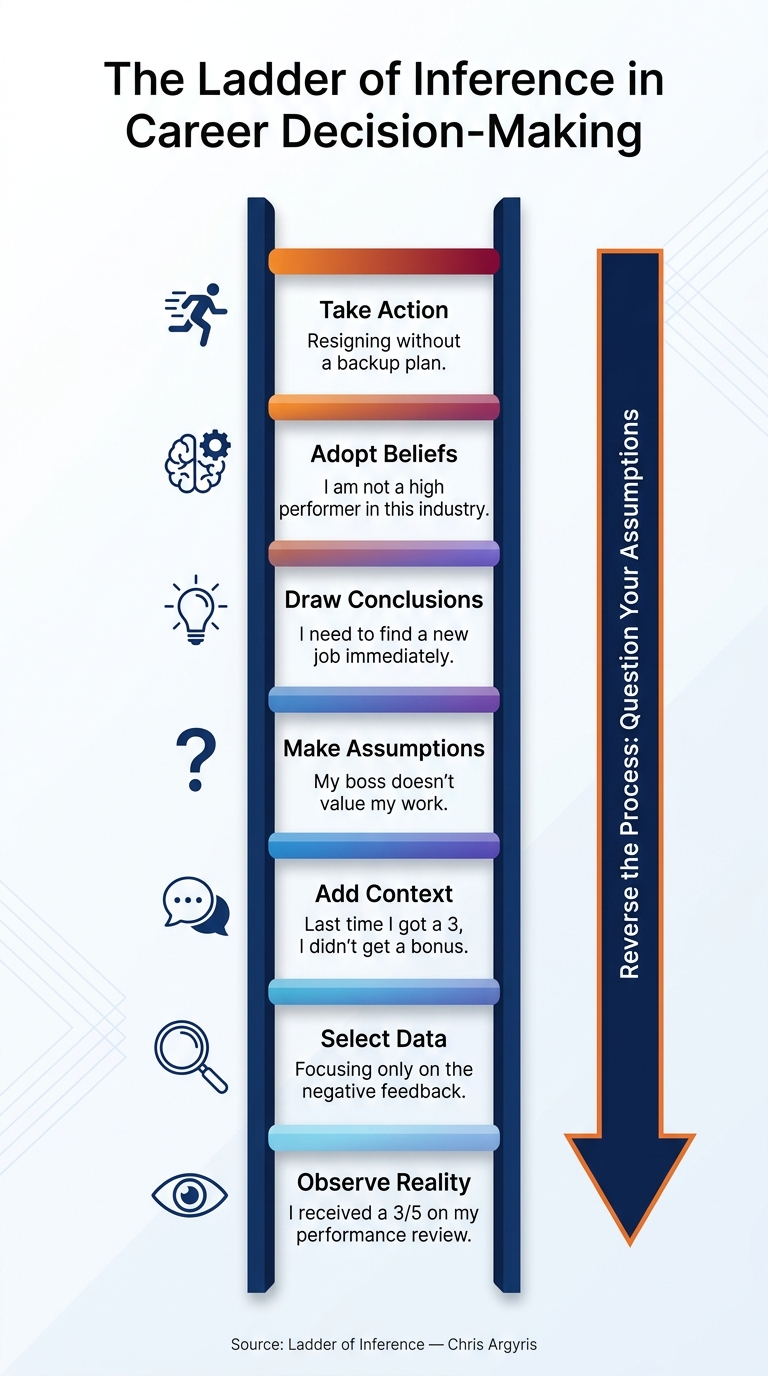
The Ladder of Inference: How Assumptions Derail Career Decisions
Reflective Journaling for Greater Clarity
Journaling regularly helps untangle vague thoughts, turning them into clear insights. This practice can highlight the difference between your true values and the expectations you think you need to meet.
One helpful method is trigger logging. When you experience a strong emotional reaction, jot down the event, your feelings, and your response. Over time, these entries can reveal what truly drives you - whether it’s a desire for independence, fairness, or creative expression [3].
Another approach is the "Time Flies" test. Write about challenges you genuinely enjoy tackling, even if they’re tough. This exercise helps distinguish lasting interests from fleeting ones. As Herminia Ibarra, a professor at Harvard Business School, explains:
"Journaling becomes the laboratory where you try on new professional identities before committing." [11]
Research backs this up. One study showed that 53% of individuals who practiced expressive writing found new jobs, compared to just 18% in the control group [11]. So, journaling isn’t just a reflective tool - it’s a practical skill that can shape your career.
Once you’ve started journaling, you can refine these insights further through structured self-inquiry.
Guided Self-Inquiry Techniques
Structured self-inquiry takes your self-awareness to the next level, helping you turn reflections into actionable career insights.
- Peak Experience Analysis: Reflect on 3–5 moments when you felt deeply engaged and authentic at work. Write down what you were doing and the values those moments expressed. Patterns often emerge, revealing what truly motivates you [6].
- Envy Diagnostic: Pay attention to what or who you envy. Envy can be a clue to desires or values you haven’t fully acknowledged.
- "Rules/Stories" Check: List beliefs you hold about your career, such as “I must be practical” or “I need to use my degree.” Then ask yourself: whose voice is this? Many of these “rules” may come from others - family, society, or peers - rather than your own experiences.
- 10:10:10 Reflection: For tough decisions, imagine you’ve already made the choice. Then consider how you’ll feel 10 minutes, 10 months, and 10 years from now. This mental shift often helps cut through short-term worries and clarifies what’s truly important.
These techniques lay the groundwork for a deeper review of your thought processes using decision-making frameworks.
The Ladder of Inference as a Decision-Making Tool
The Ladder of Inference, developed by organizational theorist Chris Argyris, illustrates how we subconsciously move from raw data to decisions [13][14]. This process often happens so quickly that we’re unaware of the assumptions shaping our choices.
Here’s an example: imagine you receive a 3-out-of-5 on a performance review. You focus only on the negative comments, recall a past experience where a similar score meant no bonus, assume your manager doesn’t value your work, and decide to quit without a backup plan. Each step feels logical, but it’s all based on selective data [15][17].
To use the Ladder of Inference effectively, reverse the process. Start with your conclusion and question the data you focused on and what you ignored. As Craig Dickerson, a writer for Harvard Business Impact, puts it:
"Certainty is the enemy of curiosity. Knowing is a barrier to learning." [12]
This tool is especially helpful for high-stakes decisions with long-term consequences. For smaller, reversible choices, a quicker review may suffice [16].
| Rung | Step | Career Context Example |
|---|---|---|
| 1 | Observe Reality | "I received a 3/5 on my performance review." |
| 2 | Select Data | Focusing only on the negative feedback |
| 3 | Add Context | "Last time I got a 3, I didn’t get a bonus." |
| 4 | Make Assumptions | "My boss doesn’t value my work." |
| 5 | Draw Conclusions | "I need to find a new job immediately." |
| 6 | Adopt Beliefs | "I am not a high performer in this industry." |
| 7 | Take Action | Resigning without a backup plan |
Slowing down to examine your assumptions isn’t overthinking - it’s a way to ensure your decisions are grounded and intentional.
This article is for informational purposes only and is not medical, health, fitness, or wellness advice. Always consult a qualified healthcare, medical, fitness, or wellness professional before making decisions, starting a new routine, changing your diet, using supplements, or acting on any health-related information.
Matching Career Choices to Your Self-Awareness
Comparing Career Fit Factors
Once you've gained a better understanding of yourself, it's time to weigh your career options against some key criteria: values fit (does the job align with what matters most to you?), role fit (do the tasks energize you and utilize your strengths?), career capital (will this path help you gain skills and connections that are valuable?), supportive conditions (does this role meet your lifestyle needs?), and exploration value (will it lead to new learning or opportunities?) [5][7].
Instead of treating a career decision as final, think of it as a working hypothesis. Consider generating three to five options to avoid getting locked into a narrow perspective [5]. Before making any big changes, test your assumptions with small, low-risk experiments. For instance, dedicate 2–5 hours to researching a field, 2–20 hours to speaking with professionals in that area, and then try a short-term project lasting 1–4 weeks. Only after these steps should you consider deeper commitments like internships or advanced education [7].
By combining your internal reflections with external feedback, you can make more informed and balanced career decisions.
Balancing Personal Insights with Outside Signals
After mapping out what feels like the right fit internally, it's essential to validate those insights with external feedback. This combination helps uncover blind spots and ensures a more grounded decision. Seek feedback from a small, trusted group of people who know your work well. Instead of asking general questions like "How am I doing?", try something more specific, such as, "What's one thing you think I could have handled better this week?" [3]. Limit this process to about five people to get focused and honest insights.
Be cautious of falling into the prestige trap, where a role is chosen for its status or approval from others rather than its actual alignment with your goals and values.
Another helpful tool is conducting a Personal SWOT analysis on a monthly basis. Ask yourself:
- What do colleagues consistently rely on me for?
- Which skills am I hesitant to develop?
- What trends could I take advantage of right now?
- Are there any habits that might quietly hold me back? [3]
This kind of regular self-check grounds your personal insights in actionable, real-world feedback and keeps your decision-making process practical and balanced.
| Factor | Internal Insight | External Signal |
|---|---|---|
| Values Fit | Does this work align with my core beliefs? | Does the company culture reward these values? |
| Role Fit | Do these tasks energize me? | Does my track record suggest I can excel in this role? |
| Career Capital | Does this path build skills I want to develop? | Are these skills in high demand in the current market? |
| Supportive Conditions | What are my essential lifestyle requirements? | Does the employer offer the necessary salary, flexibility, and commute? |
| Exploration Value | Am I curious enough to try this option? | Does this role open doors to opportunities in other high-growth fields? |
This article is for informational purposes only and is not medical, health, fitness, or wellness advice. Always consult a qualified healthcare, medical, or wellness professional before making decisions, starting a new routine, changing your diet, or acting on any health-related information.
Conclusion: A Mindful Process for Career Decisions
Steps to a Self-Aware Career Choice
Making better career decisions often begins with intentional, thoughtful steps.
Start by carving out some quiet time - step away from the constant noise of daily life and allow yourself the space to think clearly. Rushing rarely leads to clarity; slowing down is what helps you see things more sharply [18]. Then, reframe your internal dialogue. Instead of asking, "Why am I stuck?" shift to "What kind of work excites and energizes me?" Organizational psychologist Tasha Eurich explains this well:
"Why questions draw us to our limitations; what questions help us see potential." [1]
From there, challenge your assumptions. Many career decisions are shaped by unspoken "rules" - expectations passed down from family or societal norms rather than rooted in your personal values [1][4]. Take the time to identify what truly matters to you. Treat your options as experiments, testing them with small, low-risk steps before committing fully [7]. Finally, seek feedback from a trusted circle of people who can offer honest, constructive insights - even if it’s not what you want to hear [1]. These steps build on the mindfulness and reflection practices discussed earlier.
Together, these actions emphasize the importance of self-awareness in making thoughtful career choices.
Key Takeaways
Self-knowledge is a rare trait - only 10–15% of people deeply understand themselves - and without it, career decisions often miss the mark [1].
Mindfulness practices help close this gap. When combined with a structured decision-making process, mindfulness has been shown to reduce negative career thoughts by 31% and strengthen vocational identity by 22% [19]. The strategies outlined earlier demonstrate how reflective practices, paired with actionable steps, can create a strong foundation for navigating career growth.
The goal isn’t to achieve perfection but to approach your decisions with intentionality - grounded in self-awareness, tested by reality, and flexible enough to adapt as you grow.
This article is for informational purposes only and does not constitute medical, health, fitness, or wellness advice. Always consult a qualified professional before making decisions, starting a new routine, changing your diet, using supplements, or acting on any health-related information.
FAQs
How do I figure out my core work values fast?
To figure out your core work values quickly, pay attention to what you do rather than lofty aspirations. Begin by selecting five values you’d stand by, even if it meant facing personal sacrifices. Then, refine your list by cutting out those that feel less crucial and ranking what remains. Think back to standout moments - times when you felt truly energized or completely drained - and look for recurring themes. Lastly, put your values to the test by imagining how they’d hold up in tough situations. This will help ensure they truly matter when it counts.
How can I tell if I’m quitting from stress or from poor fit?
Stress or burnout can often improve with rest, clearer boundaries, or a reduced workload. This shows that you still have a connection to the work and care about it. On the other hand, a poor fit feels different. Even after taking time off, the feeling of emptiness or being out of sync remains. This happens because the work no longer aligns with your values or personal goals.
What’s a quick way to test a new career path before committing?
Testing out a new career path doesn’t have to be a massive leap. Instead, you can ease into it with small, low-risk experiments. Try things like micro-projects, job shadowing, informational interviews, or even short-term skill trials. These hands-on activities give you a taste of the role, helping you figure out if the day-to-day tasks inspire you or leave you feeling drained. By gaining this firsthand experience, you can better pinpoint career options that match your values and strengths before diving in fully.


