

How Cultural Immersion Helps Language Fluency
Daily contact with locals, homestays and structured engagement speed speaking, listening and vocabulary more than classes alone.


If I want to speak a language well, I need more than classes. The research in this article points to a simple pattern: people usually improve more when they use the language every day with local speakers, not just in lessons.
Here’s the short version:
- Daily contact matters most.
- Speaking and listening often improve the most.
- Vocabulary can grow fast - one source says it can be up to 4x higher than in home-country settings.
- Homestays, internships, and host-family contact often lead to better results than just being abroad.
- Time abroad alone is not enough. A learner who stays active in conversations may do better than someone who spends more time overseas but stays isolated.
- A survey of 1,011 learners linked more contact with locals to higher fluency.
- A 2025 study of 55 Japanese students found gains in evaluative language and story variety after 1 month of homestay.
- A 2025 study of 6 advanced ESL students found that those who used the local language setting more fully made bigger gains in oral fluency.
In other words: immersion helps because it turns the language into an all-day habit. I’m not just memorizing words. I’m hearing how people talk, testing what I know, getting corrected, and learning what sounds normal in daily life.
The main takeaway is simple: the best results come from steady use, local interaction, and structured contact like homestays or internships.
Lindie Botes -Holistic language learning through cultural immersion and culture shock
sbb-itb-3d8e4fc
Why immersion speeds up language learning
Immersion speeds learning because it pushes you to use the language all the time, get feedback on the spot, and adjust as you go. The research points to three main drivers: more input, more interaction, and faster correction. That mix of steady exposure, active use, and feedback is what helps fluency move along faster.
More input, more interaction, more feedback
Immersive settings surround learners with language that sits just above their current level, which supports acquisition [7][5]. That matters because people don’t just hear the language more often. They also have to work with it in the moment.
When learners negotiate meaning through questions, rephrasing, and gestures, they get immediate feedback. That process strengthens oral fluency and communicative competence [6][7][1][5]. It’s the difference between studying a phrase in a notebook and having to use it right now to keep a conversation going.
A May 2025 action research study led by Assistant Professor Muhammad Alrayes followed six advanced ESL students in the United States. It found that students who maximized engagement with native English speakers within the target culture achieved significantly greater advancements in oral fluency than those who didn't fully use the linguistic environment around them [5]. That same pattern carries beyond the classroom, where everyday exchanges turn the language into steady practice.
Language learned through daily use
In immersion, routine activities become repeated language encounters. Sociocultural research describes language learning in immersive settings as a socialization process, where learners absorb linguistic conventions, cultural norms, and social behaviors through everyday participation [8]. In plain terms, people learn not only what to say, but how to say it, when to say it, and what sounds natural in daily life.
That’s why ordinary tasks like shopping, commuting, and sharing meals can double as language practice [1][8]. A trip to the store isn’t just a trip to the store anymore. It becomes listening practice, speaking practice, and sometimes a quick lesson in how people phrase things in real conversation.
This shows up in the data too. In a survey of 1,011 language travelers, more contact with locals correlated with higher fluency and more meaningful native-speaker interaction, and homestays were linked to both outcomes [3].
Research shows these conditions translate into measurable gains in fluency.
What studies show about immersion and fluency gains
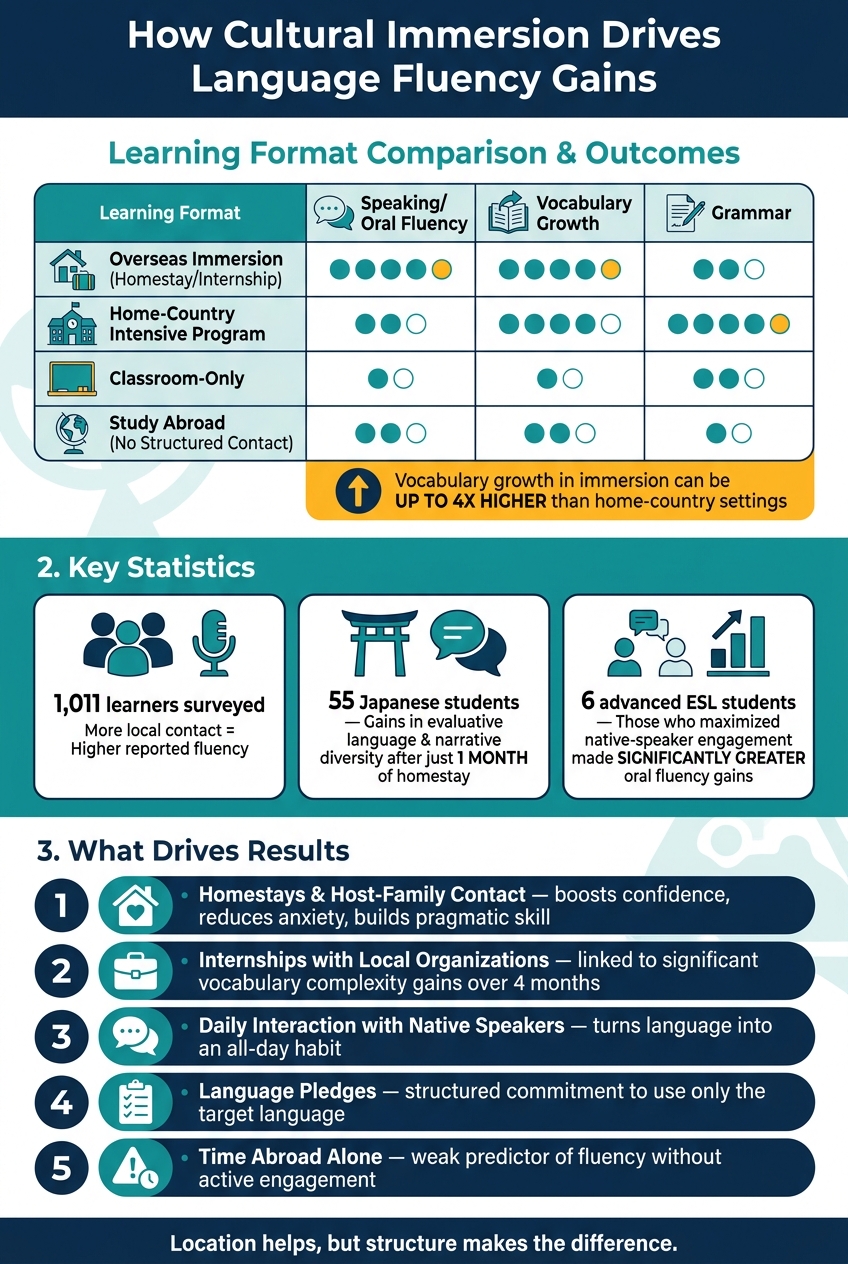
Cultural Immersion vs. Classroom Learning: Language Fluency Gains
The data backs this up pretty clearly. Research shows that immersion leads to strong language growth, and meta-analyses tend to favor study abroad over other learning settings [4][2]. The biggest jumps usually show up in speaking, listening, and vocabulary.
Where gains are strongest: speaking, listening, and vocabulary
Learners tend to speak more smoothly, process spoken language faster, and build deeper vocabulary, including idioms and regional expressions [9][10][11]. Some research suggests average vocabulary growth can be up to four times higher than in home-country settings [2].
Grammar results are a bit more uneven. Even so, sentence complexity and variety usually improve over a semester abroad [10].
Starting level matters too. Learners who begin at a higher level often make stronger gains in grammar, while lower-level learners may see the biggest jump in basic communication confidence [4][12].
Overseas immersion vs. classroom-only and home-country intensive programs
When you compare formats side by side, overseas immersion tends to produce the strongest gains in oral fluency and pragmatic skill. Homestays often add confidence and more day-to-day interaction. Home-country intensive programs can help with grammar and vocabulary, while classroom-only settings tend to lead to slower fluency growth [9][2][6][1].
The pattern is pretty simple: more contact with local speakers usually leads to better results.
How program design affects results
Just being abroad doesn't automatically lead to strong progress. In one study of Spanish L2 learners, only students who took part in internships with local organizations showed a significant increase in vocabulary complexity over a 4-month period [10].
That matters because physical presence alone isn't enough. Internships, host-family contact, and other structured local engagement tend to drive stronger gains in vocabulary use and pragmatics [10][4]. Programs that mix formal grammar instruction with content-based courses and host-family stays also tend to outperform single-format setups [4].
Language pledges help too. In these programs, students commit in writing to use only the target language, and some schools attach grade penalties if they break that agreement. The goal is simple: keep the immersive setting active and push students to communicate more often [10].
Put bluntly, location helps, but structure makes the difference [10][4].
How immersion builds communication skills beyond vocabulary
Beyond faster speaking and a larger vocabulary, immersion teaches something deeper: how language fits the moment. Learners don’t just get better at saying more words. They get better at knowing which words to use, when to use them, and how to say them in ways that fit the situation.
That’s where pragmatic competence comes in. It’s the skill of speaking appropriately, not just fluently.
Pragmatic competence and cross-cultural communication
In immersive settings, learners build pragmatic competence by seeing language in action all day long. They learn how to choose the right tone, make requests politely, and pick up on indirect social cues. Immersion gives learners the kind of linguistic exposure and cultural experience that helps them observe and practice appropriate language use in authentic settings [13].
Host families play a big part here. They show learners how phrasing shifts with the situation, which helps them adjust both their language and their social behavior [13][6].
This kind of growth shows up clearly in homestay research. In a 2025 study of 55 Japanese junior high school students in U.S. and Canadian homestays, evaluative language and narrative diversity increased after one month [14].
Motivation and confidence
Immersion doesn’t just shape language skill. It can also change how learners feel when they use the language. Research shows that direct interaction with host families reduces anxiety and builds linguistic confidence [6].
"Results indicated increased L2 linguistic confidence and lower anxiety levels after students interacted with their host families." - Ruth Wong, Department of English Language Education, The Hong Kong Institute of Education [6]
Communication-oriented motivation is also linked to stronger pragmatic awareness and a better ability to identify pragmatic errors [13].
Still, immersion can be hard at times. Culture shock and stress can make these programs tough to access [13]. These effects tend to matter most when learners stay involved in everyday interaction.
Conclusion: What cultural immersion does best
Immersion works best when it leads to repeated, meaningful use of the language. A large-scale study of 1,011 learners found that people with intense contact with local residents reported much higher fluency levels than those with limited contact [3]. The same pattern shows up in daily routines, social contact, and structured local participation.
Key takeaways from the research
Learners tend to improve more when immersion creates steady contact, daily use, and authentic conversation. That kind of experience supports broader communicative fluency.
Research also shows that time abroad by itself is a weak predictor of fluency. Even long-term residents can fall behind shorter-term visitors if they don't engage actively [15]. The main driver is intentional engagement: taking part in real communication instead of staying inside isolated social circles.
Immersion also builds confidence and intercultural sensitivity, not just fluency.
FAQs
How long does immersion take to improve fluency?
Immersion can start changing the brain’s auditory processing in as little as 2 weeks. That’s fast.
There isn’t one fixed schedule for full fluency, but research points to language gains showing up within 2 to 10 weeks. Broader changes in the brain tend to appear over the first few months.
The big driver isn’t just being surrounded by the language. It’s active engagement. Things like comprehensible input and real conversation tend to matter far more than passive exposure on its own.
Can I get immersion benefits without studying abroad?
Yes. Research suggests that studying abroad is not required for fluency, and it also doesn’t guarantee it. Some expatriates spend years living overseas and still never become proficient.
The good news is that you can build many of the same immersion gains at home. The key is steady input and regular social interaction. That can come from podcasts, streaming media, online tutoring, local cultural organizations, and daily practice.
What should I do daily to make immersion work?
To make immersion work day after day, pair deliberate study with active use in daily life. Spend 30 to 60 minutes on grammar, vocabulary, and pronunciation. Then add steady input through podcasts, shows, and news in your target language.
Use the language with people, too. Have real conversations with native speakers or online tutors so you’re not just taking things in, but also responding on the spot.
It also helps to shift your surroundings a bit. Label household items, change your device settings, and set aside daily hours when you use only target-language media.


