

How Antioxidants Protect Cells from Aging
How antioxidants balance ROS to limit cellular damage, why whole foods beat high-dose pills, and simple habits to support healthspan.


Your cells age in small steps, and antioxidants help slow some of that wear. They do this by helping control reactive oxygen species (ROS), which can damage DNA, proteins, cell membranes, and mitochondria when levels get too high.
Here’s the short version:
- ROS are normal, but too much leads to oxidative stress.
- Your body already has its own system to handle ROS, including glutathione, SOD, catalase, and GPX.
- That system gets weaker with age, with some antioxidant enzyme levels dropping by about 30% to 35% after age 30.
- Mitochondria are a main trouble spot because they both make ROS and get damaged by them.
- Food works better than high-dose pills for most people, especially when you eat a mix of fruits, vegetables, nuts, beans, greens, tea, and other plant foods.
- Antioxidants may help healthspan more than lifespan. In plain terms, they may help you stay healthier longer, but they do not stop aging.
If I had to boil the whole article down to one point, it would be this: you do not need to wipe out ROS - you need to keep them in balance.
A few facts stand out:
- Smoking, UV exposure, poor diet, stress, and sleep loss can push oxidative stress higher.
- Mitochondrial-targeted compounds like MitoQ and SkQ1 are being studied because standard antioxidants such as vitamins C and E do not get into mitochondria well.
- High-dose single supplements can be a bad idea because ROS also help with cell signaling, immune work, and healing.
What matters most day to day is pretty simple:
- Eat colorful plant foods
- Move your body often
- Sleep 7–9 hours
- Keep stress under control
- Avoid smoking and too much sun exposure
This is not about one “anti-aging” fix. It is about giving your cells steady support over time.
Antioxidants and aging: A radical theory
sbb-itb-3d8e4fc
How Antioxidants Protect Cells from Damage
When ROS build up faster than the body can shut them down, cells take the hit. Antioxidants step in by neutralizing free radicals before they damage DNA, proteins, and cell membranes.
Some antioxidants are made inside the body. Others come from food. Both help, but they don't do the exact same job.
The Body's Built-In Antioxidant Defenses: Enzymes and Glutathione
The body's internal defense system works like a relay team. One enzyme handles a dangerous radical first, then another takes over and finishes the cleanup.
The main players are antioxidant enzymes and glutathione. This system gets weaker with age, which makes the numbers below worth paying attention to:
| Antioxidant | Primary Location | Main Substrate | Role in Aging |
|---|---|---|---|
| Superoxide Dismutase (SOD) | Cytoplasm & Mitochondria | Superoxide radicals | Converts superoxide into less harmful hydrogen peroxide; levels drop ~30% after age 30 [1] |
| Catalase | Peroxisomes | Hydrogen peroxide | Finishes neutralization by converting peroxide into water; levels drop ~35% after age 30 [1] |
| Glutathione Peroxidase (GPX) | Cytoplasm & Mitochondria | Lipid peroxides | Protects cell membranes from lipid peroxidation; requires selenium as a cofactor |
| Glutathione | All cells (intracellular) | Various ROS | Major intracellular antioxidant |
| CoQ10 | Mitochondrial membrane | ROS in energy chain | Acts as a mitochondrial energy carrier and antioxidant; declines sharply with age [1] |
Why Mitochondria Are Central to Oxidative Stress
Mitochondria sit at the center of this process because they do two things at once: they produce ROS, and they get damaged by ROS.
They make most of the body's energy as ATP. But that energy-making process also creates ROS as a byproduct. So the same part of the cell that keeps you running is also one of the main places where wear and tear builds up over time.
Mitochondrial DNA (mtDNA) is at special risk. Unlike DNA in the nucleus, mtDNA doesn't have protective histone proteins, and its repair systems are far weaker [3]. Over time, damage to mtDNA can chip away at mitochondrial function.
What Research Says About Targeted Antioxidant Protection
Because mitochondria play such a big part in oxidative stress, researchers have been trying to send antioxidants straight to them. That's the key idea here.
Standard antioxidants like vitamins C and E move through the body more broadly, but they have a hard time crossing the mitochondrial membrane barrier in amounts that matter [1].
That's why compounds like MitoQ and SkQ1 have drawn so much interest. They're designed to get into mitochondria more effectively. MitoQ, for example, is a modified CoQ10 that targets mitochondria more directly. In preclinical studies, it was shown to penetrate mitochondria up to 5 times more effectively than standard ubiquinone [1].
That doesn't make these established treatments. It means they're part of an active research area. Still, the shift in thinking is hard to miss: instead of trying to manage oxidative stress only in the cell at large, scientists are looking at how to protect the place where much of the damage starts.
| Feature | Conventional Antioxidants (e.g., Vitamin C, E) | Mitochondria-Targeted Antioxidants (e.g., MitoQ, SkQ1) |
|---|---|---|
| Primary Target | General cellular environment (cytosol, bloodstream) | Mitochondrial inner membrane and matrix [1] |
| Experimental Benefits | Broad ROS neutralization | Up to 5x better mitochondrial penetration; may protect mtDNA and support ATP production [1] |
| Limitations/Uncertainties | Poor penetration of the mitochondrial membrane barrier [1] | Still in active research; long-term human data is limited [1] |
Dietary Antioxidants and the Foods That Support Healthy Aging
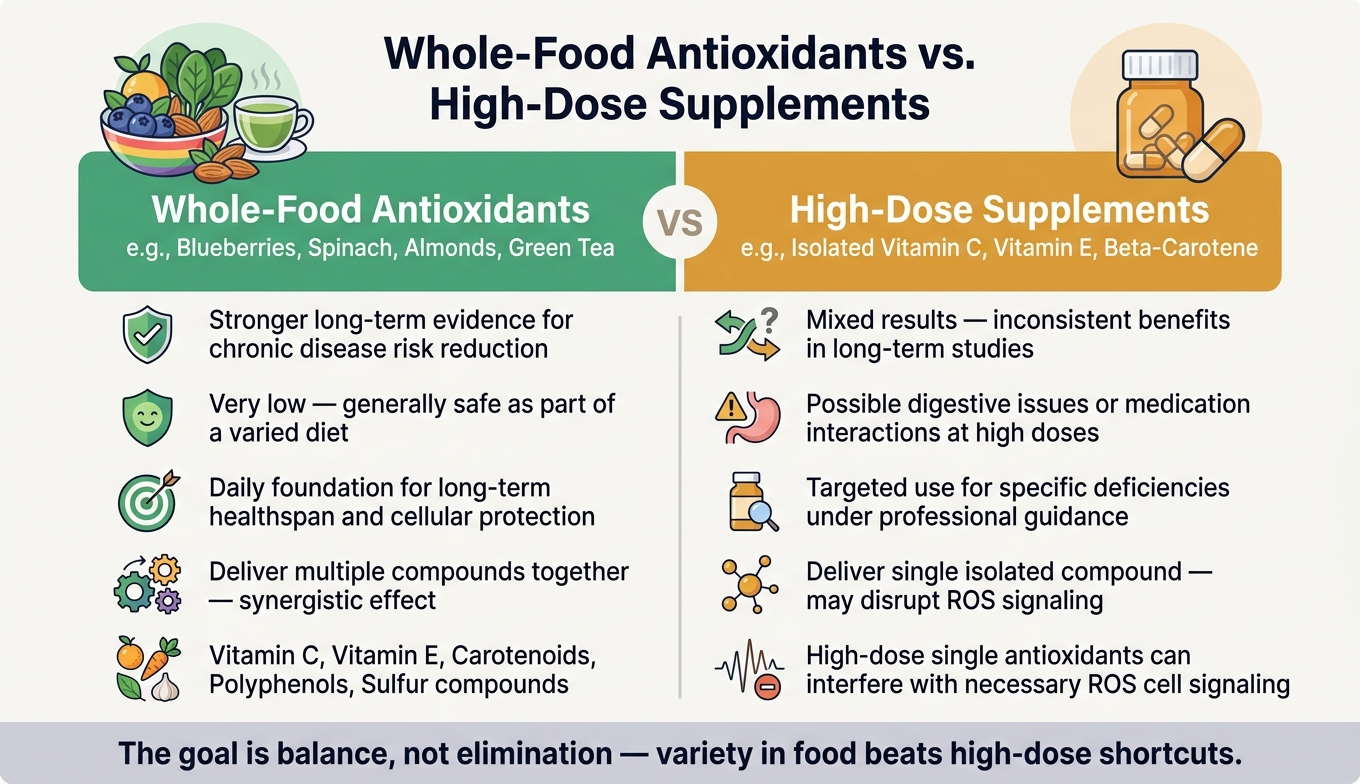
Whole-Food Antioxidants vs. Supplements: What the Evidence Shows
Understanding how antioxidants work inside cells matters for a simple reason: food is where many of those protective compounds come from. So when you choose what to eat each day, you're also helping your body keep up the defenses discussed above.
Key Antioxidant Nutrients and Plant Compounds
Antioxidants don't all do the same job. Each one helps protect cells in its own way, which is why variety beats loading up on one single nutrient.
- Vitamin C (citrus, bell peppers, broccoli) supports collagen production and helps neutralize free radicals [4].
- Vitamin E (almonds, sunflower seeds, spinach) helps protect cell membranes from oxidative damage [4].
- Carotenoids like lycopene, lutein, and beta-carotene (tomatoes, carrots, leafy greens) help protect against UV-related damage and support eye health [2][4].
- Polyphenols and flavonoids (blueberries, green tea, dark chocolate, coffee) help limit oxidative stress [2][4].
- Sulfur-containing compounds (broccoli, cabbage, kale) support the body's detox enzymes and back up antioxidant defenses [2].
A mix of antioxidants tends to do more than huge amounts of any one nutrient because each compound works a little differently [5]. Put another way: the goal isn't to hunt for the one "best" antioxidant. It's to eat a range of foods that bring different types to the table.
How to Build Antioxidant-Rich Meals Day to Day
You don't need a complicated meal plan to eat this way. A handful of steady habits can make a big difference.
At breakfast, add blueberries or raspberries to oatmeal or yogurt. At lunch and dinner, make at least half your plate colorful vegetables [8][5]. Spinach or kale can add vitamins A, C, and K, while broccoli brings sulfur-containing compounds [2]. For snacks, almonds or walnuts are a better pick than packaged snack foods if you want vitamin E and healthy fats [4]. And swapping a sugary drink for green tea is an easy way to add catechins [8][5].
The main idea here is rotation, not perfection. Rotate beans, whole grains, and greens through the week to get a broader mix of nutrients [2][7]. That's also one reason food tends to do better than isolated pills: meals bring many compounds together, not just one at a time.
Food vs. Supplements: Where the Evidence Is Stronger
For most healthy adults, whole-food eating patterns have stronger long-term evidence than high-dose antioxidant pills. Supplements, on the other hand, often show mixed results in studies and may come with downsides when the dose gets too high.
| Feature | Whole-Food Antioxidants | Supplement Forms |
|---|---|---|
| Evidence for Chronic Disease Risk Reduction | Supported by stronger long-term evidence [6][7] | Mixed results; studies often show inconsistent benefits for long-term health [5] |
| Potential Risks | Very low; generally safe as part of a varied diet [2] | Possible digestive issues or medication interactions at high doses [5][2] |
| Best Fit | Daily foundation for long-term healthspan and cellular protection [4] | Targeted use for specific deficiencies under professional guidance [5][8] |
Supplements aren't useless. They can help fill real gaps. But they tend to work best as a targeted tool, not as a stand-in for a varied diet.
What Antioxidants Can and Cannot Do for Aging
Even so, eating plenty of antioxidant-rich foods can't stop aging by itself.
How Oxidative Damage Connects to Common Age-Related Diseases
Oxidative stress affects more than how you look. Its main effect isn't that antioxidants somehow erase disease. It's that they may help cut down the oxidative damage that helps push disease forward.
| Condition | Role of Oxidative Stress | Why It Matters |
|---|---|---|
| Cardiovascular Disease | ROS contribute to atherosclerosis by damaging blood vessel linings [3] | Oxidative damage contributes to vessel injury. |
| Neurodegeneration | Oxidative damage is linked to protein misfolding and toxic aggregates in Alzheimer's and Parkinson's disease [3] | Oxidative damage can worsen neural decline. |
| Type 2 Diabetes | ROS dysregulate nutrient-sensing pathways and contribute to insulin resistance [3] | Mitochondrial dysfunction can worsen insulin resistance. |
| Cancer Risk | ROS can damage DNA and raise mutation risk [1] | Oxidative damage can raise mutation risk. |
The pattern is pretty simple: across these conditions, oxidative damage builds up over time.
Healthspan vs. Lifespan: Understanding the Difference
That distinction matters because most people aren't chasing more years at any cost. They want more good years.
There's an important difference here. Lifespan is how long you live. Healthspan is how many of those years you stay well-functioning - without major disease, cognitive decline, or physical limits. Those two things don't always move in sync.
Stronger antioxidant defenses seem to support healthspan more reliably than they increase maximum lifespan [3][1]. Put plainly, the evidence leans more toward living better for longer, not just living longer. And that matters a lot. Spending fewer years dealing with chronic disease, or keeping your mind sharper into your 60s and 70s, can make a huge difference even if it never adds another year to a life expectancy chart.
Limits, Trade-Offs, and Open Questions
Still, antioxidants are just one part of the aging picture.
Oxidative stress is a real driver of cellular aging, but it isn't the whole story. Other major drivers include genomic instability, telomere shortening, epigenetic alterations, and weaker protein quality control [3]. So antioxidants deal with one slice of a much bigger problem.
There's another catch too. ROS aren't only harmful. They also act as signaling molecules that switch on cellular pathways needed for homeostasis [3]. In plain English, your body needs some stress signals to work the way it's supposed to. A moderate amount of stress can trigger the body's own adaptive response, while trying to crush those signals with extreme supplementation may get in the way.
High-dose single-antioxidant supplements, in particular, can backfire because ROS are needed for key signaling pathways [3]. That's why diets built around a range of antioxidant-rich foods seem to support cellular health in ways isolated supplements often can't match. What still isn't clear is how much any one person gains. That's a good reason to keep expectations grounded and skip the high-dose shortcut mindset.
Conclusion: Practical Ways to Support Antioxidant Defenses Over Time
The Main Takeaways to Remember
ROS are a normal part of life. But when ROS build up faster than the body can handle, they start to damage cells.
Antioxidants help keep that damage in check. They protect cells by stopping ROS from overwhelming the body’s repair systems. As we get older, those defenses tend to weaken. That’s why steady support from food and daily habits matters more with time.
There’s another key point here: nutrients don’t work best in isolation. They tend to work together. So instead of leaning on a high-dose single supplement, it makes more sense to aim for variety across meals.
Healthy aging doesn’t come from one magic habit. It comes from a pattern of choices that add up, little by little, over the years.
Daily Habits That Help Lower Oxidative Stress
The most reliable plan is also the least flashy: eat more plants, move often, sleep enough, and cut back on the biggest sources of oxidative load. That’s why daily habits are the most practical way to keep oxidative stress under control.
Smoking is one of the strongest drivers of oxidative stress. And the goal isn’t to remove ROS completely. The goal is to keep excess ROS from piling up.
The five habits that most often help lower oxidative stress are:
- Colorful, plant-rich meals
- Regular movement
- 7–9 hours of sleep
- Stress control
- Avoiding smoking and too much sun exposure
Healthy aging depends on lowering oxidative stress in a steady way, not chasing a single fix.
FAQs
Can antioxidants reverse aging?
No - antioxidants can’t fully reverse aging. Aging happens for many reasons, and oxidative stress is just one piece of the puzzle.
What antioxidants can do is help limit oxidative damage and protect cells. That may slow age-related decline, but it doesn’t turn back the clock.
Which foods have the most antioxidants?
For antioxidant support, stick with a colorful mix of whole foods. Some of the best picks include:
- Berries like blueberries and raspberries
- Green tea
- Fatty fish like salmon and sardines
- Leafy greens, avocados, nuts, seeds, and citrus fruits
- Turmeric, cinnamon, dark chocolate, and extra virgin olive oil
Are antioxidant supplements worth taking?
It depends on your health goals and the specific antioxidant.
In most cases, foods are the better place to start. Fruits, vegetables, and fatty fish are generally preferred, and the evidence on supplements is mixed.
Some supplements may help support brain health during early cognitive decline. But once conditions like Alzheimer's are already established, they often do less.
Before you start any supplement, check with a healthcare professional, especially if you have a health condition or take medication.


