

Why Curiosity Matters for Career Growth
How curiosity boosts learning, problem-solving, and promotion chances — with simple weekly habits to build it.


Curiosity helps you keep learning, solve better problems, and stay in the running for new roles. When you stop asking questions, skill growth slows, work gets flatter, and career moves get harder.
Here’s the short version:
-
Low curiosity can stall your career
- You lean too hard on what you already know
- You pick the first answer instead of a better one
- You pull back from new topics, tools, or projects
- You get seen less for promotions and bigger work
-
Curiosity has a clear payoff
- It helps new information stick
- It turns mistakes into input for the next step
- It makes change easier to deal with
- It helps you stay useful as jobs shift
-
The numbers back this up
- 64% of employees in a 2018 Merck survey said they faced barriers to curiosity at work
- PwC found CEOs put more weight on curiosity and open-mindedness in leaders
- People who do a structured weekly review are 43% more likely to hit their yearly goals
- Novartis set a target of 5% of work time, or about 100 hours a year, for learning and curiosity
-
You can build curiosity into your week
- Write down 2–3 better questions before meetings
- Treat feedback like data, not a hit to your ego
- Spend 10–15 minutes a day learning something outside your lane
- Do a 15-minute weekly review to spot gaps and next steps
-
Your team matters too
- Strict managers and weak cross-team communication can shut curiosity down
- Teams where people can say “I don’t know” tend to learn more
- Managers who ask “What did you try?” and “What did you learn?” help keep growth in motion
If I had to sum it up in one line, it’s this: curiosity is not a personality bonus; it’s a work habit that keeps your career from going stale.
Curiosity Separates High Performers From Everyone Else
sbb-itb-3d8e4fc
How low curiosity slows career growth
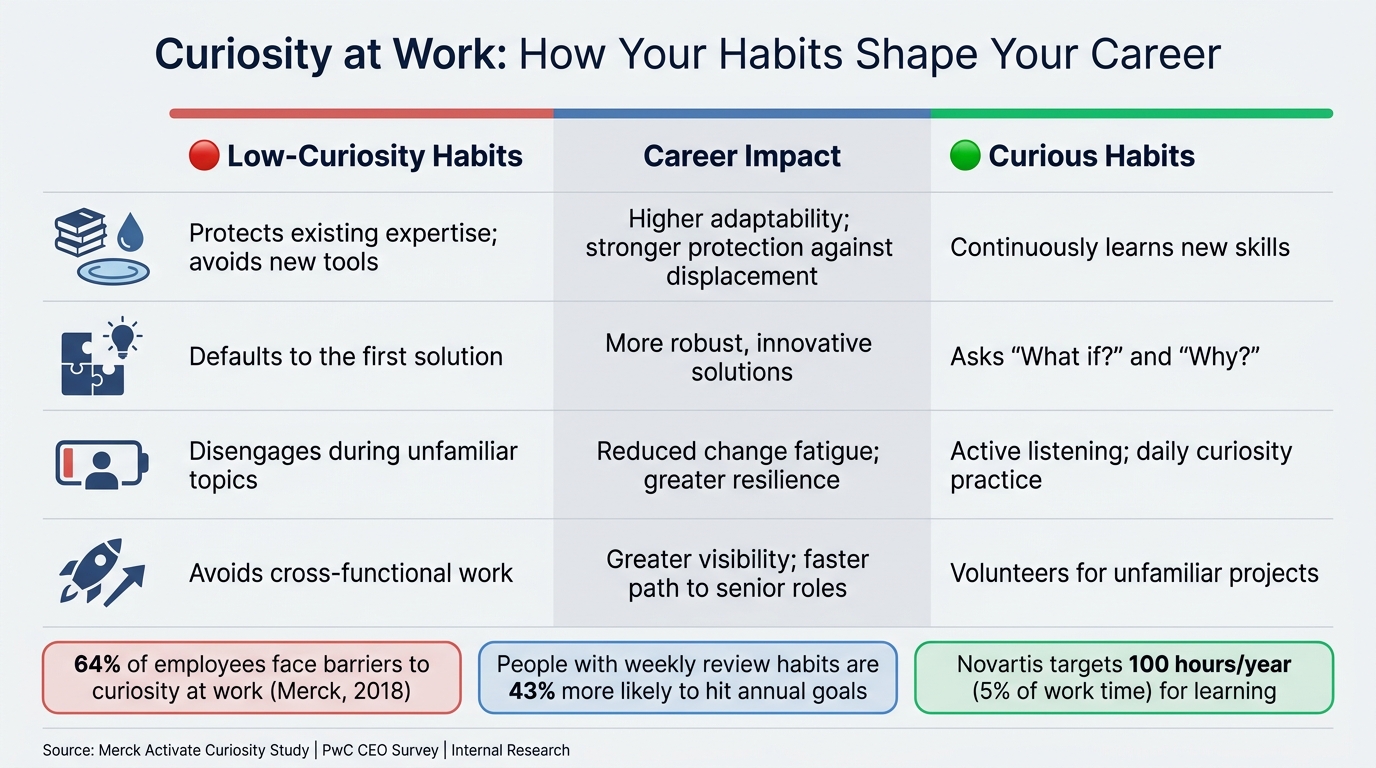
Curiosity at Work: Low vs. High Curiosity Habits and Their Career Impact
Skill stagnation, weaker problem-solving, and lower engagement
Low curiosity can turn hard-won experience into a dead end. Work changes. Tools change. Expectations change too. But when someone assumes, I already know enough, learning starts to stall. Existing expertise can feel safe, but that comfort often pushes new knowledge to the side. As workflows shift, the gap gets bigger.
The cost goes beyond slower learning. It can also weaken judgment, problem-solving, and adaptability.
Problem-solving tends to slip in the same way. People with low-curiosity habits often grab the first answer they see instead of looking for a better one [2]. At first, that may seem efficient. Over time, though, it leads to the same surface-level fixes again and again.
Engagement can drop too. When unfamiliar topics come up, low-curiosity workers often pull back instead of leaning in [3]. That pattern can feed change fatigue [1]. And once that cycle starts, work can begin to feel narrower, flatter, and harder to grow from.
Missed promotions and mobility
Those same habits shape who gets picked for bigger opportunities. People who avoid cross-functional work or unfamiliar projects are often less visible to leaders. Out of sight usually means out of mind.
That matters because leaders are paying attention to mindset, not just output. A PwC survey of 1,300 CEOs across 77 countries found that curiosity and open-mindedness are increasingly critical leadership traits [3].
You can see these patterns in day-to-day behavior:
Low-curiosity behaviors vs. curious behaviors: a comparison
| Career Problem | Low-Curiosity Behavior | Curious Habit | Career Impact |
|---|---|---|---|
| Skill Stagnation | Protecting existing expertise; avoiding new tools | Continuing to learn new skills | Higher adaptability; stronger protection against displacement [1][3] |
| Weak Problem-Solving | Defaulting to the first solution | Asking "What if?" and "Why?" | More robust, innovative solutions [2] |
| Lower Engagement | Disengaging during unfamiliar topics | Active listening; daily curiosity practice | Reduced change fatigue; greater resilience [1][3] |
| Missed Promotions | Avoiding cross-functional work | Volunteering for unfamiliar projects | Greater visibility; faster path to senior roles [3] |
Why curiosity improves learning and career value
Curiosity does more than signal interest. It helps people learn faster and stay useful as work changes.
How curiosity drives faster skill growth
Curiosity speeds up learning because interest sharpens attention and helps new information stick. People who are curious also bounce back from mistakes more easily. They see errors as data, not proof that they failed.
Microsoft offers a clear example. Under CEO Satya Nadella, the company began moving from a competitive "know-it-all" culture to a "learn-it-all" culture in 2014. Over the next decade, its market capitalization grew from $300 billion to more than $3 trillion [5].
That shift lines up with what many employers now want. Top global companies treat learnability as a main sign of career potential and future employability [3]. In plain English: employers care not only about what you know now, but also about how fast you can learn what comes next.
How curiosity helps people adapt and contribute new ideas
That edge matters even more when things feel uncertain. Curious people are more likely to adjust instead of freezing up.
Curiosity can help move attention away from fear and toward problem-solving. Merck’s "Activate Curiosity" pilot used curiosity tools across 10 cross-functional teams to support innovation and problem-solving [1].
"Instead of something vague and inchoate like a state of mind, we soon started to think of curiosity as a process." - Christine Blum-Heuser, Senior Manager for Brand Communication, Merck [1]
Researchers also list curiosity as one of four human skills - alongside consciousness, creativity, and collaboration - that can help protect workers from displacement by AI and machine learning [3]. As routine tasks become automated, curiosity helps people stay relevant by asking better questions and linking ideas that others might miss.
The next step is turning that edge into a weekly practice.
How to build curiosity into your workweek
Ask better questions and use feedback as data
Curiosity shows up in the questions you ask and in what you do with feedback.
Before your next meeting, jot down two or three questions that start with "Why", "How", or "What if" [2]. That small step pushes you past surface-level discussion. You walk in with sharper questions, and people start to see you as someone who thinks ahead and spots problems before they grow.
Feedback works the same way. Instead of taking it as a personal hit, treat it like data. Look for patterns. Is the same gap showing up in more than one review? Is there a skill you keep bumping into that you haven’t built yet? A structured weekly review helps you separate outside roadblocks from skill gaps and turn setbacks into clear next steps [6]. That shows coachability and leadership maturity.
These habits do more than sound good on paper. They work best when they become part of your weekly rhythm.
Set up a simple weekly learning routine
Once curiosity turns into a question habit, a simple routine keeps it alive. Novartis set a company-wide goal for employees to spend 5% of their working time - about 100 hours per year - on learning and curiosity [1]. That’s a useful benchmark. Small routines can build the learnability employers want to see.
A simple setup can look like this:
- Block 10–15 minutes a day for one question or one article outside your field [2][4]
- Add a 15-minute weekly review to look at wins, setbacks, and next steps [6]
That may not sound like much, but it adds up. Individuals who conduct structured weekly reviews are 43% more likely to achieve their annual goals [6].
The point isn’t to make your calendar look busy. The point is to change behavior, one week at a time.
Curiosity habits and their career outcomes: a comparison
| Strategy | Key Actions | Short-Term Impact | Long-Term Career Outcome |
|---|---|---|---|
| Question-First Meetings | Prepare 3 "What if" or "How" questions before each meeting [2] | Surfaces hidden risks and new ideas | Recognition as a strategic thinker and problem-solver |
| Feedback Integration | Treat feedback as data to spot skill gaps | Less defensiveness | Promotion readiness through coachability and leadership maturity |
| Micro-Learning Blocks | Spend 10–15 minutes daily reading outside your field [4] | Faster acquisition of new skills and less boredom | Broader skills and stronger adaptability [3] |
| Weekly Review Practice | 15-minute wins review to extract lessons from setbacks [6] | Reduced stress and quicker course correction | Faster course correction |
How to build a work environment that keeps curiosity going
How to find or shape a team that supports curiosity
Personal habits matter. But they hit a wall in places that reward output and shut down questions. Strict supervision and weak communication between teams are some of the most common blockers. That isn't a personal failure. It's a structural issue.
Curiosity grows in teams where people feel safe taking risks, saying "I don't know", and asking questions without worrying they'll be judged. Managers play a big part here. When they ask, "What did you try?" and "What did you learn?", they send a clear message: learning counts, not just output.
Teams that back curiosity also leave space to pause and think. Short retrospectives can turn mistakes into shared knowledge. And "Yes, and…" helps ideas keep moving instead of getting shut down too early. If you have any say in how meetings run, push for question-first meetings and time set aside for learning.
If the culture around you won't budge, be selective where you can. Look for managers who coach, projects where you have real ownership, and teams that give you room to learn. That shift can turn curiosity from a personal habit into something the whole team does again and again.
Conclusion: Curiosity as a repeatable habit for career growth
Low curiosity rarely shows up in obvious ways. It tends to appear quietly: avoided feedback, skipped learning, and comfort zones that keep getting smaller. Over time, that can slow growth and shrink your options.
Curiosity is a career engine. It helps build innovation, resilience, and long-term learning.
Sometimes the change starts small. A few better questions. A weekly reflection. Team habits that reward learning. When curiosity becomes part of the environment, it stops feeling like a personality trait you either have or you don't. It becomes a repeatable habit that keeps your career moving forward.
FAQs
How do I show curiosity at work without seeming unprepared?
Ask focused, specific questions instead of broad ones. That usually leads to better answers and keeps the conversation on track.
Before a meeting, write down one assumption you haven’t tested yet. It’s a simple habit, but it helps your questions stay clear and tied to what matters.
If you’re missing information, say that plainly and ask for help. For example:
"Can you explain that to me?"
You can also share your own questions first. That makes it easier for other people to admit they’re unsure too, and it shows active engagement rather than poor preparation.
What if my manager discourages questions or experimentation?
Use low-risk ways to stay curious on purpose. One simple move is micro-curiosity: ask one new question each day, check your own assumptions in private, and shape questions around avoiding errors or making better decisions.
Keep the stakes small. Run 1 percent experiments that are easy to reverse and tied to clear success metrics. And when you ask questions, aim below the surface. Don’t just look for small tweaks. Look for the root problem.
How can I build curiosity if I feel stuck or burned out?
Start with self-compassion. Burnout usually means your mind is carrying too much, not that you’ve failed.
So instead of pushing harder, make things easier. Lower the mental load with micro-curiosity.
That can be as small as asking yourself one new question each day, spending 10 minutes away from screens, or taking one tiny step, like writing a single sentence or just opening the document. It may feel almost too small to matter. But that’s the point.
These low-pressure habits can help you get moving again and reconnect with your sense of growth at work.


