

High-Speed Rail in Europe: What Travelers Need to Know
City-center high-speed trains beat short flights for 2-6 hour trips—book early, reserve seats, and mind luggage and arrival times.


If your trip is about 2 to 6 hours between major cities, I’d usually pick the train over a short flight. In many cases, it’s faster from door to door, starts and ends in the city center, and cuts out airport lines, baggage claim, and long transfers.
Here’s the short version:
- Best rail trips: direct routes like London–Paris (2h 16m), Paris–Lyon (~2h), Madrid–Barcelona (~2h 30m), and Rome–Milan (~3h)
- Best booking move: I’d book 3 to 6 months ahead for the lowest fares, which can start around $22 to $65
- When passes make sense: mostly if you want flexibility across several countries
- What many people miss: high-speed trains in France, Italy, Spain, and on Eurostar often need seat reservations, even with a rail pass
- When night trains fit better: trips over about 8 to 10 hours, like Vienna–Venice
- When to arrive: about 15 to 30 minutes early for most trains, 60 to 90 minutes for Eurostar, and 20 to 30 minutes for Spanish high-speed rail with security screening
- Bag rules: you usually carry your own luggage on and off the train, with fewer fees than flying
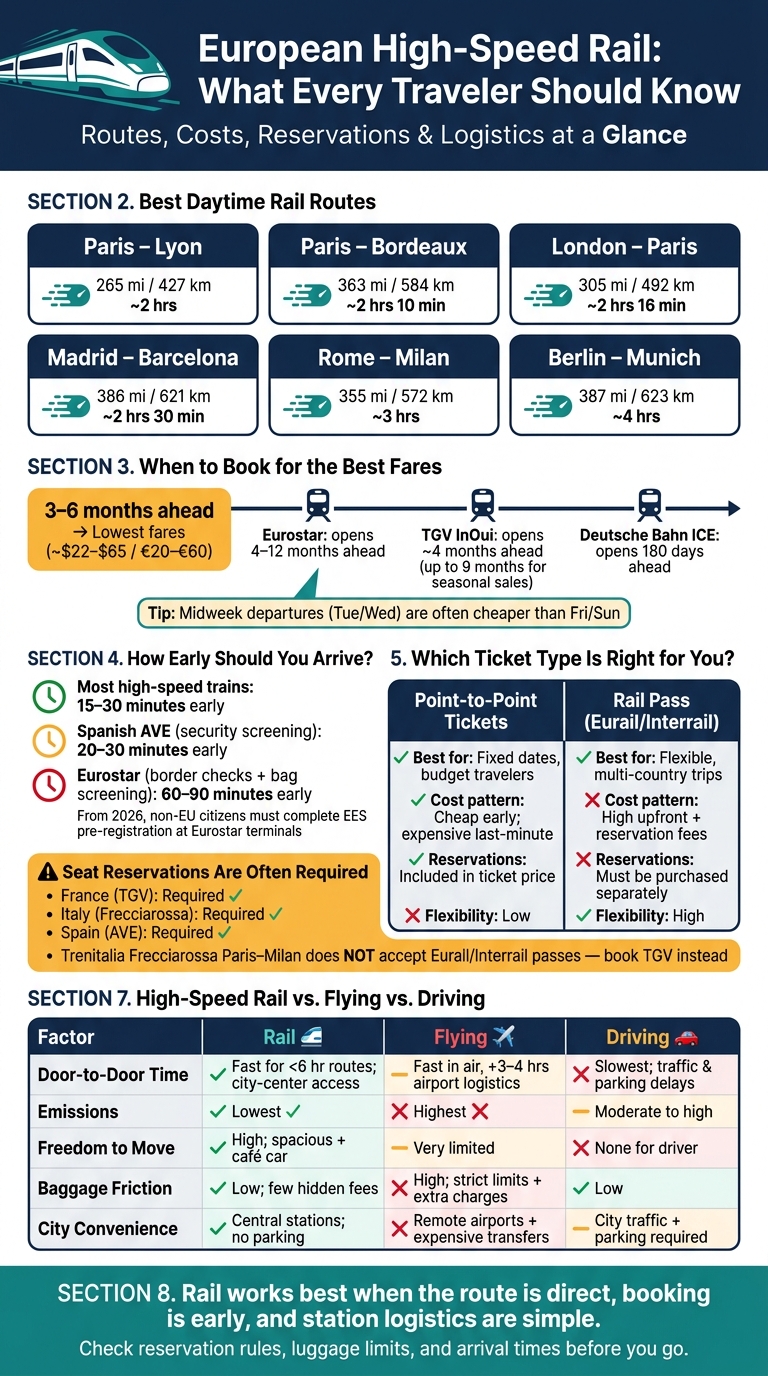
European High-Speed Rail vs. Flying vs. Driving: The Complete Traveler's Comparison
Europe’s €345BN High-Speed Rail Plan
Quick Comparison
| Topic | Best Rule of Thumb |
|---|---|
| Route length | Pick rail for direct trips under 6 hours |
| Long trips | Consider a night train after 8–10 hours |
| Tickets vs. passes | Fixed plans: point-to-point tickets; flexible plans: rail pass |
| Reservations | Often required on many high-speed routes |
| Stations | Big time saver because they’re usually in the city center |
| Main downside | Too many connections can wipe out rail’s time edge |
I’d sum it up like this: European high-speed rail works best when the route is direct, the booking is early, and the station logistics are simple. If you check reservation rules, luggage limits, and arrival times before you go, train travel across Europe is often the easier choice.
Planning Routes Across Major European Rail Corridors
Best Daytime City Pairs
The strongest daytime rail routes are direct, city-center to city-center trips that take about 2 to 6 hours. Start with the route itself. Then decide whether a day train, night train, or flight makes the most sense. The main filters are simple: direct service, under 6 hours, and no airport shuffle.
| Route | Distance | Travel Time |
|---|---|---|
| Paris – Lyon | 265 miles (427 km) | ~2 hrs |
| Paris – Bordeaux | 363 miles (584 km) | ~2 hrs 10 min |
| Madrid – Barcelona | 386 miles (621 km) | ~2 hrs 30 min |
| Rome – Milan | 355 miles (572 km) | ~3 hrs |
| London – Paris | 305 miles (492 km) | ~2 hrs 16 min |
| Berlin – Munich | 387 miles (623 km) | ~4 hrs |
Why do these routes work so well? They stay direct and skip the usual airport hassle. You leave from the middle of one city and arrive in the middle of another.
Paris deserves extra care here. It’s a major transfer hub with six stations [2]. If your trip includes a change, route choice can matter more than raw speed. And if you need to switch stations in Paris, give yourself at least 60–90 minutes to make the transfer by Metro [2][5].
When Cross-Border Trains and Night Trains Make More Sense
Cross-border high-speed trains work best on direct links, like London to Paris or Paris to Barcelona [1][4]. The Paris to Barcelona TGV/AVE runs 667 miles (1,073 km) in about 6 hours and 45 minutes [4], and advance fares can start at around $43 [4]. That’s a long ride, sure, but still simple because it stays direct.
Once a trip stretches past 8–10 hours, a night train is often the smarter pick [1]. You travel while you sleep and cut out a hotel night at the same time. Two names worth knowing are ÖBB Nightjet and European Sleeper. Nightjet runs Vienna to Venice overnight in about 10–12 hours [1]. European Sleeper has also expanded its Brussels to Prague service, with stops in Berlin and Dresden [1].
This is where train planning can go sideways: too many changes. A route with several connections can eat up the main edge rail usually has. For example, London to Rome takes 14.5+ hours and includes three changes - Paris, Turin, and Milan - while a flight takes about 2.5 hours [5].
Day Trains vs. Night Trains: Side-by-Side Comparison
| Feature | Day High-Speed Train | Night/Sleeper Train |
|---|---|---|
| Typical trip length | 2–5 hours | 8–14+ hours |
| Seat or sleeper options | Standard seats | Seats, couchettes (4–6 berths), or private sleepers (1–3 berths) |
| Sleep quality | N/A | Moderate in couchettes; higher in private sleepers |
| Hotel-night savings | None | Saves one night of accommodation |
| Best use case | Fast travel between nearby hubs | Long cross-border trips where daytime travel is impractical |
If privacy matters, go for a private sleeper instead of a couchette. On Nightjet, private sleepers often come with a washbasin and more space from other passengers, while couchettes usually have 4–6 berths [1]. On the Vienna to Venice route, prices run from about $43 for a seat up to $161 for a private sleeper [1].
Once you’ve chosen the corridor, the next thing to check is fare structure and reservation rules before you book.
sbb-itb-3d8e4fc
Buying Tickets, Rail Passes, and Seat Reservations
After you pick your route, the next thing that shapes your total cost is simple: ticket type and reservation rules.
This is where a lot of travelers get tripped up. A rail pass can look like the easy option, but once reservation fees enter the picture, the math can change fast.
When Point-to-Point Tickets Beat Passes
If your dates are set and you're only traveling between a handful of cities, point-to-point tickets usually cost less than a rail pass. That’s even more true if you book early.
The lowest fares often appear about 3 to 6 months before departure, and they can drop to around €20–€60 ($22–$65). As seats fill up and your travel date gets closer, prices tend to climb. [9][10]
Booking windows depend on the train operator:
- Eurostar tickets can open 4 to 12 months ahead
- TGV INOUI usually opens around 4 months ahead, and sometimes up to 9 months for seasonal sales
- Deutsche Bahn ICE tickets open 180 days ahead [9][10]
A good rule of thumb: book 3 to 6 months ahead. Midweek departures, especially Tuesday and Wednesday, are often cheaper than Friday or Sunday trains. [9][10]
Where Reservations Are Required and How to Add Them
One of the biggest mistakes travelers make is thinking a rail pass is all they need.
It isn’t.
A rail pass covers the base trip, but many high-speed trains still require a separate seat reservation. In France, Italy, and Spain, reservations are required on almost all high-speed services, including TGV, Frecciarossa, and AVE, whether you have a pass or a regular ticket. Eurostar also requires a reservation. If you board without one, you could face fines or even lose your pass. [7][8][11]
Some cross-border routes come with tighter pass rules. For example, the Trenitalia Frecciarossa route between Paris and Milan does not accept Eurail or Interrail passes. On that route, you’ll need to book the French TGV instead. It’s usually smartest to book through the official operator website or app so you can avoid extra fees and keep seat choices easier to handle. [10][11][12]
Rail Passes vs. Point-to-Point Tickets: Side-by-Side Comparison
| Feature | Point-to-Point Tickets | Rail Passes (Eurail/Interrail) |
|---|---|---|
| Best traveler type | Fixed dates, budget-focused, short list of routes | Spontaneous travelers or multi-country tours |
| Typical cost pattern | Cheap early; expensive last-minute | High upfront cost plus separate reservation fees |
| Reservation requirements | Included in the ticket price for high-speed trains | Must be purchased separately for most high-speed and night trains |
| Trip flexibility | Low; tied to a specific train and time | High; useful for flexible regional travel |
Onboard Experience, Luggage Rules, and Station Logistics
With your tickets sorted, the next part is the station routine. For most trips, that comes down to three things: boarding, bags, and timing.
What to Expect Once You Board
Most high-speed trains have Standard and First Class. Eurostar uses Standard, Plus, and Premier. On many newer trains, you’ll also find power outlets and free Wi-Fi. Most have a cafe car that any passenger can use.
One big difference from flying: you handle your own luggage the whole time. There’s no baggage claim at the other end. You bring your bags onto the train, store them yourself, and take them off when you arrive. Bags usually go in overhead racks, end-of-car racks, or in the space between seat backs. [13]
Tag every bag with your full name. Eurostar and French SNCF trains require this. [13] It’s also smart to keep your passport, electronics, and wallet in a small bag at your seat instead of putting them in the larger racks at the end of the car. [13][16]
Luggage Limits, Security Checks, and How Early to Arrive
On most routes, arriving 15 to 30 minutes early is enough. In many cases, you just show up, scan your ticket, and get on the train. [14]
There are two main exceptions.
Eurostar needs more time because of border checks and bag screening, so plan for 60 to 90 minutes. [10] Starting in 2026, non-EU citizens must also complete Schengen Entry-Exit System (EES) pre-registration at station terminals on the day of travel, including fingerprints and a photo. [10]
Spanish high-speed trains work a bit differently too. They require X-ray screening before you reach the platform, and boarding closes 2 minutes before departure. [15]
Luggage Policies by Operator: Side-by-Side Comparison
The biggest difference between operators is usually baggage size rules, not whether bags are allowed at all.
| Operator | Bags Allowed | Size Limits | Weight Limit | Recommended Arrival |
|---|---|---|---|---|
| Eurostar | 2 large + 1 hand luggage | Max 85 cm (33.5 in) in any dimension | No strict limit | 60–90 mins [10] |
| TGV InOui (SNCF) | 2 large bags + 1 small bag | Large: 70 x 90 x 50 cm (27.6 x 35.4 x 19.7 in) | Must be carryable | 15–20 mins [16] |
| Renfe (AVE) | Up to 3 items total | Total dimensions under 290 cm (114 in) | 25 kg (55 lbs) total | 20–30 mins for security [15] |
| Ouigo / Avlo | 1 cabin bag + 1 handbag | Cabin bag: 55 x 35 x 25 cm (21.7 x 13.8 x 9.8 in) | No strict limit | About 30 mins [16] |
Once you know the boarding routine, it gets much easier to judge whether rail makes sense on price, not just convenience.
Costs, Emissions, and Final Takeaways
Why High-Speed Rail Is Often the Lower-Hassle Option
After fares and reservations, the next thing that matters is overall value: cost, time, comfort, and emissions.
Ticket price is only one piece of the puzzle. Once you add airport transfers, parking, bag fees, and time spent getting through security, flying can cost more than it first seems. Train stations are usually in city centers, so you skip the drag of far-off airports and long transfers. On shorter routes, rail can match or even beat flying when you count the full door-to-door trip. The Eurostar, for example, connects London to Paris in 2 hours and 15 minutes - often faster than the total trip by air once airport logistics are added in. [1]
High-speed rail also produces much less carbon per passenger than short-haul flights, which makes it the lower-emissions option for travelers who weigh climate impact in their choice. [6][17]
High-Speed Rail vs. Air vs. Car: Side-by-Side Comparison
Use this quick comparison to choose between rail, air, and driving.
| Factor | High-Speed Rail | Flying | Driving |
|---|---|---|---|
| Door-to-Door Time | Efficient for many shorter trips; city-center access [5][3] | Faster in the air, but adds 3–4 hours for airport logistics [5] | Slowest for long distances; subject to traffic and parking delays [3] |
| Emissions | Lowest; primary sustainable travel choice [6][17] | Highest per passenger | Moderate to high |
| Ability to Move Around | High; spacious seats and café cars [6] | Very limited; cramped cabins | None for the driver |
| Baggage Friction | Low; generous limits and few hidden fees [17] | High; strict weight limits and extra charges [17] | Low; limited only by vehicle size |
| City-Center Convenience | Stations in city centers; no parking needed [5][3] | Remote airports; requires expensive transfers | Flexible but requires navigating city traffic and parking [3] |
Conclusion: Key Booking Rules
Book early, reserve seats, and check luggage rules. A Madrid–Barcelona AVE ticket can start at €17 and jump to four times that price closer to departure. Most high-speed trains require reservations, and peak dates sell out early. [15][18]
Before you travel, confirm luggage rules for your operator, since policies vary. Arrive 90 minutes early for Eurostar, 20–30 minutes early for Spanish AVE security, and 15–20 minutes early for most other high-speed trains. On split-service trains, make sure your carriage goes to your destination. [18]
If you stick to routes built around the major rail corridors, high-speed rail is often one of the most efficient, low-friction ways to get across Europe.
FAQs
Is a rail pass worth it for my trip?
It depends on your itinerary and how you like to travel. A rail pass can be a good deal if you plan to visit several countries or cities within a set time frame and want the freedom to change plans along the way.
That said, there’s a catch: many high-speed, long-distance, and night trains charge a separate seat reservation fee. So before you buy a pass, compare the total pass cost with individual point-to-point tickets for your route.
How far in advance should I book high-speed rail tickets?
The available information does not say how far ahead you should book high-speed rail tickets in Europe.
For the best timing, check the rail operator’s booking details.
When should I fly instead of taking the train?
Fly when the train trip is much longer, involves a few messy transfers, or simply doesn’t have a direct route.
Take London to Rome. By train, the trip can take 14.5 hours and require three station changes. By air, it’s about 2.5 hours.
That’s a huge gap.
If the rail option would leave you juggling connections, switching stations, and burning most of a day on the move, a short-haul flight may make more sense.


