

How Feedback Drives Lifelong Learning
Small, focused feedback loops turn daily experience into real expertise—ask, reflect, adjust, and repeat.


Feedback turns effort into improvement. If I don’t check what’s working and what’s off, I can spend weeks repeating the same mistakes.
Here’s the short version:
- I use a simple loop: ask, reflect, adjust
- I ask for input on one clear skill, not a broad topic
- I treat feedback like information about behavior, not a label about who I am
- I do short reviews so lessons don’t fade; people can forget 50% of new information within an hour and about 90% within a week if they don’t review it
- I compare input from myself, peers, managers, mentors, and clients before making a big change
- I keep the habit small, because it can take about 66 days for a new routine to feel automatic
- I remember that weekly reflection can improve performance by 25% compared with monthly review or no review
What helps most is keeping the process simple:
- Ask: “Was my opener clear?”
- Reflect: What went well? What missed?
- Adjust: What will I do differently next time?
I also look for specific examples. Comments like “good job” or “do better” don’t give me a next step. But a note like “slow down in the first minute” does.
When I make feedback part of daily or weekly review, learning stops being random. It becomes a repeatable habit. That’s the core idea of this article.
The Power of Reflection: How Thinking Improves Learning & Performance - ft. Giada Di Stefano
sbb-itb-3d8e4fc
Build a Feedback-Ready Mindset and Routine
The next step is to make the collect-reflect-act loop almost automatic. Getting feedback is only half of it. The other half is being ready to use it. Treat feedback like data, not judgment.
Respond to Feedback With a Growth Mindset, Not an Instant Reaction
That first moment after critical input is where people often lose the upside. Feedback can land like personal criticism when it hits competence or self-worth, so it's easy to get guarded. One simple move helps: pause for 10 seconds and take a breath before you answer. That short gap gives you room to shift from an instant reaction to a more deliberate response, with the focus on behavior instead of identity.
Separate the feedback from your reaction to the person giving it.
Process-based feedback - comments tied to your effort, preparation, or approach - tends to support a growth mindset. Personality-based criticism, such as "you're not a strong presenter", pushes in the other direction and can make people hold back. If feedback is vague or centered on personality, ask yourself what behavior or strategy it actually points to.
Once the first reaction settles, make the question narrower.
Set Specific Learning Targets Before Asking for Input
Ask for feedback on one clear skill or behavior, like your presentation opener. A focused question such as "Was the presentation opener clear?" gives the other person something concrete to respond to. A broad question like "What do you think of my communication?" usually leads nowhere useful.
This also changes how feedback feels. When you ask for input on a clear goal, the response becomes a data point for something you're already working on, not a surprise judgment.
After you name the target, set a regular time to review it.
Build Small Feedback Habits Into Your Day
Tie the review to something you already do so feedback becomes part of your day, not a separate project. For example: "After I close my laptop for the day, I'll spend 5 minutes reviewing what I learned." If you want a weekly rhythm, a 15-minute Friday review with the Plus-Minus-Next framework works well: write down what went well (Plus), what didn't (Minus), and one clear adjustment for Monday (Next).
Use a simple routine so feedback becomes part of the day, not a separate project.
| Review Routine | Frequency | Duration | Core Focus |
|---|---|---|---|
| Daily Review | End of day | 5 minutes | Immediate wins and tactical errors |
| Friday Post-Mortem | Weekly | 15 minutes | Pattern recognition and planning for the next week |
| Project Debrief | End of project | 30 minutes | Process improvement and what to do differently |
How to Give and Receive Feedback That Actually Works
Once feedback becomes part of your routine, the next move is making it useful in actual conversation.
Good feedback is clear, specific, and actionable. Poorly delivered feedback can do the opposite of what you want and hurt performance instead of improving it. The key is simple: talk about the behavior, not the person.
Pick a Simple Feedback Framework
A simple framework keeps feedback from turning into a ramble or a personal jab. Use SBI for work tasks, OSBD for sensitive conversations, and Feedforward for fast, future-focused coaching.
| Framework | Best Use Case | Strengths | Limitations |
|---|---|---|---|
| SBI | Professional deliverables; behavioral adjustments | Specific; removes character judgment | Can feel mechanical without relational warmth |
| OSBD | Sensitive or emotional situations | Respectful; focuses on needs | Requires high emotional intelligence to execute well |
| Feedforward | Fast-paced environments; creative brainstorming | Energizing; reduces defensiveness | Doesn't address the root cause of past errors |
How to Receive Feedback Without Shutting Down
The framework matters less than how you hear the input and what you do with it.
The hardest moment is usually your first reaction. If someone says something that stings, pause. Separate the feedback from your feelings about the person giving it. Then name the trigger: truth, relationship, or identity. That small step helps you respond instead of react.
From there, keep it simple:
- Listen all the way through.
- Reflect back what you heard before you answer.
- Ask for one specific example if the feedback is vague.
After you make the change, follow up with the same person and check whether the result is what they meant. That closes the loop.
Use Peer and Mentor Input to Improve Faster
Trusted peers, mentors, and coaches can spot blind spots much faster than self-reflection alone. Google's Project Aristotle, launched in 2012, analyzed 180 teams and found that psychological safety - the ability to give and receive feedback without fear of punishment - was the single strongest predictor of team effectiveness, outweighing individual talent or experience [3][4]. As Amy Edmondson, Professor at Harvard Business School, explains:
"Psychological safety doesn't mean comfort - it means a willingness to take interpersonal risk without fear of retribution." [4]
That idea shows up in small moments. A focused ask like "Can you watch how I open the meeting and tell me if the framing is clear?" gives you much better input than a broad "What do you think?" It gives the other person something concrete to watch for, and it gives you feedback you can use right away.
Over time, those small check-ins can become a personal feedback loop you can track and learn from.
Build Personal Feedback Loops for Skill and Career Growth
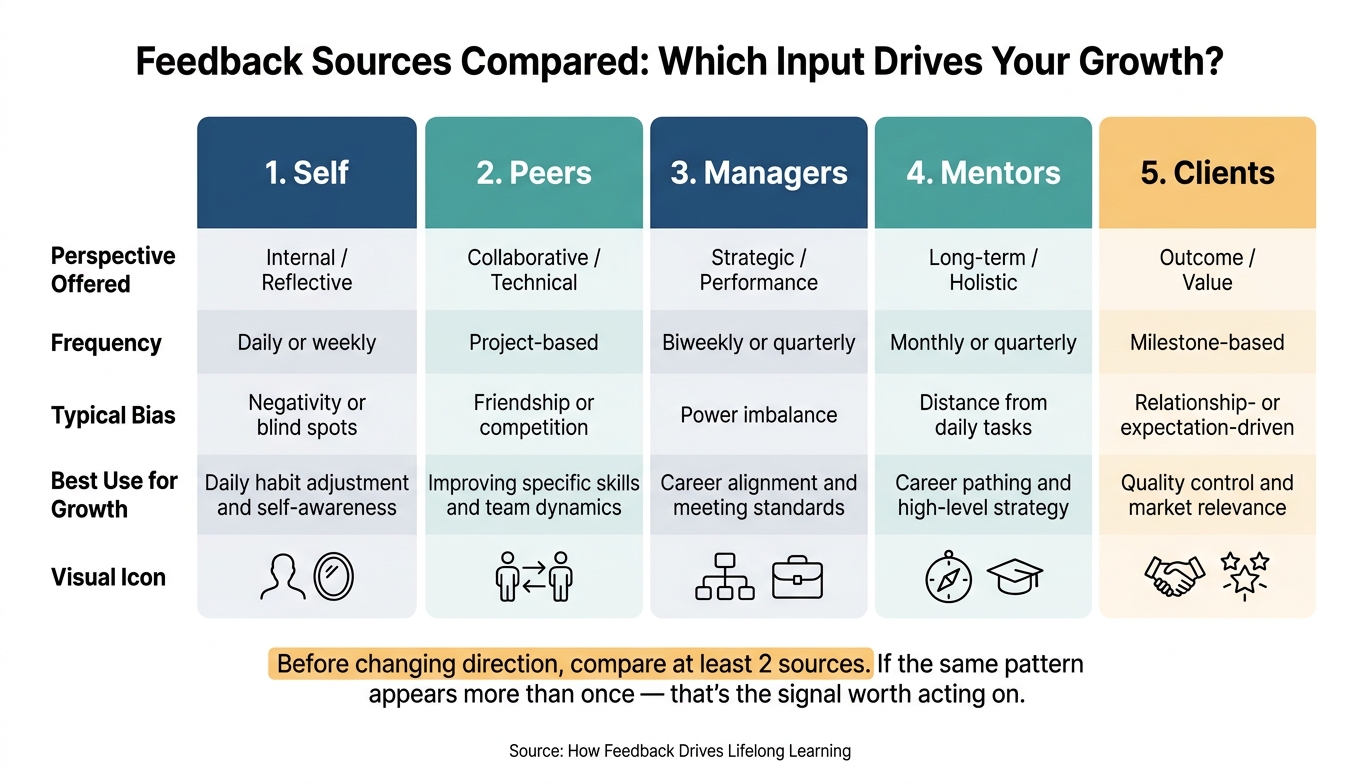
Feedback Sources Compared: Which Input Drives Your Growth?
Once feedback becomes part of your routine, the next step is simple: save it before it slips away. A personal feedback loop helps you hold onto what you learn and turn random comments into a steady pattern of growth.
Pair Self-Reflection With Outside Input
Self-reflection helps, but it has limits. Most of us notice the things that already fit the story we tell ourselves. That’s why outside input matters. It shows you what you miss.
In your weekly review, write down Plus, Minus, and Next. Then line that up with input from a manager, peer, or client. Look at where your view matches theirs and where it doesn’t. Those gaps can be the most useful part, because they show you what to work on.
"Experience only turns into expertise because we capture it. Without a system to trap our lessons, we repeat the same mistakes." - Keith Williams, Founder, Nom@d Learning [1]
Write your reflections in whatever format you’ll actually return to. A doc, notebook, or voice note all work. Then save a short summary in a searchable notes app so you can find it later without digging through old files.
Track Your Progress With Simple Tools
You don’t need a fancy setup. Put the review on your calendar. Then log each completed review in a basic habit tracker. The goal is to make the practice feel automatic, like brushing your teeth instead of making a big decision every week.
Employees who reflect weekly on their goals improve their performance by 25% over those who review monthly or not at all [5]. It also takes an average of 66 days for a new habit to become automatic [2]. That means the first two months matter most, so guard that window.
Compare Feedback Sources Before Relying on Just One
No one source gives the whole story. Every kind of feedback comes with its own slant. A manager may look at your work through results and standards. A peer notices how you work day to day. A mentor may spot patterns across years, not just weeks.
| Feedback Source | Perspective Offered | Frequency | Typical Bias | Best Use for Growth |
|---|---|---|---|---|
| Self | Internal/Reflective | Daily or weekly | Negativity or blind spots | Daily habit adjustment and self-awareness |
| Peers | Collaborative/Technical | Project-based | Friendship or competition | Improving specific skills and team dynamics |
| Managers | Strategic/Performance | Biweekly or quarterly | Power imbalance | Career alignment and meeting standards |
| Mentors | Long-term/Holistic | Monthly or quarterly | Distance from daily tasks | Career pathing and high-level strategy |
| Clients | Outcome/Value | Milestone-based | Relationship- or expectation-driven | Quality control and market relevance |
Before you change direction, compare at least two sources. If the same pattern shows up more than once, that’s usually the signal worth acting on.
Conclusion: Make Feedback a Daily Practice
Lifelong learning grows through small, steady feedback loops. That’s why the cycle of asking, reflecting, and adjusting matters more than any one flash of insight. The ideas in this guide do their best work when you fold them into your normal routine instead of treating them like extra work.
The takeaway is simple: keep the loop small - ask, reflect, adjust. Feedback works best when it becomes part of a steady rhythm. Keep the habit small so it sticks. If a full review feels too big, write two sentences: what changed and what you’ll do next.
The aim is to make feedback feel like a tool, not judgment. When that shift happens, small, repeatable loops turn daily experience into real expertise. Repeat the loop often enough, and everyday feedback turns into lasting skill. Ask, reflect, adjust. Repeat daily.
FAQs
How do I ask for useful feedback?
Ask with clear context, not vague questions like “What do you think?” Spell out your goal, your audience, and any limits you’re working with.
Then say what kind of feedback you want - appreciation, coaching, or evaluation - and ask 3–5 targeted questions. That gives people something concrete to respond to, so you get focused, actionable feedback tied to your success metrics instead of loose opinions.
What if feedback feels personal?
Feedback can sting when it sounds like a verdict on you instead of a comment on the work. That’s when people get guarded, and once that happens, learning gets a lot harder.
A better move is to talk about observable behaviors and the gap between current performance and the project’s requirements. That keeps the discussion grounded in what happened, not in someone’s character. It also helps to keep the tone collaborative and aimed at what happens next, so feedback feels less like personal criticism and more like problem-solving.
How often should I review feedback?
Use a mix of daily and weekly reviews. For daily tasks, spend 5 minutes going over feedback right after you finish the work, while the details are still fresh in your mind.
For bigger goals and long-term progress, block off 15 to 30 minutes each week. The main thing isn't doing a long review every time. It's sticking with a simple routine you can repeat week after week.


