

Time-Sensitive Decision Frameworks Explained
Triage decisions by reversibility, stakes, and time—then pick the lightest framework (OODA, RPD, satisficing, rules) to decide faster and smarter.


When the clock is ticking, I don’t need more options. I need the right level of thinking.
Here’s the short version: I can make better fast decisions by sorting each choice by stakes, reversibility, and time left. Then I use the lightest framework that still fits the situation. That helps me avoid two common mistakes: overthinking small calls and rushing big ones.
A few takeaways stand out:
- Time pressure can hurt accuracy, even when confidence feels high.
- In one study, experts used recognition-primed decisions in 80%+ of decision points in high-pressure settings.
- Short decision reviews can lead to about a 20% gain in decision quality over six months.
- Second-guessing and fatigue can drag decision quality down by as much as 40% by late afternoon.
If I want a simple way to remember the article, it comes down to this:
- Use OODA when facts keep changing.
- Use RPD when I know the domain well and have seen the pattern before.
- Use satisficing when “good enough” is enough.
- Use if-then rules for repeat choices.
- Use the two-way door / one-way door test to decide how much process a choice deserves.
Quick Comparison
| Framework | Best use | Time frame | Main watchout |
|---|---|---|---|
| OODA | Shifting situations | Seconds to minutes | Acting without stopping to orient |
| RPD | Expert judgment under pressure | Seconds | Trusting instinct in unfamiliar areas |
| Satisficing | Low- to mid-stakes choices | Minutes to hours | Chasing the “best” option |
| If-Then Rules | Repeat decisions | Instant | No rule set before pressure hits |
| Two-Way vs. One-Way Door | Reversible vs. hard-to-undo choices | Varies | Treating every choice like it’s permanent |
What I like about this article is that it turns fast decision-making into a simple habit: triage first, decide second, review after.
Decision-Making Under Pressure: 3 Frameworks That Changed My Life
sbb-itb-3d8e4fc
5 Core Frameworks for Fast Decisions
Each framework below fits a different kind of pressure. You don’t need to memorize all five. You just need to spot which one matches the situation in front of you.
The goal is simple: use the lightest framework that still fits the stakes. If a choice doesn’t need a long review, don’t give it one.
OODA Loop for Fast-Moving Situations
OODA stands for Observe, Orient, Decide, Act. Use OODA when the facts keep shifting.
Here’s how it works. First, pay attention to what’s happening now, not what you thought would happen. Next, make sense of that information through your experience and mental models. Then choose a tentative action. After that, act and watch what changes. Then you loop back and do it again.
The biggest mistake with OODA is blowing past the Orient phase. That step matters because it shapes how you read the situation. Your experience and mental models affect what you think you’re seeing. Skip that part, and you’re not reading the situation well - you’re just reacting to noise.
Use OODA when events move faster than one fixed plan can handle. If things are stable and the pattern is familiar, switch to recognition-based judgment instead of looping.
Recognition-Primed Decisions and Fast Heuristics
Recognition-Primed Decision-making (RPD) describes what experienced people do when there’s no time to line up options side by side. They spot a pattern, run a quick mental simulation of a response, and act if it seems like it will work.
Research on fireground commanders found that experts used RPD in over 80% of decision points, rarely comparing multiple options [6].
RPD only works in domains you know well. In time-pressured, low-ambiguity settings, fewer options can lead to better and faster calls. But there’s a catch: this approach belongs in areas where you’ve had repeated experience and clear feedback. If not, intuition can fool you.
When the same choice keeps coming up, don’t lean on expert instinct forever. Turn it into a rule or a checklist.
Satisficing and PDCA for Limited Time and Repeated Choices
Use satisficing for one-off choices and PDCA for repeated ones. In plain English, pick the first option that clears your minimum bar, then review and adjust the next time around. Satisficers often feel less regret because they stop once a choice is good enough [4].
Put together, these two approaches cut mental load on repeated low-stakes choices. That matters more than people think. A lot of bad decisions don’t come from lack of effort - they come from decision fatigue.
Pre-Made Rules and If-Then Triggers for Recurring Pressure
Pre-made rules turn repeated choices into near-automatic responses. You define the trigger, decide on the response ahead of time, and remove the need to debate it in the moment.
If a meeting has no agenda, I decline.
That’s a simple example, but it shows the idea well. Pre-made rules work because they move the choice out of the pressure moment. Set your thresholds when you’re calm and rested, not when Slack is blowing up and your calendar is a mess.
Two-Way Door vs. One-Way Door Decisions
Jeff Bezos formalized this model in Amazon's 2015 Shareholder Letter [3]. Use this lens to decide how much process a choice deserves: reversible decisions should move fast, while hard-to-reverse decisions should slow down.
Before you dig into analysis, ask one question: If this doesn’t work out, how hard is it to change course? That question won’t tell you what to pick. What it does tell you is how much process to use. Think of it as a last check before deciding how much analysis the choice deserves.
| Framework | Best For | Main Risk |
|---|---|---|
| OODA Loop | Fast-changing situations | Skipping the Orient phase |
| RPD / Heuristics | Expert domains or high uncertainty | Using intuition outside your experience |
| Satisficing | Routine, repeated choices | Looking for "perfect" when "good enough" works |
| If-Then Rules | Recurring pressure and interruptions | Not setting rules before pressure hits |
| Two-Way Door | Reversible tactical choices | Treating reversible decisions like permanent ones |
How to Choose the Right Framework
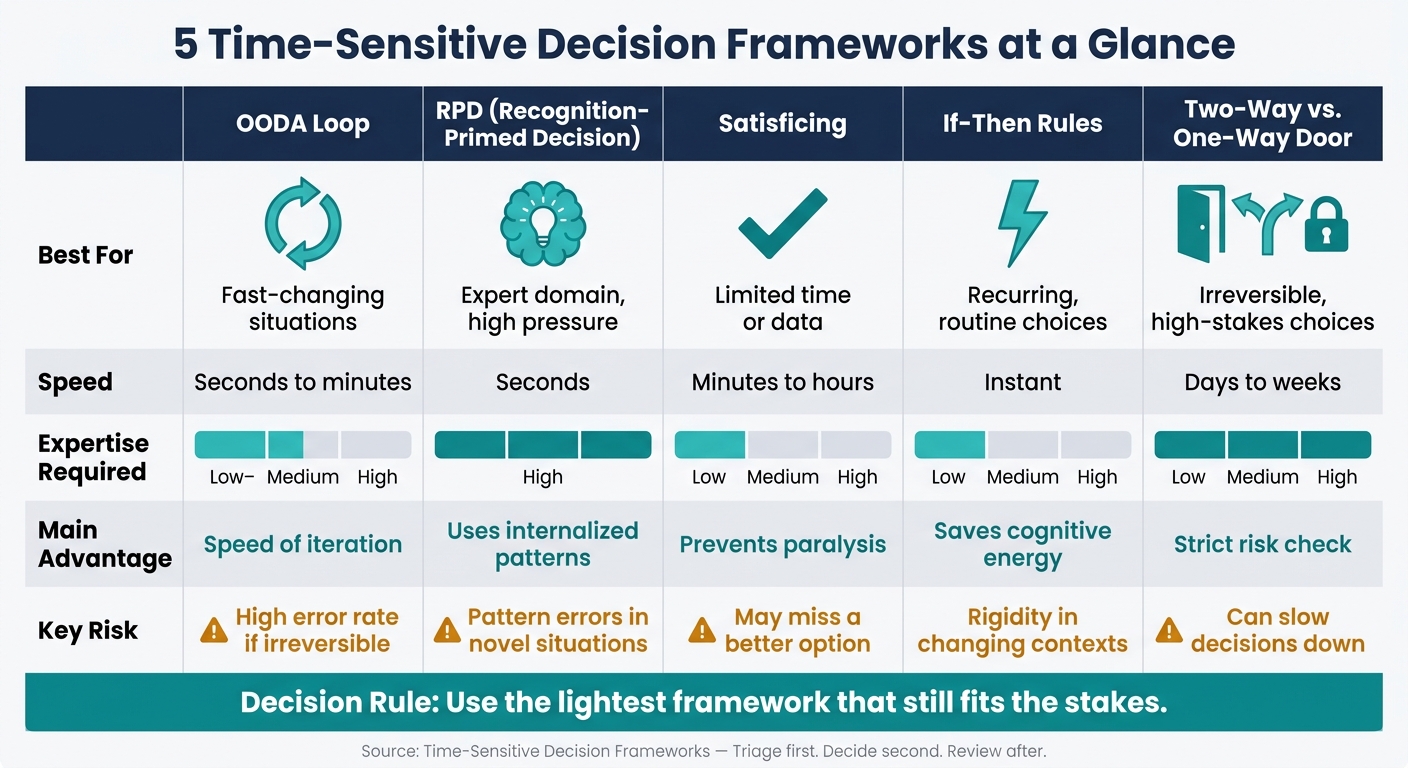
5 Time-Sensitive Decision Frameworks: When & How to Use Each
These frameworks are not interchangeable. Pick the wrong one, and you don't just lose time - you can steer yourself toward a worse result. Before choosing, take 60 seconds and ask four things: How reversible is it? How many variables matter? How long will the consequences last? What does analysis cost? That quick check helps you avoid falling back on whatever feels familiar.
Use Cases by Decision Type
Once you've sorted the decision by reversibility and urgency, use the scenarios below to route it to the right tool.
Reversibility is the first filter. If a decision is easy to undo, use a lighter framework. If it's hard to reverse, slow down and add more structure. From there, look at whether the situation is dynamic or stable, and whether you're working in a domain you know well.
In dynamic situations - where facts shift and iteration speed matters - OODA is the right tool. In stable situations, where the pattern is familiar and your experience is strong, recognition-primed decisions work fast. For routine or recurring choices, if-then rules and satisficing cut mental load when time is tight. For team decisions under deadline, use OODA to keep the group moving and assign one decision owner.
Match decision time to consequence time. A scheduling call doesn't need the same process as a vendor contract.
Framework Comparison Table
| Framework | Best For | Speed | Expertise Required | Main Advantage | Risk |
|---|---|---|---|---|---|
| OODA Loop | Rapidly changing situations | Seconds to minutes | Low to medium | Speed of iteration | High error rate if irreversible |
| RPD | Expert domain, high pressure | Seconds | High | Uses internalized patterns | Pattern-matching errors in novel situations |
| Satisficing | Limited time or data | Minutes to hours | Low | Prevents paralysis | May miss a clearly better option |
| If-Then Rules | Recurring, routine choices | Instant | Low | Saves cognitive energy | Rigidity in changing contexts |
| Two-Way Door / One-Way Door | Irreversible, high-stakes choices | Days to weeks | High | Strict risk check | Can cause organizational slowness |
Use this table to match the shape of the problem before you decide how much analysis to spend.
Decision Routing Table for Common Scenarios
| Decision Type | Stakes | Reversibility | Recommended Framework |
|---|---|---|---|
| Routine scheduling | Low | High | If-Then Rules |
| Same-week budget tradeoff | Medium | High | Satisficing |
| Urgent team coordination | Medium–High | Medium | OODA Loop |
| Expert, high-pressure call | High | Low | RPD |
| Irreversible choice | High | Low | Two-Way Door vs. One-Way Door |
If the scenario still feels fuzzy, start with reversibility, then choose the lightest tool that can still do the job.
Common Mistakes When Picking a Framework
The wrong framework usually breaks down in three ways: it overthinks easy choices, underthinks hard ones, or leans on intuition when experience is thin.
One common mistake is using intuition outside your experience. Intuition works best when you've had repeated feedback in that domain. As psychologist Daniel Kahneman put it:
"The confidence people have in their intuitions is not a reliable guide to their validity." [2]
Pattern recognition holds up only when you've logged real hours and gotten clear feedback. In unfamiliar territory, gut feel is often just guessing dressed up as intuition.
Also watch for the urgency trap - treating every fast-approaching deadline like a high-stakes emergency. Urgency and stakes are not the same. Classify by reversibility first, then decide how much process the choice deserves.
And don't fall into information hoarding. Stop when you have enough information to make a sound call. Waiting for certainty is usually delay, not rigor.
Applying These Frameworks at Work, in Health, and in Daily Life
Picking the right framework is only step one. When you're under pressure, start with three things: Can this be reversed? How high are the stakes? How much time do I have? Then use the lightest tool that still gets the job done. That simple rule plays out a little differently at work, at home, and in emergencies.
Workplace and Team Decisions Under Deadline Pressure
In teams, delay often comes from fuzzy ownership, not a lack of ideas. People talk, circle the issue, and wait for someone else to make the call.
A simple fix: separate discussion from decision-making. The main risk in group settings is stall, so give one person clear ownership. Then match the framework to the speed of the situation:
- Use OODA when facts are changing.
- Use RPD when one expert sees the pattern right away.
- Use satisficing for routine calls that are easy to reverse.
That keeps the team from turning every small choice into a meeting marathon.
Personal Wellness, Home, and Lifestyle Decisions
Most daily wellness choices are low-stakes and easy to undo, so they should move fast.
Satisficing works well as the default. Set a minimum bar - "this meal needs to be reasonably nutritious and ready in under 20 minutes" - then pick the first option that meets it. Satisficers report higher life satisfaction and less regret than maximizers, even when maximizers technically find the objectively "better" option [4].
That same idea works well for other repeat choices. Batch meals, workouts, and chores. Use if-then rules to cut down on repeat decisions. For example:
- If it's a worknight, then dinner comes from the meal prep list.
- If it's 7:00 a.m., then it's time for the planned workout.
- If the sink is full, then run the dishwasher before bed.
For bigger lifestyle calls - like starting a new health routine or making a major home purchase - use the 10-10-10 Rule. Ask how you'll feel about the choice in 10 minutes, 10 months, and 10 years. It helps pull your attention away from short-term discomfort and back to long-term values.
Emergency and High-Stress Situations
When time shrinks, the goal is not deep analysis. The goal is safe execution.
In high-stress situations, keep the process simple. State the decision in one sentence. Check only the facts that affect safety. Pick the best option you have right now. Then give one person ownership and a short action plan.
In a crisis, experienced people often spot a familiar pattern and move at once. That can work well, but only when the situation closely matches prior experience. If it doesn't, that gut call can mislead you.
For safety-critical or medical emergencies, follow official protocols and get professional help immediately.
How to Make Better Fast Decisions Over Time
Fast decisions get better when you review them. Not with a long postmortem every time. Just a short feedback loop that helps your instincts get sharper.
Use Brief After-Action Reviews
After a fast decision, do a quick review so the next call takes less effort. For any decision that matters, write down four things in one pass:
- what happened
- what you decided
- which assumptions failed
- what to use next time, including the framework you used and whether it matched the situation
This works because it helps you spot bad assumptions before they show up again. Professionals who use decision journaling and review their outcomes over six months see a 20% improvement in decision quality [8]. Writing things down also cuts second-guessing [7]. That matters more than most people think. If second-guessing runs wild, decision quality can drop by as much as 40% by the afternoon [8].
If you catch yourself replaying an old call, don't keep chewing on it. Pick one specific time to revisit it later, then leave it alone until then [4].
Build Personal Checklists and Thresholds
When the same kind of pressure keeps showing up, set the rule before the moment hits. That's where this gets practical. Reversibility and stakes should already tell you how much time a choice deserves.
Set your thresholds ahead of time: fully reversible decisions should take less than 60 seconds, reversible but uncomfortable ones 24–72 hours, and permanent or costly decisions 72+ hours [5]. Another smart way to calibrate your judgment is to log major decisions with a confidence score from 0–100%, along with your reasoning and expected outcome [3]. After a while, patterns start to show. You'll see where your confidence lines up with results and where it drifts.
Protect Your Judgment With Short Reset Habits
When stress muddies your thinking, pause before you decide. Stress doesn't just feel bad. It weakens deliberate judgment, which ties straight back to time pressure and decision fatigue.
"Judgment does not fail under pressure because you are weak. It fails because the brain region that carries deliberate decisions is the first thing stress takes offline." - Dr. Sydney Ceruto, Neuroscientist [9]
If you're looping, stalling, or feeling mentally foggy, take that as a signal to reset first, then decide. Don't just push through. A short reset can be simple: identify the key facts, core assumptions, and downside map before you commit [1]. Also, avoid high-stakes calls when you're tired, hungry, dehydrated, or late in the week. Put important decisions in late morning, when focus is usually highest [2].
One simple habit helps here: spend 20 minutes drafting a first answer and three reasons. That starting point can make the final call faster and cleaner.
Conclusion: Build a Repeatable Fast-Decision Habit
The framework matters. But the habit matters just as much.
Fast decisions get better when you match the method to the stakes, the time you have, and your own experience in that area. A small call doesn't need a heavy process. A big one does.
Start with a quick triage: reversible, high-stakes, or time-boxed. Then move. Use the lightest framework that still fits the decision.
The last part is the review. Log your major decisions and look back on them over time. That gives you a clear view of where your judgment is sharp and where it starts to drift. If you changed your mind later, treat that as proof the process is doing its job - not as a failure. The aim isn't perfect speed. It's making the next decision faster and better.
Decide, act, review, repeat. That's how fast decisions improve: with a simple system, not more pressure.
FAQs
How do I choose the right framework fast?
Use the Decision Type Filter in less than 60 seconds. Check three things: is the decision reversible, are the stakes high, and how much time do you have?
For reversible, low-stakes choices, keep it simple. You can use a quick rule like 10-10-10, or pick the first option that meets three core criteria.
For irreversible, high-stakes choices, slow down and use more structure. A weighted decision matrix can help you compare options side by side. A pre-mortem can help you spot what might go wrong before you commit.
Still stuck? Set a hard deadline and choose the first satisfactory option.
When should I trust intuition under pressure?
Lean on intuition under pressure when it rests on deep experience and expertise. People who know a field well can spot patterns and familiar signals fast, which lets them make sound calls without stopping to weigh every option.
In messy, uncertain situations, intuitive judgment can beat overthinking. But that only holds up when intuition comes from knowledge and reflection. Without that base, it slips into impulse or guesswork.
How can I avoid decision fatigue?
Schedule big decisions for the time of day when you have the most energy. Then trim your options with a simple framework that checks each one against your top three to five core values.
If you start to feel overloaded, zoom in on one clear question you can act on. Put a firm deadline on the decision so you don't get stuck overthinking, and satisfice by picking the first option that meets your minimum standards.


