

How to Align Goals Across Remote Departments
Set 1–3 shared outcomes, name one owner per goal, map dependencies, and use a single tracking system plus async updates to keep remote departments aligned.


Remote teams drift when goals, ownership, tracking, and communication are not clear. If you want departments to stay lined up, I’d keep it simple: set 1–3 shared company goals, give each goal one owner, track work in one shared system, and use meetings only for decisions and blockers.
Here’s the short version:
- I’d turn company direction into 3–5 quarterly outcomes that every department can support.
- I’d ask each team to define, in one sentence, how its work helps the company goal.
- I’d map dependencies, handoffs, and decision rights before work starts.
- I’d keep progress visible with weekly async updates using the same status labels and number formats.
- I’d use a simple meeting rhythm: weekly, monthly, and quarterly.
Why does this matter? Because cross-team misalignment can drag output, delay work, and cost a mid-sized team $9,000 to $15,000 per month. And a 25-person team can lose more than 500 hours a month when priorities and handoffs are fuzzy.
A quick way I think about it is this:
| Area | What I’d do | Why it helps |
|---|---|---|
| Goals | Set a small number of shared outcomes | Keeps teams pointed at the same target |
| Ownership | Name one owner and write down support roles | Cuts confusion during handoffs |
| Tracking | Use one dashboard or linked dashboards | Makes progress and blockers visible |
| Communication | Use async updates for visibility, meetings for decisions | Lowers meeting load and saves focus time |
The core idea is simple: make goals small, visible, and shared. When everyone knows what matters, who owns it, and where work stands, remote departments waste less time and miss fewer handoffs.
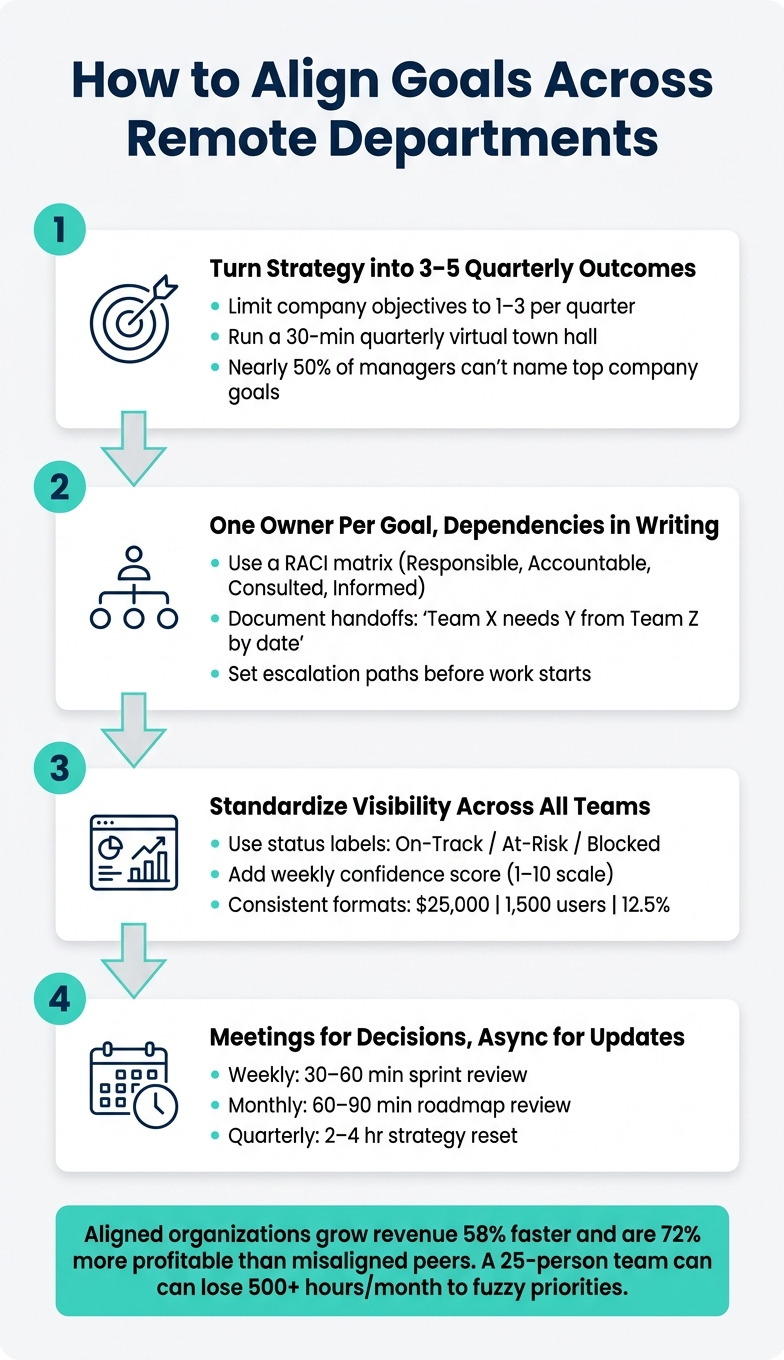
How to Align Remote Teams: 4-Step Framework for Goal Clarity
Using OKRs with Remote Teams to Improve Team Communication and Alignment
sbb-itb-3d8e4fc
1. Turn company strategy into shared goals every department can support
Leaders need to turn company strategy into 3 to 5 quarterly outcomes that each department can get behind. In remote teams, that step matters even more. People need goals they can see, understand, and act on without waiting for a live meeting to clear things up.
A simple place to start: run a 30-minute quarterly virtual town hall where founders define one measurable outcome the team can rally around. That sounds basic, but this step often gets missed. Nearly 50% of managers can't name their company's top strategic goals [6]. If people can't name the goal, they can't line up their work around it.
Once those shared outcomes are clear, the next step is picking the right way to track them.
When to use OKRs, KPIs, and milestones
OKRs, KPIs, and milestones are not the same thing. Each one solves a different problem. When teams blur them together, they end up with goals that look neat in a doc but don't help people coordinate day to day.
| Framework | Best For | Measurability | Fit for Remote Work |
|---|---|---|---|
| OKRs | Strategic outcomes and driving change | High - quantifiable Key Results | Excellent for aligning distributed teams on impact |
| KPIs | Ongoing health and process stability | High - steady-state metrics | Good for monitoring ongoing operations without extra meetings |
| Milestones | Project delivery and specific checkpoints | Binary - Done or Not Done | Critical for mapping cross-department dependencies |
Use OKRs when you're trying to move something in a new direction, like reducing churn, increasing activation, or entering a new segment. Use KPIs when you want to watch what's already in motion, such as monthly recurring revenue or support response time. Use milestones when a team needs to mark a clear checkpoint, like a QA-approved staging release.
Put simply, each framework answers a different question. OKRs show where change should happen. KPIs show whether the engine is running well. Milestones show whether a deliverable is done. Remote teams usually need all three.
Write department goals that connect to shared outcomes
After company-level OKRs are set, each department should write a one-sentence contribution statement that answers: how does our work move this shared outcome? [2] This is where strategy stops being abstract and starts becoming usable.
For example, if the company goal is to reduce churn, the Customer Success team might focus on improving time-to-first-value for new accounts. One sentence like that gives the team a clear link between daily work and the company outcome. It also makes handoffs easier. People can see why their work matters, not just what they're supposed to do.
Keep the number of priorities small. Limit company-level objectives to 1 to 3 per quarter, and let each team own a manageable set of supporting goals [2][6]. Add too many, and you get surface-level alignment: people nod during planning, then scatter during execution.
That kind of clarity gives remote teams one target to work toward before dependencies and tracking start to get messy.
2. Map dependencies, assign ownership, and document decision rights
Once teams share a goal, the next step is simple: make the moving parts plain. Spell out who depends on whom, who gets the final say, and what each handoff needs. Shared goals help, but handoffs are often where work gets stuck.
Surface cross-department dependencies early
Before work starts, do a quick dependency check at kickoff. Ask:
- What does your team need from another team to move forward?
- What does another team need from you?
Write the answers down as written commitments. For example: We need X from Team Y by date Z. That’s much better than letting people rely on memory or guesswork.
A metric map can help here too. It shows how team-level metrics connect to the shared result. Say Engineering tracks page load time and Marketing tracks activation rate. Those may look like separate numbers, but both feed into Weekly Active Users. Once people can see that link, dependencies stop hiding in the background.
Most bottlenecks don’t sit inside one team. They usually show up between teams, in handoffs, reviews, and approval steps that don’t have a named owner.
Assign one owner, supporting teams, and escalation paths
This is where clarity saves a lot of friction. Every shared goal needs exactly one accountable owner [2]. A RACI matrix is a practical way to make that plain. It shows who is Responsible for doing the work, Accountable as the single decision-maker, Consulted for input, and Informed so they stay in the loop [8].
| Goal | Lead Department | Supporting Departments | Owner Title | Tracking Tool |
|---|---|---|---|---|
| Feature Launch | Product | Engineering, Design, QA | Product Lead | Jira / Asana |
| User Acquisition | Marketing | Product, Data Science | Growth Manager | HubSpot / Notion |
| Customer Retention | Customer Success | Product, Marketing | CS Director | Gainsight / ChurnZero |
| Quarterly Budget Audit | Finance | All Departments | Finance Lead | Confluence |
Set the escalation path at the start too. If two departments clash on priority, who steps in and decides? If that part is fuzzy, work can sit still while everyone waits for someone else to make the call.
Document work in one shared system everyone can use
Ownership can’t live in someone’s head or in a one-off email, especially on a remote team. Use one shared system - Asana, Jira, Notion, Trello, or Confluence - to track who owns what, what each handoff needs, and what “done” means at every stage.
Be direct about handoffs. For example:
Product to Tech requires MVP approval. Tech to Sales requires release documentation.
These steps aren’t busywork. A 25-member team can lose over 500 hours per month to misaligned work [1]. When ownership is visible and written down in one place, remote teams spend less time chasing updates and more time getting work across the line. Once ownership is clear, put that same information into one tracking system.
3. Build one clear system for tracking goals and progress
Once ownership is documented, the next challenge is visibility. Your tracking system should give every team the same live view of progress.
Choose a tracking setup that fits how your teams work
There’s no one-size-fits-all setup here. A small team may be fine with a single company-wide dashboard. Larger organizations often need departmental dashboards that connect to a master view for leadership. The right choice depends on team size, your tech stack, and how much upkeep your team can handle. No matter which setup you choose, track the same owners, milestones, and dependencies in it.
| Dashboard Approach | Best For | Pros | Cons |
|---|---|---|---|
| Company-wide Dashboard | Small to mid-sized teams | Single source of truth; high transparency | Can become cluttered; requires consistent adoption across teams [2] |
| Linked Departmental Dashboards | Large organizations | Departmental autonomy; less noise per team | Risk of misalignment if roll-ups aren't automated [2] |
| Automated Rollup View | Complex tech stacks | Pulls live data from Jira, GitHub, and CRM automatically | High setup effort; ongoing maintenance [2] |
Whichever route you take, send updates into Slack or Teams. When a ticket moves or a milestone closes, the update should happen on its own [4]. The dashboard should surface blockers, not create extra reporting work.
Standardize what gets updated and how it is displayed
Once progress is visible, make sure every update looks the same.
A dashboard only works if people use it in a consistent way. Standardize three things: status labels, confidence score, and metric format.
Use plain status labels like On-Track, At-Risk, and Blocked [7]. Add a simple confidence score on a 1–10 scale that owners update every week [3]. That makes it easier for leaders to spot risk early and clear blockers before they grow.
Formatting matters more than teams often think. If one team reports $25,000 and another writes 25k, side-by-side comparison gets messy. Pick one format for dollar amounts, counts, and percentages, such as $25,000, 1,500 users, and 12.5% [7].
For update cadence, weekly is enough for most teams [2]. Ask each owner to post a short async update every Friday [5]. Keep it tight:
That structure keeps teams aligned and can cut back-and-forth queries by up to 62% [9].
4. Set a communication cadence that keeps teams aligned without burning out
When goals and progress already live in one shared system, meetings should do one job: help people make decisions and clear blockers.
Use weekly, monthly, and quarterly alignment checkpoints
A simple rhythm works best: weekly, monthly, and quarterly.
Weekly, run a 30–60 minute cross-functional sprint review. Keep it tight and stick to snapshots, blockers, decisions, and next steps [8]. That keeps the conversation tied to outcomes instead of sliding into a long status update.
Monthly, hold a 60–90 minute roadmap review focused on trend analysis, milestone changes, and resource shifts [2][10]. Then quarterly, set aside 2–4 hours for a strategy reset: look back at what slowed execution, run a virtual town hall, and spell out priorities for the next 90 days [3][2].
The point isn’t to add more meetings. It’s to give each type of meeting a clear role. Live check-ins stay short, after-hours replies stay off the table, and updates keep moving without piling more onto the calendar.
Use meetings for decisions and async updates for visibility
Here’s the cleanest rule: live meetings are for decisions, not for dumping information.
Progress updates and feedback work better in docs or short recorded videos. Tools like Loom help teams share context in a way people can review on their own time, which matters a lot when coworkers sit in different time zones.
| Feature | Synchronous (Live Meetings) | Asynchronous (Docs/Video) |
|---|---|---|
| Time Efficiency | Low; requires calendar syncing | High; consumed at own pace |
| Inclusivity | Challenging across time zones | High; supports all schedules |
| Depth of Discussion | High; best for complex decisions | Moderate; best for status and nuance |
| Primary Purpose | Relationship building and decisions | Visibility and progress updates |
A couple of ground rules make this work:
- Enforce a "no agenda, no meeting" policy.
- End every live session with clear action items and owners.
- Put every meeting decision into a shared decision log.
That log can be simple: one short paragraph on what was decided, who decided it, and why. If no one writes it down, remote teammates are left guessing, and guessing slows work.
Protect team wellbeing while keeping goals on track
Misalignment doesn’t just hurt output. It wears people out.
A 25-member team that loses 5 hours per week per person to extra meetings or fuzzy priorities gives up more than 500 hours of lost productivity every month [1]. That kind of drag adds stress fast.
One of the best ways to lower that stress is plain, direct expectations. People do better when they know when blocked work will get attention and what counts as urgent in each communication channel. Clear response-time norms help a lot too. For example: replies within 4 hours during working hours, and no reply expected after hours [11]. That takes away the feeling that everyone has to be online all the time.
| Practice | Meeting-Heavy Alignment | Async-First Alignment |
|---|---|---|
| Clarity | High, but often leads to fatigue | High, through documentation |
| Stress Level | High; constant interruptions | Low; predictable routines |
| Work-Life Balance | Poor; "always-on" culture | Strong; async-first habits |
Conclusion: Keep goals simple, visible, and shared
Remote alignment breaks down when goals get fuzzy, ownership gets shaky, and communication turns into background noise. The fix is simple on paper, but it takes discipline: set a small number of shared outcomes, tie each department’s work to them, and make sure nothing stays hidden.
The payoff shows up in the numbers. Highly aligned organizations grow revenue about 58% faster and are 72% more profitable than less aligned peers [6]. That kind of gap usually comes down to execution. When teams know what they’re working toward, who owns what, and where things stand, they waste less time and make fewer avoidable mistakes.
Shared outcomes give every department the same north star. Clear ownership and dependency mapping remove the handoff mess that slows cross-team work. One tracking system keeps progress out in the open. And a steady communication cadence - one that still protects deep work time - helps teams keep moving without burning people out.
Treat alignment as an ongoing operating practice, not a one-time planning ritual. Goals drift. Priorities change. People move into new roles. What holds up over time is a repeatable system: simple goals, clear ownership, shared visibility, and a cadence that catches problems early.
FAQs
How do we align goals across time zones?
Move away from a meeting-heavy approach and lean more on asynchronous work. Put goals, reasoning, and project status in one shared written source so every team, in every location, can see the same picture.
Save overlap hours for high-stakes collaboration, not routine status updates. To keep everyone lined up, use simple routines like:
- Rotating ownership of project briefs
- Set decision windows
- Morning broadcast updates
What should we do if departments disagree on priorities?
When departments disagree on priorities, the problem is usually system-level, not personal. That means the fix usually isn't another meeting. It's a better way of working.
Set shared goals and cross-functional OKRs so teams are pulling in the same direction. Then map day-to-day tactics back to that shared vision, and rank work by impact versus effort. This helps people stop arguing from their own lane and start looking at the same scoreboard.
If conflict keeps showing up, add more structure:
- Document decisions so people can see what was agreed and why
- Keep one source of truth for dependencies
- Use formal escalation paths when teams hit a dead end
- Review root causes in retrospectives
That kind of structure cuts down on repeat friction and makes priority calls a lot less messy.
How often should remote teams review shared goals?
Remote teams should review shared goals on a tiered cadence:
- Weekly check-ins to manage day-to-day actions
- Monthly reviews to spot trends
- Quarterly retrospectives for higher-level course corrections
This rhythm helps teams stay aligned on shared goals while making room for both tactical shifts and bigger directional resets.


