

How to Improve Communication Across Diverse Teams
Diagnose gaps, set shared norms, use fewer tools, and build daily habits to improve communication in diverse, remote teams.


Poor communication can cost teams time, money, and trust fast. In remote teams, nearly 80% report communication barriers, and poor communication costs U.S. businesses about $1.2 trillion a year in lost productivity.
If I wanted to fix communication across a mixed team, I’d focus on four things first:
- Find the actual breakdown before changing tools or meeting schedules
- Set shared rules for channels, response times, language, and decisions
- Use fewer tools with clearer jobs so updates and ownership do not get lost
- Build daily habits like recap notes, pause time, and clear next-step checks
Here’s the short version: people often leave meetings with different meanings attached to the same words. A “yes” may mean “I heard you,” not “I agree.” Add remote work, different time zones, job levels, and different speaking styles, and small gaps turn into missed deadlines and rework.
A few facts stand out:
- Teams with more ethnic and cultural diversity at the executive level are 36% more profitable
- 63% of people thinking about leaving jobs in 2026 say poor internal communication is a factor
- Psychological safety explains 43% of the difference in team performance
- Async updates can cut meeting time by 40% to 60%
What I like about this approach is that it stays simple:
- Diagnose the problem
- Agree on team rules
- Pick the right tools
- Practice clear habits every day
You do not need more messages. You need clearer meaning, clearer ownership, and clearer follow-through.
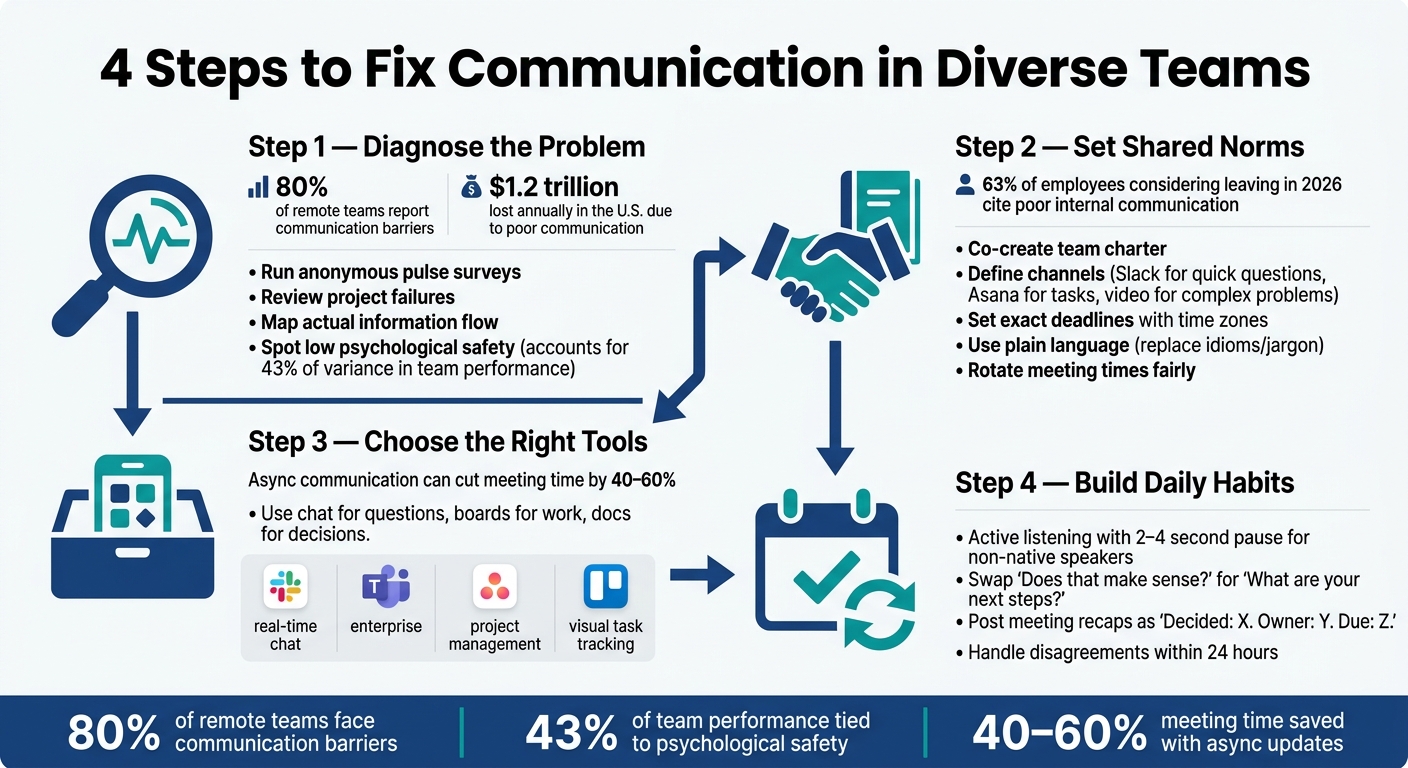
4 Steps to Fix Communication in Diverse Teams
Communication in Multicultural Teams: 6 Steps to Make it Work | Be an Effective Communicator
sbb-itb-3d8e4fc
Step 1: Diagnose communication problems before fixing them
Most teams rush to fixes - a new Slack channel, a different meeting cadence, or communication training - before they know what’s broken. That’s like replacing parts in a car before checking why it won’t start. Before you change anything, figure out where communication is failing.
Use the SPLIT model to look at structure, process, language, identity, and technology. Then use what you find to sort the problem: is the breakdown about trust, structure, language, or access?
Here’s a simple way to read the signals. If people talk openly in casual channels but go quiet in decision-making meetings, the issue is probably trust or psychological safety. If communication feels thin everywhere, the problem is more likely structural - unclear ownership or silos [11].
Use surveys, project reviews, and workflow mapping
Anonymous pulse surveys can surface what people won’t say out loud. Ask direct questions about clarity, inclusion, and comfort speaking up, especially since 63% of people considering leaving their jobs in 2026 cite poor internal communication as a factor [9].
Then look at recent project failures. Check for missed deadlines, repeated rework, or last-minute surprises. From there, trace each issue back to a specific breakdown in clarity, commitment, or ownership.
It also helps to map how information actually moves between people and departments - not how leaders think it moves. That’s often where you find the choke points: updates that stall, handoffs that drift, and decisions that get buried.
If the pattern points to silence or uneven participation, the next place to look is safety and access.
Spot low psychological safety and accessibility gaps
Psychological safety is a strong predictor of team effectiveness, accounting for 43% of the variance in team performance [11]. In plain terms, when people don’t feel safe to speak, team output suffers.
Watch for a few warning signs:
- The same people stay quiet in meetings
- Some ideas get talked over or brushed aside
- Concerns show up in private messages after the meeting instead of during it
Also watch response time. Multilingual team members, or people who need more time to process, may need a 2–4 second pause after a complex question before answering [10]. If the meeting moves too fast, that silence can be mistaken for disengagement when it’s just a timing issue.
When these signs show up, don’t just try to “fix” meeting behavior. Fix access to participation. Give people a way to share input in writing before the meeting, so alignment doesn’t depend only on speaking live. For example, silent written idea sharing before meetings gives everyone the same starting point, no matter their verbal fluency or processing speed.
Step 2: Set shared norms for clear, fair communication
Once you see where communication breaks down, the next move is simple: set rules the team builds together.
A lot of team norms don’t come from the whole team. They come from the people with the most power in the room - the senior leader, one department, or the group whose way of working already sets the tone. That isn’t a shared norm. It’s one group’s habits being treated like the default.
A better path is co-creation. Ask team members to write down proposed norms before the discussion starts, so quieter people have room to contribute before stronger voices take over. Start with written input, then confirm the norms together as a team. [12][2]
Build a team charter for channels, response times, and decisions
Create a team charter that spells out which tool is used for what. Use messaging apps like Slack or Teams for quick questions, project management tools like Asana for task updates, and video calls for harder problem-solving.
Be specific about response windows too. Use exact dates, times, and time zones instead of vague phrases like “ASAP” or “end of week.”
Decision-making needs the same level of clarity. Define how decisions are made and where they are recorded. Put every decision in one shared document that everyone can access. That cuts down on confusion about how the team operates. [3]
Use plain language and meeting rules that give everyone a voice
Language rules matter just as much. Up to 60% of members in multinational teams run into language-related obstacles, including misunderstood corporate jargon. [3]
That’s why plain language helps. Swap idioms like “ballpark figure” and “touch base” for direct phrases like “rough estimate” and “follow up.” Spell out each acronym the first time it appears.
Meetings need structure too. If you don’t set it up on purpose, the conversation often tilts toward whoever talks first, fastest, or loudest. Ask junior team members to speak before senior leaders respond. [7] Send agendas at least 24 hours ahead of time. [10] And instead of asking, “Does everyone agree?” ask, “What is one thing that could break this plan?” [13]
Behaviors to stop and start: a quick-reference table
The table below gives a fast reference for changes you can make right away. These aren’t abstract ideas. They’re direct swaps that cut confusion and make it easier for more people to take part.
| Category | Stop (Exclusionary) | Start (Inclusive) |
|---|---|---|
| Meeting input | Rapid verbal brainstorming; loudest voices lead | Brainwriting before discussion; multi-channel input via chat, polls, or shared docs |
| Deadlines | Vague terms like "ASAP" or "end of week" | Exact dates and times, including time zones |
| Language | Idioms, metaphors, and unexplained jargon | Plain, literal language; all acronyms spelled out |
| Asking questions | "Does that make sense?" or "Are we aligned?" | "What would you need to make this possible?" or "What are your next steps?" |
| Feedback | Blunt public criticism | Private feedback or asking for each person's preferred feedback style |
| Meeting times | Always defaulting to HQ's time zone | Rotating meeting times so the inconvenience is shared |
Use these norms to shape the tools and routines in Step 3.
Step 3: Choose tools and routines that make communication easier
Shared norms fall apart if the tools don't back them up. The fix is simple: use a small, steady set of tools and spell out how each one should be used. When teams bounce between too many apps, people lose track of updates, decisions, and ownership [14].
Once the team agrees on the rules, put them where people already work. That way, decisions, updates, and responsibilities stay visible in one place instead of getting buried across chat, email, and meetings.
Set up messaging, task tracking, and shared calendars with clear rules
Set up channels by purpose. In Slack or Microsoft Teams, separate project updates, announcements, and casual chat. Then document what belongs in each channel. If people know where to look, fewer updates slip past unnoticed.
For task tracking, Asana and Trello help the whole team see deadlines, dependencies, and owners at a glance. That beats chasing status updates through chat. Instead, anyone can open the board and check progress, blockers, and next steps.
Scheduling works the same way: the rules matter as much as the tool. Shared calendars work better across a distributed team when every event includes a time zone label and the team stays aware of regional holidays and workweeks. Some regions, for example, follow a Sunday–Thursday schedule [4]. Put the time zone on every event. Every time.
Use async updates, written decisions, and regular team check-ins
Move routine updates out of meetings and into written threads. Teams that lean on async communication can cut meeting time by 40% to 60% [16]. That's a big chunk of time people can put back into focused work.
Written updates also help people stay aligned even if they miss a meeting or work in a different time zone. After meetings, log decisions and owners in the team's shared workspace [6][15][16]. For recurring updates, use async check-ins instead of adding yet another meeting to the calendar.
Collaboration tools compared: Slack, Microsoft Teams, Asana, and Trello
Pick tools based on the job they need to do: chat for quick coordination, task boards for ownership, and shared docs for decisions. You don't need all four.
| Tool | Primary Use | Best For | Standout Feature |
|---|---|---|---|
| Slack | Real-time and async chat | Quick coordination and casual talk | Threaded discussions, strong third-party integrations |
| Microsoft Teams | Enterprise collaboration | Teams already using Microsoft 365 | Seamless Word, Excel, and SharePoint integration |
| Asana | Project management | Cross-functional projects with multiple owners | Task dependencies, timelines, and workload views |
| Trello | Visual task tracking | Small to mid-size teams with straightforward workflows | Kanban boards that are easy to set up and read |
A simple rule helps here:
- Use chat for questions
- Use boards for work
- Use docs for decisions
Clear lanes cut confusion and help the team keep momentum.
With the tools in place, the next move is turning them into daily habits that people actually follow.
Step 4: Build the day-to-day communication habits that keep diverse teams aligned
Tools and team rules help, but they don’t do much on their own. The day-to-day part is what keeps people lined up. Once channels and expectations are in place, the next job is making those habits show up in regular conversations, so mixed interpretations don’t turn into rework or missed deadlines. Most of this happens in small moments: listening well, clearing things up, and dealing with friction before it spreads.
Use active listening, plain language, and understanding checks
Active listening in diverse teams means you briefly restate what you heard and check that you got it right. That shows people their input matters and can reduce communication bias [8].
In high-context settings, “yes” may mean someone heard you, not that they agree. That’s one of those small gaps that can send a project off course.
A few simple habits help close that gap fast:
- Swap confirmation questions for action questions. Instead of asking “Does that make sense?” ask “What are your next steps based on this decision?” [6]
- Leave a short pause. Non-native speakers often need 2–4 seconds to process and respond, so jumping in too fast can cut them off before they’ve had a chance to add anything [10]
- After a dense discussion, post a short recap in the shared channel: “Decided: X. Owner: Y. Due: Z.” [2][17]
When a misunderstanding comes up, keep the discussion tied to goals, facts, and impact.
Handle disagreement by focusing on goals, facts, and impact
Not every disagreement belongs in a public channel or group meeting. When tension shows up, bring the conversation back to the shared goal, what can be observed, and how the issue affects the work. If a teammate’s behavior feels unexpected, pause before making it personal and ask what norm might explain it [1]. If the disagreement feels personal or tied to status, move it to a private 1:1 so the other person can respond without losing face [5][6].
Weak habits vs. useful skills: a side-by-side table
| Weak Habit | Stronger Skill | Micro-action |
|---|---|---|
| Interrupting or filling silence | Active listening | Wait 2–4 seconds after a colleague finishes speaking before responding [10] |
| Assuming "yes" means agreement | Understanding checks | Ask: "What are your next steps based on this decision?" [6] |
| Using idioms or jargon | Plain language | Replace vague terms with a specific date, time, and time zone, like "Friday at 2:00 PM ET" [2][17] |
| Multitasking in meetings | Focused presence | Close all other tabs and summarize the last point made before responding |
| Unclear ownership at meeting end | Written confirmation | Post a 3-line summary in the shared channel: "Decided: X. Owner: Y. Due: Z." [2][17] |
Conclusion: Make clear communication part of everyday work
The answer isn’t more communication. It’s clearer communication built into the way people work every day.
In diverse teams, clear communication comes from habits the team repeats again and again, not from a one-time training session. That usually means diagnosing the gap, setting shared norms, picking simple tools, and reviewing them on a regular basis. Communication works better when the team treats it like a system, not a one-off fix.
When breakdowns happen, move fast. Repair conversations within 24 hours can prevent resentment from compounding [9].
It also helps to keep communication norms on a steady schedule. A short monthly check-in or a quick retrospective item can catch drift before it turns into habit. The goal is simple: make clarity, inclusion, and follow-through part of every meeting and handoff.
FAQs
How do I know which communication problem to fix first?
Start by looking for repeat friction in how people communicate. Don’t treat it like one person’s flaw right away. And don’t rush into new tools or extra meetings, because those can cover up the actual problem instead of fixing it.
A simple way to sort it out is with a gap diagnosis:
- Clarity gap: rework, mixed signals, or missed expectations
- Channel gap: tool fatigue, scattered messages, or updates buried in the noise
- Culture gap: people agree in public, then push back in private
Once you spot the gap, restate the issue as a system problem. For example, the root cause may not be “people aren’t aligned.” It may be something more concrete, like unclear approval ownership.
What team norms matter most for remote communication?
The most important norms for remote teams do one thing well: they cut down confusion.
That usually starts with clear docs and a few agreed-upon habits. A communication charter can help set the ground rules, including:
- expected response times
- which tools to use for which tasks
- meeting etiquette
An async-first approach helps teams work across time zones without dragging everyone into live calls. It also makes room for deeper work. When meetings do happen, rotating meeting times helps spread the inconvenience instead of dumping it on the same people every week.
It also helps to standardize how the team handles conflict and makes decisions. If people know where to raise issues, how choices get made, and who has the final say, there’s a lot less second-guessing.
Simple, direct language matters too. It can go a long way in preventing misunderstandings, especially across cultures and language barriers.
How can I improve communication without adding more meetings?
Shift to an asynchronous-first approach. Use meetings for the moments that need live back-and-forth: complex problem-solving, time-sensitive decisions, or team connection.
Keep key information in one centralized, searchable place. Then lean on async channels like recorded video updates, threaded discussions, and detailed project docs. A clear communication charter helps a lot here. It should spell out expected response times and make it clear which channel fits which kind of message.


