

How Emotional Regulation Reduces Procrastination
Learn how naming feelings, urge-surfing, tiny starts, and removing distractions help stop procrastination.


Procrastination is usually about feeling bad, not planning bad. If a task brings up stress, self-doubt, boredom, confusion, or anger, I may avoid it just to get short-term relief. That relief trains the habit to keep coming back.
About 20% of adults deal with chronic procrastination. The fix is not just a tighter schedule. It starts when I name the feeling, sit with the urge for a few minutes, make the first step tiny, and remove easy distractions.
Here’s the whole idea in plain English:
- I procrastinate because a task feels emotionally hard
- Avoiding the task gives brief relief
- That relief strengthens the delay habit
- Naming the emotion can lower the stress response
- Small actions like opening the file or writing one sentence make starting easier
- If procrastination is tied to ADHD, anxiety, or depression, therapy such as CBT may help
A simple way to think about it:
| What happens | What I can do |
|---|---|
| I feel fear or self-doubt | Name the fear and lower the pressure |
| I feel overwhelmed | Cut the task into a tiny first step |
| I feel bored or resistant | Start for 2 minutes and remove distractions |
| I feel confused | Find the first clear action |
| I want to avoid the task | Wait 5 minutes and watch the urge pass |
The core message is simple: I do not need to feel ready to start. I need a way to handle the feeling that shows up right before I avoid the task.
Emotions are the #1 reason for procrastination
sbb-itb-3d8e4fc
Identify the Emotions Behind Your Procrastination
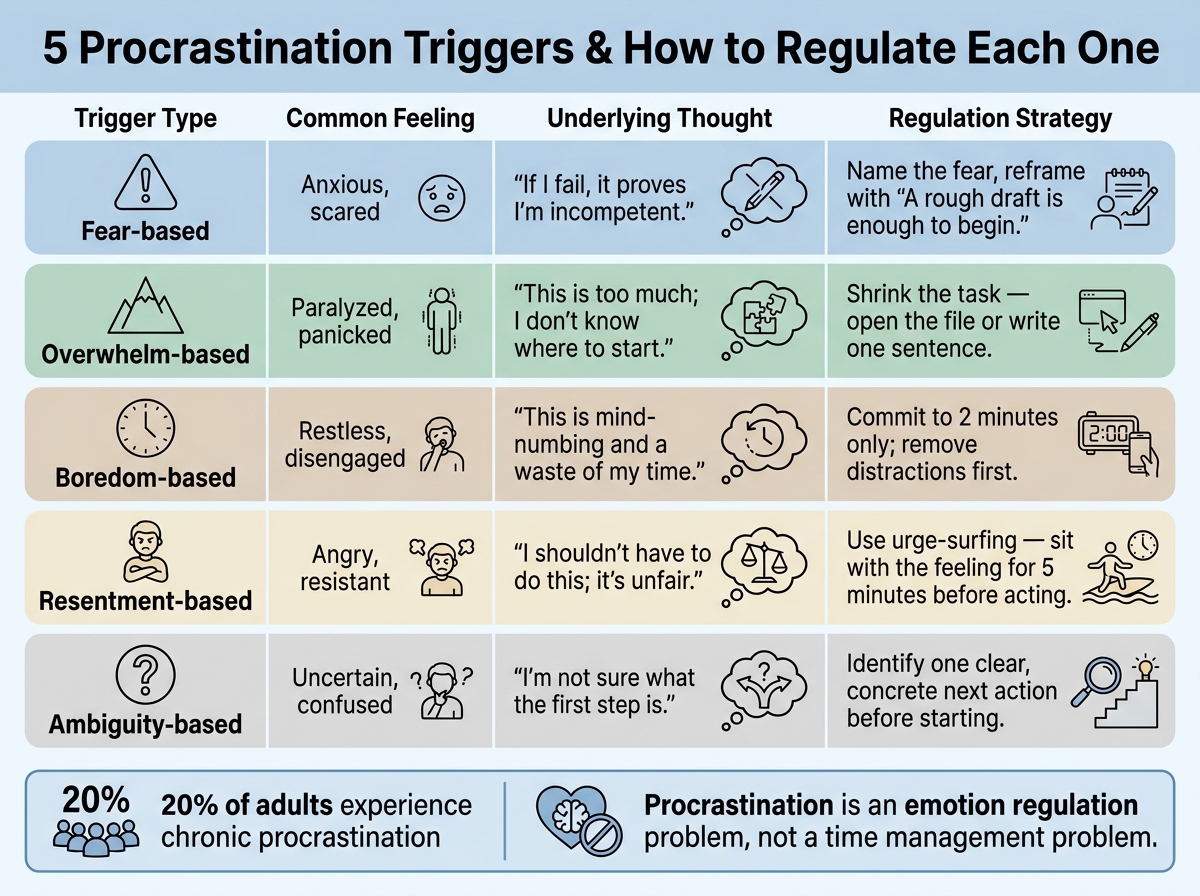
5 Procrastination Triggers & Emotional Regulation Strategies
The next step is simple, but it matters: name the exact emotion that shows up right before you switch away from the task. That brief pause is your opening. It's the moment where you can step in and stop the habit from running on autopilot.
Name the Feeling Before You Name the Task
Most people talk about procrastination in fuzzy terms, like “I just don’t feel like it” or “I’m not in the mood.” The problem? That label is too broad to help. If you want to interrupt avoidance, you need a sharper read on what’s going on.
A more exact label gives you something you can work with.
Five common triggers are fear, overwhelm, boredom, resentment, and ambiguity. Why does that matter? Because the best way to regulate the moment depends on the feeling under the delay. Different triggers need different responses.
| Trigger Type | Common Feeling | Underlying Thought |
|---|---|---|
| Fear-based | Anxious, scared | "If I fail, it proves I'm incompetent." |
| Overwhelm-based | Paralyzed, panicked | "This is too much; I don't know where to start." |
| Boredom-based | Restless, disengaged | "This is mind-numbing and a waste of my time." |
| Resentment-based | Angry, resistant | "I shouldn't have to do this; it's unfair." |
| Ambiguity-based | Uncertain, confused | "I'm not sure what the first step is." |
This kind of precise emotion naming, often called affect labeling, can lower threat response and make action feel a little more doable.[8][4]
Track Your Procrastination for 7 Days
A single week of honest tracking can show patterns that are hard to catch in the moment[1]. Every time you avoid a task, write down:
After seven days, you’ll have a much clearer picture of which emotions trigger your avoidance most often. That gives you a better shot at picking the right regulation skill next.
Use Emotional Regulation Skills to Start Before You Feel Ready
Use the emotion you identified to begin while the discomfort is still there.
Pause and Label the Emotion
Use the pattern you tracked to catch the feeling in the moment. When resistance shows up, pause instead of pushing harder. Notice where it lands in your body: a tight chest, a jittery feeling in your legs, a knot in your stomach.
Then name it as clearly as you can. Not “I don’t want to do this,” but something more exact, like “I’m afraid this won’t be good enough” or “I feel overwhelmed and don’t know where to start.”
Putting a name to the feeling can dial down the intensity and make the next move easier to see.
Use Mindfulness and Urge-Surfing for 5 Minutes
If naming the feeling doesn’t ease the pressure, let the urge rise without obeying it. The urge to switch tasks isn’t an order. It comes up, peaks, and then passes.
After you name the feeling, stay with it for five minutes instead of reacting. Set a timer. Use your breath as an anchor. Watch the discomfort without doing anything about it.
When the timer ends, commit to one small, concrete action:
- Open the document
- Read the first line
- Write one sentence
That’s often enough to loosen the resistance.
Reframe the Thought That Makes the Task Feel Harder
Perfectionism adds emotional weight to the start. Catch the thought, check whether it’s making the task seem bigger than it is, and swap it for something you can work with.
| Thought Pattern | Reframed Alternative |
|---|---|
| "It has to be perfect." | "A rough draft is enough to begin." |
| "This is too overwhelming." | "I'll just open the file and read the first line." |
| "I'm not ready." | "I can start this while still feeling uncomfortable." |
| "I'll do it when I have more energy." | "What can I do now that my future self will thank me for?" |
The goal isn’t comfort. The goal is to make the task feel less threatening than avoidance.
If the task still feels heavy, make the first step smaller and take away anything that makes avoidance easier.
Build a Low-Friction Routine That Supports Follow-Through
When a task still feels heavy, make it easier to begin. Your setup can help you follow through, or it can quietly push you off course.
Shrink the Starting Point Until It Feels Safe to Begin
Starting is usually the hardest part. And once you start, the urge to avoid the task often drops.
Try this: commit to two minutes only. Write one sentence. Open the spreadsheet. Read the first paragraph. That's it. The goal isn't to finish. It's to begin, even if you still feel uncomfortable.
You can also tie the task to a simple if-then plan. For example: "If I sit down with my coffee, then I'll write three sentences." Plans like this can make people 2 to 3 times more likely to achieve their goals [2].
Remove Cues That Invite Avoidance
Once you've started, protect that momentum by getting rid of the easiest distractions first.
Your brain is always picking up signals from the space around you. If your phone is on the desk, that's a cue. If ten browser tabs are open, each one pulls at your attention. Those little signals offer fast relief, which makes avoidance a lot easier.
The fix is simple and concrete:
- Put your phone in another room before you start working.
- Close every tab that isn't tied to the task.
- Clear your desk of anything that doesn't belong to what you're doing right now.
- Set out your materials the night before, so there's less friction between sitting down and getting started.
"Procrastination serves a self-protective function by allowing the individual to avoid, for the moment, the threat implicit in task engagement." - Fuschia Sirois and Timothy Pychyl, Researchers [9]
Reduce those cues before you begin so the easiest next step is the task itself.
Use the tool that fits the trigger: mindfulness for urges, reframing for fear, tiny starts for overwhelm, and distraction control for avoidance cues.
Conclusion: Turn Emotional Awareness Into Consistent Action
When a task still feels heavy, pushing harder usually backfires. The answer isn’t more pressure. It’s a calmer way in. Once you see procrastination as a way of dealing with discomfort, the next move gets pretty clear: settle the feeling, then start.
"Procrastination is an emotion regulation problem, not a time management problem." [2][3]
That shift starts with noticing what you feel, letting the discomfort be there, and beginning anyway. Emotion labeling, urge-surfing, reframing, and tiny starts help because they lower resistance right when it shows up. In plain English, they work on the feeling underneath the delay instead of just trying to force action.
If procrastination feels severe, or if it’s linked to ADHD, anxiety, or depression, talk with a therapist. CBT can help. [7][5]
Key Points to Carry Into Your Next Task
The next time avoidance kicks in, keep it simple:
- Name the feeling
- Start for two minutes
- Stay with the urge instead of obeying it
- Remove distractions
What you need is a setup that makes starting feel safe enough to attempt. Start small, stay aware, and make the easier choice the productive one.
FAQs
Why is procrastination so hard to stop?
Procrastination is tough to stop because, a lot of the time, it’s an emotion regulation problem, not just a time-management problem.
When a task stirs up anxiety, boredom, or fear of failure, your brain starts looking for fast relief. And that relief usually comes from not doing the task.
Avoiding it feels good in the short term. That little sense of comfort trains the habit and makes it more likely you’ll do the same thing next time.
Stress makes the whole thing worse. It can weaken the brain’s ability to plan ahead and control impulses, which makes getting started feel way harder than it should.
How do I know which emotion is triggering my procrastination?
Pause for a moment and pin down the exact discomfort linked to the task. Instead of lumping it under “I just don’t want to do this,” ask what’s actually going on.
Is it anxiety about being judged or messing up? Boredom? Self-doubt? Resentment? Overwhelm?
Putting a name to the feeling can break the autopilot cycle of avoidance and help you deal with the real issue.
When should I get professional help for procrastination?
Consider getting professional help if your procrastination points to something deeper. Chronic procrastination is often driven by anxiety and avoidance. And when it’s tied to conditions like depression, managing emotions can get a lot harder.
If you keep falling into the same cycle even after trying emotional regulation techniques, outside support can help. A mental health professional can offer structured treatment, such as cognitive behavioral therapy, to work through stubborn emotional and behavior patterns.


