

How Rest Boosts Productivity and Focus
Use sleep, micro-breaks, and mental detachment to protect focus, cut errors, and keep energy steady across a busy workday.


If I want better work, I need better rest first. Sleep, short breaks, and clear off-hours help me think better, make fewer mistakes, and keep my energy more steady through the day.
Here’s the short version:
- More hours do not always mean more output.
- After about 90 minutes of focused work, attention often dips for 15–20 minutes.
- Short movement breaks can leave workers feeling 50% more energized by day’s end.
- Sleeping fewer than 6 hours can make workers up to 29% less productive than people getting 7–8 hours.
- Most people only have about 3 to 4 strong focus blocks in a day.
So if I keep working while tired, I often get slower decisions, more typos, more rework, and less of the hard stuff done. Rest is not a reward at the end of work. It is part of the work.
The article breaks this down into three simple parts:
- Why fatigue hurts focus and output
- Which kinds of rest help most
- How to fit rest into a busy 9:00 a.m. to 5:00 p.m. day
A simple way to think about it: sleep helps the next day, micro-breaks help the next hour, and mental detachment helps when my brain feels stuck or overloaded.
Healthy Rest as a Steppingstone to Productivity and Well-being
sbb-itb-3d8e4fc
Why Working Through Fatigue Reduces Focus and Output
Pushing through tiredness can look like discipline. But fatigue is a biology issue, not a willpower issue. Once rest drops out, focus and output tend to fall together. And that slide often starts well before you feel completely drained.
Long periods of focused work put heavy strain on the brain systems tied to attention, planning, and judgment. [3] As that load builds, the brain slows activity to protect itself. Keep working without recovery, and the quality of each hour drops. In complex work, problem-solving ability can fall by as much as 20%. [6] In plain English: more time at the desk doesn't always mean more good work. Often, the first warning signs show up in the work itself.
A lot of people feel guilty about stepping away from their desks, even when a short pause would help protect the quality of what they're doing. [5]
Signs of Mental Fatigue During a Normal Workday
Mental fatigue usually doesn't arrive with a big flashing sign. It tends to show up in small, easy-to-miss ways: slower decisions, rereading the same line, more typos, and a drift toward low-stakes busywork instead of the work that matters most. [3]
After about 90 minutes of focused work, attention tends to dip for 15 to 20 minutes. [6] You can't bulldoze past that dip and expect the same level of work. If anything, pushing through often makes the output worse. Those small signs are the early warning: stop before errors start stacking up.
How Skipped Breaks Create More Work Later
The cost of skipping breaks often doesn't hit right away. It shows up later that day, or even a few days later, when one small mistake turns into hours of cleanup. What looks like saved time can turn into rework, follow-up messages, corrections, and mistakes that didn't need to happen in the first place. [5]
That is why the next step is choosing the right kind of rest.
How Different Types of Rest Support Productivity
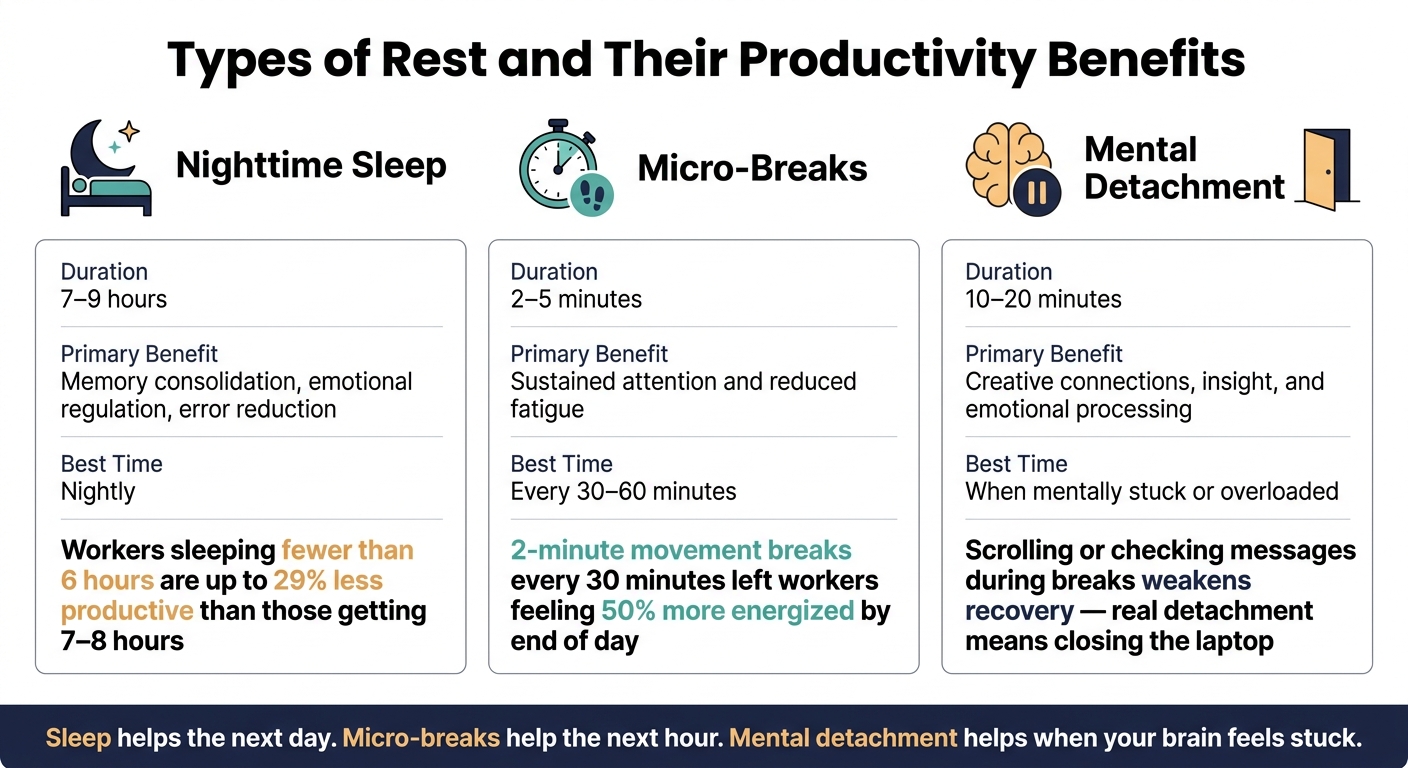
Types of Rest and Their Productivity Benefits
Not all rest does the same job.
Some kinds of rest help you stay sharp for the next hour. Others help your brain recover for the next day. For a workday, the most useful types are the ones that help restore attention, memory, and mental energy without taking much time.
| Type of Rest | Typical Duration | Primary Productivity Benefit | Best Time of Day |
|---|---|---|---|
| Nighttime Sleep | 7–9 hours | Memory, emotional regulation, error reduction | Nightly [1] |
| Micro-Breaks | 2–5 minutes | Sustained attention and reduced fatigue | Every 30–60 minutes [8] |
| Mental Detachment | 10–20 minutes | Creative connections, insight, and emotional processing | When mentally stuck or overloaded [8] |
How Sleep Supports Attention, Memory, and Steady Performance
Start with sleep. It supports the kind of recovery that short breaks simply can't replace.
Sleep helps consolidate learning, clear waste, and support emotional regulation.[1] When you don't get enough of it, the effects tend to show up fast the next day: weaker memory, less steady focus, and more errors.[1]
That matters at work. You might push through a tired morning with coffee and momentum, but sleep loss still chips away at performance in the background.
How Micro-Breaks Help Maintain Energy and Concentration
Short breaks can do a lot more than people think.
Even a brief pause can reset attention and reduce fatigue. Research shows that small diversions help prevent the slide in concentration that builds during long tasks.[8] The main thing is simple: step away from the screen.
A short walk to get water, a stretch by your desk, or even standing up for a minute can help increase circulation and give you a quick reset.[8] In one case, office workers who took 2-minute movement breaks every 30 minutes said they felt 50% more energized by the end of the day.[8]
How Mental Detachment Supports Deeper Thinking
Micro-breaks help you keep going. Mental detachment helps you recover more deeply.
If you spend your break checking messages or scrolling, your mind is still tied to input and demands. That weakens recovery.[5][8] Real mental distance means closing the laptop and leaving the phone alone for a bit.
That kind of psychological detachment gives your mind room to process in the background. And that's often when better connections, insight, and emotional processing start to happen.[8]
How to Build Rest Into a Busy Workday
Knowing rest matters is one thing. Making room for it in a jam-packed day is another. The big shift is simple: treat breaks like calendar appointments, not prizes you get after clearing your to-do list. The aim isn’t more idle time. It’s better timing.
When rest is on the calendar, you can place it where it protects your hardest work instead of squeezing it in after the fact.
How to Structure Rest in a 9:00 AM to 5:00 PM Day
Most people do their best work in 75–90 minute stretches, then need 15–20 minutes to reset. If you work with that rhythm instead of pushing past it, planning breaks gets a lot easier.
Use your strongest energy for the hardest tasks, then move lighter work into the afternoon slump. Your morning peak - the first 3 to 4 hours of the day - is the best window for demanding work like strategic thinking, writing, and analysis. At around the 90-minute point, take a real break: step away from your screen and phone, walk to get water, or do a few minutes of stretching. After lunch, energy tends to drop, so that’s a good time for lighter admin work like email triage, scheduling, or routine approvals. A short pause later in the afternoon can help you finish the day with steadier attention.
Set meetings for 25 or 50 minutes when you can. That built-in 5–10 minute buffer gives your brain a genuine reset between one demand and the next. [9]
| Schedule Pattern | Break Frequency | Subjective Energy | Typical Focus Level | Common Outcomes |
|---|---|---|---|---|
| 90-Minute Blocks | Every 90 mins (15–20 min break) | High/Stable | Peak | High-quality deep work; sustained performance [1][10] |
| 52-17 Method | Every 52 mins (17 min break) | Moderate/Consistent | High | High output; good for knowledge work [9][8] |
| Pomodoro Stack | Every 25 mins (5 min break) | Variable | Moderate | Good for routine tasks or ADHD patterns [10][9] |
Once your day has some shape, repeatable cues can make breaks happen with less effort.
Use Repeatable Rest Rituals to Make Recovery Automatic
Small rituals help turn breaks into habit. A five-minute walk, a brief stretch, or a written shutdown note can cue your brain to step out of work mode for a moment.
Conclusion: Better Rest Leads to Better Work
When rest has a real place in the day, focus gets sharper and output stays more steady. Constant busyness does the opposite. It creates mental fog, leads to mistakes, and gives you less for the time you put in.
The fix is simple and repeatable. Workers sleeping fewer than 6 hours per night are up to 29% less productive than those getting 7 to 8 hours [7]. Short breaks help stop the 5% to 15% drop in reaction time that builds during low-energy periods [1]. And most people can only sustain 3 to 4 high-quality focus blocks per day, which is why firm workday boundaries matter so much if you want to protect the hours when your thinking is at its best [2][4].
Protect your sleep, take real breaks, and set a clear end to the workday. Small habits sharpen focus and steady output because they give your mind and body time to recover.
FAQs
How do I know when I need a break?
You likely need a break if you feel drained or worn out, can't focus, or start noticing headaches, aches, or pains. Other common signs include feeling swamped, losing motivation, or making more mistakes than usual.
If work stress is spilling into your personal life or messing with your sleep, that's another clear sign. Paying attention to your energy, mood, and performance can help you spot when it's time to step away and reset.
What kind of break helps focus most?
The best break for focus is genuine rest for 15 to 20 minutes.
That usually means getting your body moving, stepping outside, or doing something light and low-effort, like:
- walking
- stretching
- looking at nature
These kinds of breaks often help more than passive screen time or scrolling on social media.
How can I fit rest into a busy workday?
Try working in focused 90-minute blocks, then take a real 15- to 20-minute break. Use that break to walk, do some light stretching, or chat with someone. Skip more screen time or anything that keeps your brain working hard.
A good target is 4 to 6 cycles during your active hours. Save your hardest work for the times when your focus is strongest, and step away when your energy starts to drop.


