

10 Journal Prompts for Gratitude and Reflection
Five-minute gratitude prompts to build a steady journaling habit that highlights small comforts, support, growth, and self-compassion.


You do not need a long journaling session to get something out of it. In many cases, 5 minutes and one clear prompt are enough to help me slow down, name what matters, and see my day with more care.
Here’s the core idea in plain terms:
- I pick one prompt
- I write for 5 minutes
- I stay specific
- I do it 2–3 times a week if I can
- I aim for honesty, not a polished answer
Research named in the article links gratitude journaling with better well-being, sleep, and exercise habits. The prompts focus on 4 main areas:
-
Everyday appreciation
I look at small moments, routines, and sensory details. -
Relationships and support
I name one person, one act, and what it meant to me. -
Growth through challenge
I write about what a hard time took from me and what it showed me. -
Self-compassion and strengths
I notice what I handled well, even if no one else saw it.
How to build a gratitude habit: 9 journal prompts
sbb-itb-3d8e4fc
Quick Comparison
| Focus area | What I write about | Best for |
|---|---|---|
| Everyday appreciation | Small moments, habits, daily comforts | Busy or routine days |
| Relationships and support | Help, kindness, feeling seen | Disconnected or lonely days |
| Growth through challenge | Lessons, limits, inner strength | Stressful or hard days |
| Self-compassion and strengths | Effort, progress, quiet pride | Days with self-criticism |
My takeaway: the article is not about forcing a good mood. It is about using short, plain writing to spot one thing that mattered today - whether that was comfort, support, a lesson, or my own effort.
How to Use These Journal Prompts With Intention
Pick one prompt per session. That's it. Just one.
When you sit down to write, take one slow breath, read the prompt slowly, then write without editing. As Tessa Geurts-Meulendijks, MSc Psychologist, says:
"Gratitude journaling works when it's in service of psychological honesty - not performance."
- Tessa Geurts-Meulendijks, MSc Psychologist [2]
So you don't need to push yourself into a good mood by the bottom of the page. If all you have is one honest sentence, that's enough.
Use whatever format feels easy to stick with. Full sentences are fine. Bullet points work too. Even a few short phrases can do the job. What matters most is being specific - "the smell of coffee this morning" often hits harder than "I'm grateful for my health" [2][3]. If you're stuck, try starting with: "Part of me is grateful that..." [2]
On hard days, make it easier, not harder. "I'm grateful I got through this hour" is enough [2]. Used on a regular basis, this kind of journaling is linked to better well-being, sleep, and exercise habits [3].
The first prompts start with what already helps you in everyday life.
1. Everyday appreciation
Start with what’s already in front of you.
These prompts help you pay attention to the ordinary moments that quietly shape your day. Small positives matter because they train your attention toward what’s already working [5].
- "What's one small thing that went right today that I almost didn't notice?" Tiny moments slip by fast, so it helps to name them [5].
- "What sensory moment did I enjoy today?" When you describe the moment, it tends to come back more clearly in your mind [6].
- "Which daily routine quietly supports me?" The parts of your day that help you most are often the ones you stop seeing [3].
A simple way to make your answer more specific is to add "because."
For example: "I'm grateful for my coffee because the warmth felt grounding."
From there, move from your own routines to the people who help hold your life together.
2. Relationships and support
Once you’ve noticed the small bits of help in your day, look at the people behind them. Don’t write about support in a broad way. Pick one clear moment.
- "Who is quietly helping me, and what exactly did they do?" Write down one plain, specific act: a coworker covering for you, a driver making a delivery easier, or a family member taking care of dinner. That kind of detail makes the gratitude feel concrete [3].
- "When did someone make you feel seen or heard, and what did they say or do?" Stick to the exact words or gesture, not just the emotion. Small details often carry the most weight and make the memory easier to hold onto [7].
- "Who am I taking for granted, and what would my day lose without them?"
"Gratitude journaling only works when it's specific, vivid, and connected to genuine emotion." - Robert Emmons, Psychologist [5]
If your answer catches you off guard, act on it. Send a text. Make a quick call. Even a short thank-you can deepen that connection [5].
3. Growth through challenge
Hard experiences are easy to dodge. But when gratitude gets tougher, it helps to look straight at what the hard season showed you - without acting like it didn’t hurt.
These three prompts can help:
-
"What is this difficulty teaching me that I couldn't learn any other way?"
This keeps your attention on the lesson. You don't have to be happy it happened. You’re just noticing whether anything useful came out of it, like clarity, patience, or a boundary you finally set. -
"What did I outgrow in this season - a habit, a role, or a way of relating - that creates space for something new?"
Put the shift into words, then name the room it opened up. -
"What strength in myself helped me get through today, and how can I acknowledge that strength?"
Focus on the part of you that got you through: persistence, asking for help, or resilience.
Try using "obstacle gratitude": name what the challenge took and what it revealed [1]. That’s the point. Not forcing a silver lining, but holding two truths at the same time. Something hurt, and something was shown. If that feels too heavy, make it smaller: write down one hard truth and one steadying fact.
"Difficult experiences often result in growth, clarity, closer relationships, or redirected paths that genuinely mattered. Acknowledging that does not minimise the hard parts." - Willow Pages, Writer, Journal for Wellbeing [1]
If a prompt feels too big, keep it simple. Write one sentence about what’s hard, and one sentence about what still supports you.
4. Self-compassion and strengths
"What am I quietly proud of today, even if no one else noticed it?"
Once you've looked at what a hard moment taught you, shift your attention to what you did well. This prompt helps you spot your own effort without waiting for someone else to clap for it.
Pick one exact moment: the hard call, the meeting where you spoke up, or the task you finished even though you were tired. Being specific keeps the reflection grounded in self-recognition, not just vivid detail [6].
If self-criticism sneaks in, try this version instead: "What strength am I showing today, even if it doesn't feel like one?" That slight change puts the focus on steady effort, not perfection.
"Gratitude is not about ignoring pain or forcing positivity - it is about noticing what still carries value, warmth, meaning, and connection within life." - Sandy ElChaar, Therapist [4]
Self-compassion means seeing the hard part without judging yourself, then naming the strength that got you through it.
A Quick Way to Choose the Right Prompt for Your Day
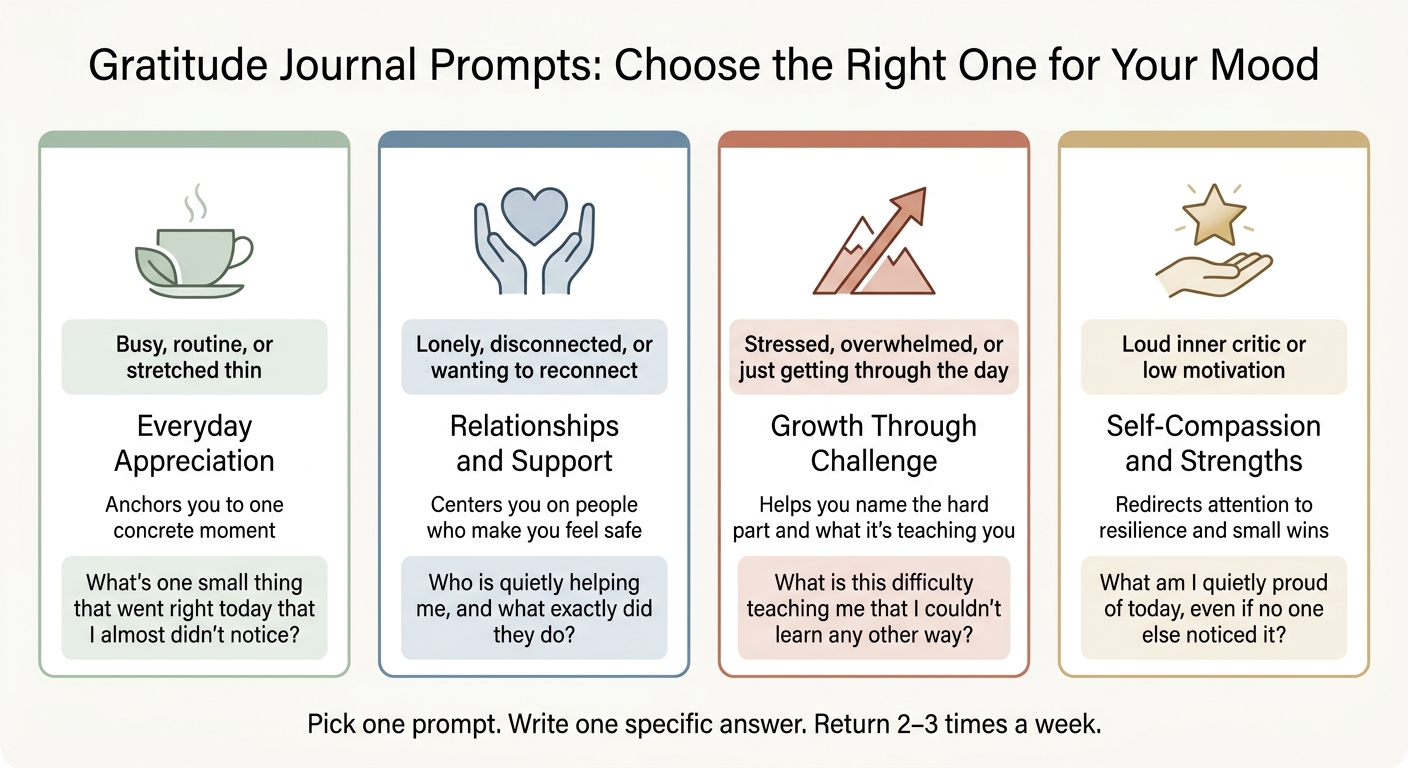
Gratitude Journal Prompts: Choose the Right One for Your Mood
When you only have a minute, pick the theme that fits how you feel right now. These four themes match the moods most people run into. Use this when you want the right prompt fast.
| Your Current State | Best Fit | Why It Helps |
|---|---|---|
| Busy, routine, or stretched thin | Everyday Appreciation | Anchors you to one concrete moment |
| Lonely, disconnected, or wanting to reconnect | Relationships and Support | Centers you on people who make you feel safe |
| Stressed, overwhelmed, or just getting through the day | Growth through Challenge | Helps you name the hard part and what it's teaching you |
| Loud inner critic or low motivation | Self-Compassion and Strengths | Redirects attention to resilience and small wins |
Start with the table, then narrow your focus to one moment, one person, or one feeling. Write one specific answer, and stop there. That's the whole point. Keep it simple so the habit doesn't start to feel like homework.
Try this shortcut 2–3 times a week to keep the practice from going stale.
Conclusion
These prompts work best when you use them lightly and often. Gratitude journaling tends to help most when you come back to it on a regular basis, not when you try to do it perfectly.
The goal is honesty, not performance. That steady rhythm is what makes the practice useful.
That’s why the best prompt is the one you’ll come back to.
Pick one prompt. Write one specific answer. Return regularly.
FAQs
How do I start journaling if I feel stuck?
Start very small. Even one sentence is enough.
It also helps to link journaling to something you already do each day, like your morning coffee or your evening wind-down. That way, it feels less like one more task and more like part of your routine.
Use a notebook or app you like. Then keep your entries simple and specific. You don't need deep, life-changing thoughts. Just write what happened, what you felt, or what stayed with you.
And on hard days, skip the pressure to sound upbeat. Just note one small thing that gave you a bit of relief, helped you keep going, or simply did not fall apart.
What if gratitude feels hard on bad days?
When gratitude feels hard, it may be a sign that your nervous system is maxed out, not proof that you lack gratitude. On rough days, don't force positivity.
Start by naming your pain or stress. Then, if you have the bandwidth, point to one small, specific thing that is also true, such as, “Part of me is grateful that...” Keep your attention on small moments of comfort, relief, or steadiness.
How often should I use these prompts?
There’s no single right frequency. What matters most is finding a rhythm that fits your routine and sticking with it.
Some people like to journal every day. Others get just as much out of doing it once a week. You can start with a few minutes a day, then adjust based on what feels comfortable.


