

Psychology of Minimalism: Why Less Is More
Intentional minimalism reduces clutter, lowers stress, and boosts life satisfaction by freeing attention and supporting core needs.


Less stuff can mean less stress. Research in the article points to a clear pattern: people who choose to own less often report better well-being, more life satisfaction, and lower mental strain, while clutter is linked with higher stress, lower mood, and less comfort at home.
Here’s the short version:
- Minimalism is a choice, not forced lack
- Clutter adds mental load and can make home feel less restful
- Simplicity supports control, focus, and purpose
- Studies cited in the article found links with higher positive emotion, better life satisfaction, and lower stress
- The strongest effects seem tied to intentional living, not just a plain-looking space
I’d sum it up like this: when I cut down on excess, I often make daily life easier. There’s less to track, less to clean, and fewer things competing for my attention. That can leave more room for time, calm, and what matters most.
A few numbers stand out:
- 17% of Americans say they already live this way
- Another 23% say they want to try it
- A review of 23 studies found that most linked voluntary simplicity with better well-being
- One study of 571 adults tied simplifying habits to higher life satisfaction
- A matched study of 200 simplifiers vs. 200 controls found higher positive emotion in the simplifier group
This does not prove cause and effect in every case. But the pattern is hard to ignore: chosen simplicity seems to help many people feel lighter, more in control, and less weighed down by clutter.
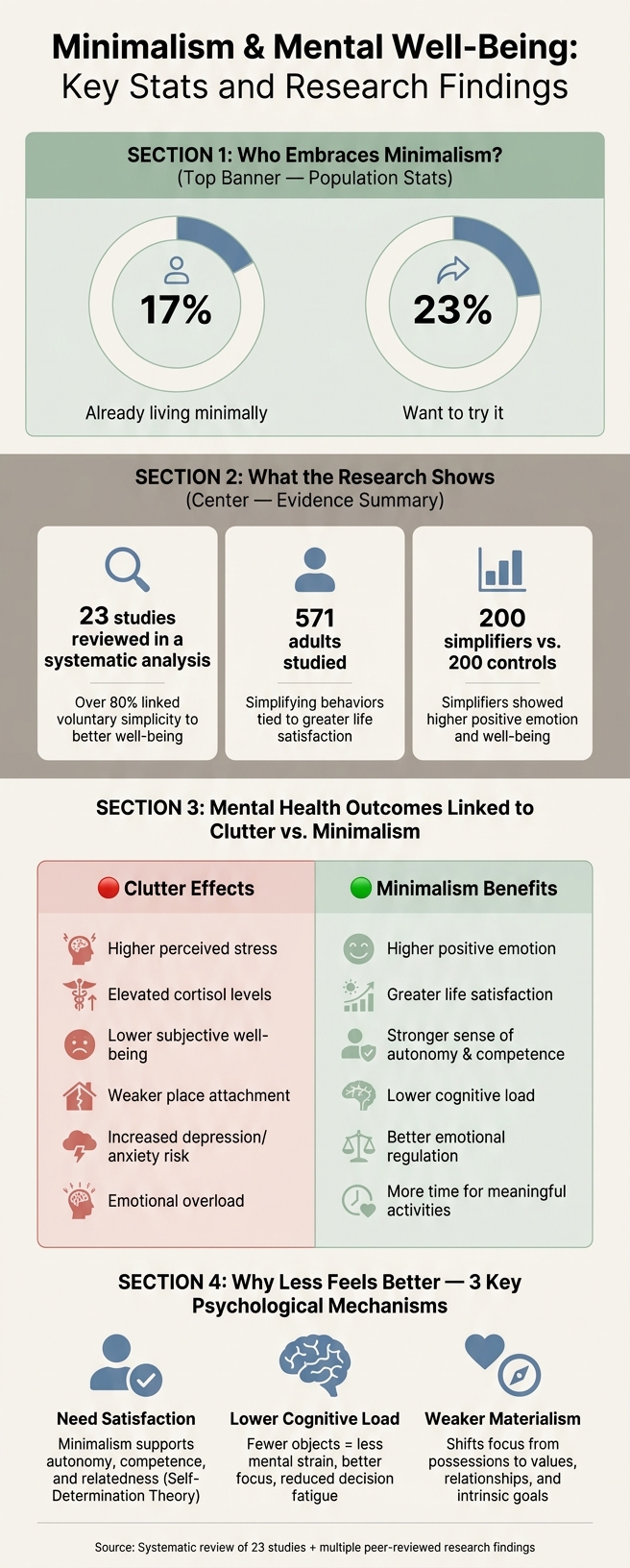
Minimalism & Mental Well-Being: Key Stats and Research Findings
The Psychology of Minimalism | Can Minimalism Make You Happier?
sbb-itb-3d8e4fc
What Research Says About Minimalism and Mental Well-Being
Research points in the same direction again and again: when people choose to live with less, they often feel better. A systematic review of 23 studies found that more than 80% of quantitative studies and more than 85% of qualitative studies linked voluntary simplicity with better well-being [1][3]. Across different methods, the pattern stayed steady. Put simply, less clutter often means less mental load.
Clutter, Stress, and Emotional Strain
Clutter can chip away at one of the main things a home is supposed to offer: relief. Research describes it as an "antagonist" to the psychological benefits of a home, weakening a person's felt security and sense of comfort [7]. That lands hard, because home should feel like a place where your mind can exhale.
Studies have also linked high-clutter spaces to higher perceived stress and emotional overload [8]. In a structural equation model using U.S. and Canadian adults with mild to severe clutter, cluttered homes were directly associated with lower subjective well-being and weaker place attachment [7]. And the problem isn't just emotional. Clutter can get in the way of basic tasks like cooking, cleaning, and moving around safely. Over time, that friction adds up.
Life Satisfaction, Purpose, and Flourishing
The picture looks different when people simplify. In a study of 571 adults, simplifying behaviors were linked to greater life satisfaction through basic psychological need satisfaction [4]. In plain English, when people cut back on excess, they may feel more in control of their lives and more supported in what matters to them.
A matched study of 200 voluntary simplifiers and 200 controls found higher positive emotion and well-being among simplifiers [3]. Qualitative research added five recurring benefits: autonomy, competence, mental space, awareness, and positive emotions [8]. The effect appears stronger among lower-income adults [3].
Mental Health Outcomes Linked to Clutter and Minimalism: Evidence Table
The main outcomes are summarized below.
| Outcome Measure | Study Type | Direction of Association | Sample Characteristics |
|---|---|---|---|
| Subjective well-being | Systematic review | Positive (with minimalism) | 23 studies, global [1][3] |
| Perceived stress | Structural equation model | Higher (with clutter) | U.S. & Canadian adults with mild to severe clutter [7] |
| Positive emotion | Quantitative (Comparative) | Higher (in simplifiers) | 200 simplifiers vs. 200 controls [3] |
| Life satisfaction | Structural equation model | Positive (with simplicity) | 571 adults [4] |
| Cortisol levels | Empirical findings | Higher (with clutter) | High-clutter home environments [8] |
| Depression/anxiety/stress | Longitudinal (3-wave) | Negative (with home attachment) | 289 Americans during COVID-19 [7] |
The next step is figuring out why this link shows up so often. Reduced clutter seems to free up attention, support autonomy, and make day-to-day life feel easier to handle.
Why Less Can Feel Better: Key Psychological Mechanisms
Less often feels better for a few clear reasons. Research ties clutter to stress and links simplicity to higher life satisfaction. Across the studies, three ideas stand out most: need satisfaction, lower cognitive load, and weaker materialism.
Self-Determination Theory: Autonomy, Competence, and Relatedness
Self-Determination Theory (SDT) says people do better when three basic psychological needs are met: autonomy, competence, and relatedness [4][3].
Minimalism can support all three. It pushes people to make intentional, value-based choices instead of buying or keeping things out of habit, pressure, or impulse [3][1]. It can also make everyday life simpler to handle, which helps people feel more capable and more in control.
A 2017 study found that simplicity was linked to higher life satisfaction through psychological need satisfaction [4]. In plain English, minimalism seems to help in part because it supports core human needs. That same feeling of control also helps explain why simpler spaces can feel mentally lighter.
Attention, Cognitive Load, and Decision Fatigue
Clutter puts more strain on attention and focus. It competes for mental space, slows processing, and adds to cognitive load, while minimalism cuts down the number of objects and choices the brain has to deal with [8].
When there’s too much to sort, organize, and keep track of, daily life can start to feel heavier than it should. A simpler space reduces that overload and can support a stronger sense of control in day-to-day life [9][5].
Materialism, Gratitude, and Need Satisfaction
Minimalism can also help by weakening the pull of materialism. It encourages people to choose with care, so they can put more energy into values and meaningful activities instead of excess [1][3]. That shift may move attention toward intrinsic goals and psychological need satisfaction, not just more stuff [1][3].
It can also open up room for mindfulness, reflection, and a deeper sense of appreciation for life [5].
These effects don’t stop with possessions. They can shape the home, daily routines, and the way people spend their time.
This article is for informational purposes only and is not medical, health, fitness, or wellness advice. Always consult a qualified healthcare, medical, fitness, or wellness professional before making decisions, starting a new routine, changing your diet, using supplements, or acting on any health-related information.
Minimalism Beyond Stuff: Environment, Identity, and Intentional Living
Beyond easing mental strain, minimalism can change how home feels, how people see themselves, and how they use their time.
Home Environments, Cortisol, and Emotional Regulation
Cluttered homes can push stress up and life satisfaction down. A 2025 study of 501 adults found a link between home clutter, higher negative affect, and lower life satisfaction [11].
Why does that happen? Because clutter keeps disorder in plain sight. It can keep background stress humming along and chip away at a person’s sense of control. Both of those patterns can affect emotional regulation [5][2].
And this doesn’t stop at the room itself. It can also shape self-image.
Voluntary Simplicity and Values Alignment
When people stop tying identity to what they own, they often shift their energy toward relationships, personal growth, and community [12]. In plain English, less energy goes into managing stuff, and more goes into what feels meaningful.
That shift can support a more deliberate, values-based identity. People start choosing what to keep based on personal values, not habit or social pressure [12].
Once values start guiding ownership, another change tends to follow: time opens up.
Time Use, Mindfulness, and Social Connection
Minimalism can free up a surprising amount of time. Some estimates suggest people spend about two hours a day managing, cleaning, and organizing their possessions [10]. Owning less can give part of that time back for relationships, rest, and healthier routines.
That extra time can also support the kind of presence and attention often tied to mindfulness. And when attention is less scattered, it becomes easier to invest in the people and experiences that matter most [1][3].
Limits of the Research and Key Takeaways
What Current Studies Cannot Fully Prove
The benefits look promising, but there are still gaps in the evidence. Current research links minimalism with better well-being, yet most studies are cross-sectional. That means they can show a correlation, not direct cause and effect [1].
There’s also the issue of self-report bias. People may describe their habits or feelings in ways that aren’t fully accurate. On top of that, other factors like income, age, personality, and prior mental health can muddy the results. Some findings suggest the link may be stronger for low-income and older adults than for high-income groups [1][3].
Where Future Research Needs to Go
Those limits make the next steps pretty clear. The field needs longitudinal studies and intervention studies that track well-being before and after guided decluttering [1][12]. That kind of design would help researchers sort out whether minimalism leads to lasting mental health gains, or whether it mainly draws in people who already feel better to begin with.
Researchers also need to separate different types of minimalism more carefully. A 2025 study in the Journal of Environmental Psychology found that aesthetic minimalism had little to no link with life satisfaction, while mindful minimalism and owning fewer belongings were tied to positive affect [6].
Conclusion: Why Less Is Often Better for Mental Well-Being
Even with those limits, the pattern still stands out. Most studies report a positive link between voluntary simplicity and well-being [3]. The signal is strong, even though causation has not been proven.
The strongest evidence points to less clutter, lower cognitive load, and better need satisfaction [1][4][5]. And when minimalism is self-initiated and tied to personal values, those gains tend to matter more [1][5].
FAQs
How is minimalism different from just having less stuff?
Minimalism is more than owning fewer things. It’s a deliberate way of cutting out distractions so you can focus on your values, your growth, and your sense of purpose.
Owning less can be part of the outcome. But at its core, minimalism is about making mental and physical room for what matters most.
Can decluttering really improve stress and focus?
Yes. Decluttering can lower stress and help you focus.
Research shows that cluttered spaces can push up cortisol, the body’s main stress hormone. That can feed anxiety and leave you feeling overloaded.
When you clear out visual noise, your brain has less to sort through. That means you use less mental energy on background distractions and can pay more attention to what matters.
A simpler space can also cut down on daily decision fatigue. And that can support mental clarity, mood, and emotional control.
What kind of minimalism is best for well-being?
Research suggests the best kind of minimalism is intentional and mindful. It’s not just about a clean look or owning fewer things.
People often call this voluntary simplicity. The idea is simple: consume less so you can focus more on what matters to you and on core human needs like autonomy, competence, and meaningful relationships.
That shift can lead to more mental clarity, more room for personal growth, more purposeful experiences, and a stronger sense of well-being.


