

Ultimate Guide to Cognitive Bias Training
Spot biases, slow decisions, and use checklists, premortems, and meeting rituals to build repeatable decision habits.


Bad decisions often come from small thinking errors, not lack of effort. In this guide, I break cognitive bias training down into one clear idea: spot the bias, slow the decision, and use a simple process before you act.
Here’s the short version:
- I explain what cognitive bias training is, and what it is not
- I point out the main biases that shape personal, team, and high-stakes decisions
- I show the training formats that fit solo work and team use
- I list practical exercises like checklists, premortems, blind review, and decision journals
- I show how to make training stick with 5-minute checks, meeting habits, and weekly reviews
- I explain how to track results by looking at process, not just outcomes
A few numbers stand out. The article notes that bias awareness scores improved by 26 points over six months with steady practice. It also cites a Carnegie Mellon study of nearly 700 participants that linked better group decisions to social sensitivity and equal speaking time, not just the smartest person in the room.
The main point is simple: awareness alone is not enough. If you want fewer bad calls, you need rules, prompts, and repeatable habits that help you think before you commit.
That’s what the rest of the article walks through.
7 Hidden Cognitive Biases Sabotaging Your Learning - and How to Stop Them! (MASTERCLASS)
sbb-itb-3d8e4fc
Core Cognitive Biases to Recognize Before You Try to Change Them
Start by naming the biases that are already steering your choices. That’s the first step. When you can spot the pattern, any training method has a much better shot at working.
Biases That Distort Personal Judgments
A lot of personal bias comes from fast, automatic thinking [2].
Confirmation bias pushes you toward information that fits what you already think and screens out what doesn’t [2]. You might skim headlines and click the ones that back up your view. Or you might read a coworker’s message in the worst possible tone because you’d already decided they were irritated with you.
The availability heuristic leads people to judge how likely something is based on how easily examples pop into mind. After heavy news coverage, for example, flying can feel more dangerous than it actually is [2].
Overconfidence bias shows up when confidence gets ahead of the evidence. At work, that can make people trust shaky judgments, including AI outputs, without checking them closely enough [4].
Biases That Distort Group and High-Stakes Decisions
Bias gets tougher to catch when a decision is shared. In groups, the pull of belonging, status, and uncertainty can steer people toward weak calls [4] [2].
Groupthink happens when a team values harmony more than honest disagreement. People stay quiet, assume someone else has already tested the weak spot, and the group keeps moving without putting the decision under enough pressure. Authority bias makes this worse: when a leader shares an opinion early, the rest of the team often build around it instead of pushing back [4] [5].
Metacognition: The Skill Behind Better Decisions
Once you can name a bias, the next move is spotting it while it’s happening. That’s where metacognition comes in. It helps you notice the pattern in the moment and shift direction before the decision sets in [4].
Most people accept the first answer that feels right, so a short pause can do a lot of work. Ask yourself:
- What am I assuming?
- What would change my mind?
- Does my confidence match the evidence?
That small mental timeout can keep a snap judgment from turning into a bad call.
Training Formats That Work for Individuals and Teams
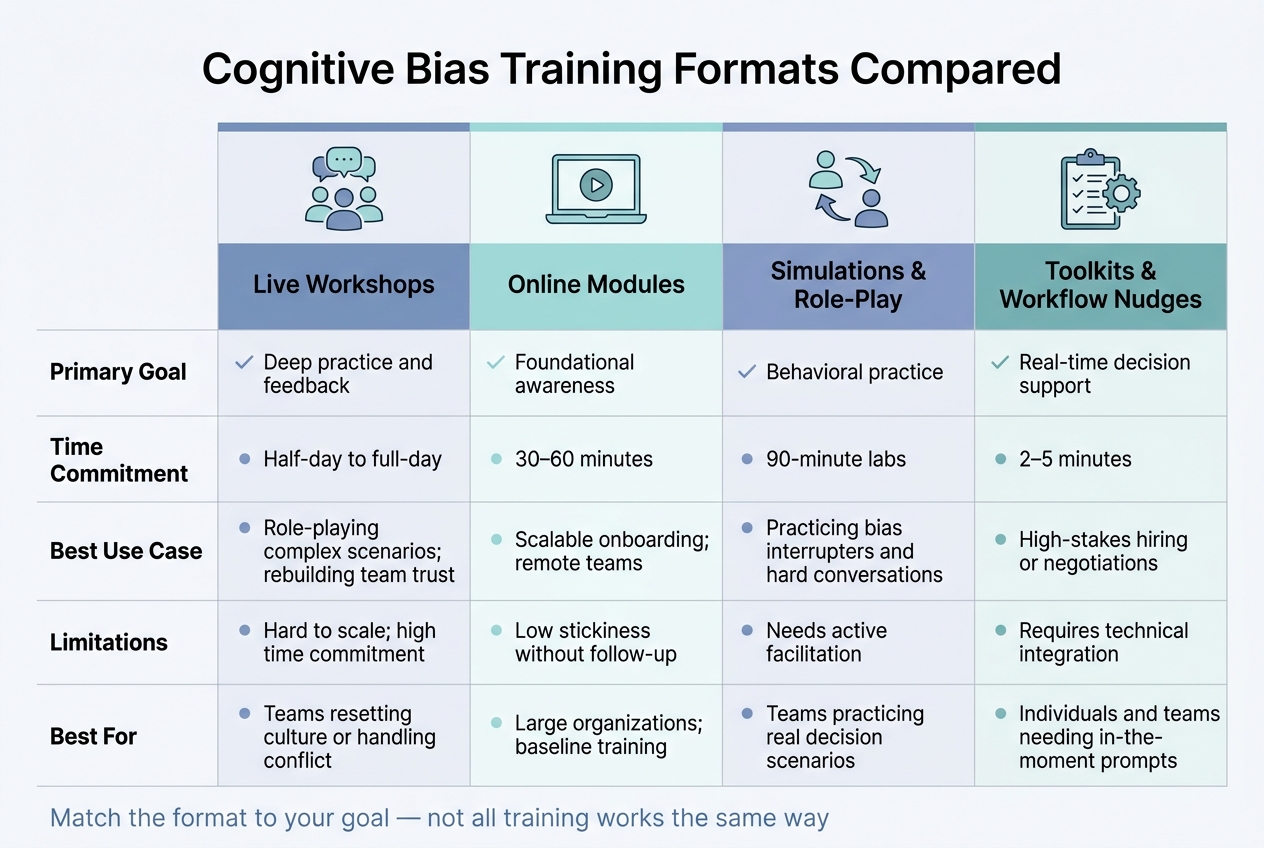
Cognitive Bias Training Formats Compared: Which One Is Right for You?
Once you know which biases to look for, the next step is simple: pick a training format that fits the job. That part matters more than it may seem. Some formats help people spot patterns. Others help them practice what to do in the moment. The best setup turns bias awareness into something people can use again and again.
Workshops, Online Modules, Simulations, and Toolkits Compared
Each format does a different kind of work. Some go deep. Some scale well. Some help in the exact moment a decision gets made. So it helps to match the format to the goal instead of treating all training the same.
| Format | Primary Goal | Time Commitment | Best Use Case | Limitations |
|---|---|---|---|---|
| Live Workshops | Deep practice and feedback | Half-day to full-day | Role-playing complex scenarios; resetting team culture and building trust [8] | Harder to scale; high time commitment [3] |
| Online Modules | Foundational awareness | 30–60 minutes | Scalable onboarding and baseline knowledge for remote teams [7] | Lower stickiness without follow-up [3] |
| Simulations/Role-Play | Behavioral practice | 90-minute labs | Practicing bias interrupters and difficult conversations [3] | Needs active facilitation [7][3] |
| Toolkits/Workflow Nudges | Real-time decision support | 2–5 minutes | Reducing avoidable forgetting during high-stakes hiring or negotiations [9] | Requires technical integration [3] |
Live workshops are best when people need feedback in the room. They work well for messy situations, especially when a team needs to rebuild trust or reset how it works together [8]. The tradeoff is time and scale. They take more effort to run, and they’re harder to roll out across a large group [3].
Online modules are almost the opposite. They’re easy to use for onboarding and remote teams, and they give everyone the same starting point [7]. But on their own, they don’t always stick. Without follow-up, people may finish the module and move on [3].
Simulations and role-play sit in the middle. They give people a chance to practice bias interrupters and hard conversations, not just read about them [3]. That said, they need someone to guide the session well, or the exercise can fall flat [7][3].
Toolkits and workflow nudges are the most direct. Think of them as prompts built into the flow of work. They take only 2–5 minutes and can cut down on avoidable forgetting during high-stakes hiring or negotiations [9]. The catch is that they often need technical integration [3].
How Team Training Differs From Solo Practice
Solo practice and team training aim at different things.
When you’re working alone, the tools are mostly personal: journaling, decision checklists, reflection, and self-audit exercises [7][9]. The point is to notice your own habits before they shape a call you’re about to make. One useful rhythm is to block off 90–120 minutes for focused decision work early in the day, before meetings and interruptions start piling up [9].
Team training has a different job. It has to deal with group behavior, not just individual habits. That’s where facilitated discussion, shared norms, rotating roles, and decision rules come in [7][3]. A good example is naming a voice steward in meetings - someone whose role is to track airtime and invite quieter people into the discussion [3]. When that role rotates, it stops being a one-off exercise and starts becoming part of how the team works.
The results differ too. Individual practice tends to sharpen personal accuracy. Bias awareness scores have increased by 26 points over six months of steady training [6]. Team training aims at system-level change, including cross-team collaboration and psychological safety [6].
Debiasing Methods and Exercises You Can Use Right Away
Aim for better decisions, not perfect objectivity. The goal is simple: make fewer avoidable mistakes, ask sharper questions, and make choices you can still stand behind later.
Structured Methods That Reduce Common Decision Errors
Structure beats willpower. If the rule is built into the process, you don't have to rely on being perfectly careful in the moment.
These methods push bias work out of the abstract and into the decision itself.
| Method | Targeted Bias | Strengths | Limitations | Best Context |
|---|---|---|---|---|
| Checklists | Overconfidence, Omission | Ensures consistency | Can become ritualized without real engagement | Routine operations; pre-flight/pre-trade [1][5] |
| Premortem | Optimism Bias | Identifies failure points before they happen | Requires psychological safety | Project launches; new product development [4] |
| Devil's Advocate | Confirmation Bias, Groupthink | Surfaces hidden risks | Can create friction if unstructured | High-stakes strategy; major investments [1][5] |
| Blind Review | Halo Effect, Affinity Bias | Increases objectivity by removing identifiers | Requires administrative setup | Hiring; performance evaluations; peer reviews [10] |
| Mandatory Dissent | Authority Bias, Herding | Forces diverse perspectives | May slow simple decisions | Team decision-making; board meetings [5] |
Before a major decision, write down one piece of evidence that goes against your view. Then run a premortem and ask: "What would have to go wrong for this to fail?"
Exercises for Building Bias Awareness Through Practice
Once you know which method fits, use it on live decisions.
Thought records are one of the clearest tools here. If a decision feels emotionally loaded, like turning down a job offer or doubling down on a project that's not working, write down the situation, your automatic thought, and the evidence for and against it [10]. That small step can slow down snap judgment.
If you're struggling to walk away because you've already put in time or money, take a short mindfulness pause before acting [1]. It sounds simple, but that pause can keep sunk-cost thinking from taking over.
A positive data log can help with confirmation bias. Pick one strong belief, then track evidence for and against it for one week [10]. You're training your attention to notice facts you might otherwise brush past.
How to Turn One-Time Exercises Into Habits
One-off exercises wear off. Repeated prompts are what turn them into habits.
Add a 5-minute bias check to something you already do, like your commute or your first coffee. That makes the practice easier to keep.
For teams, end each meeting with a 60-second decision check: assumptions, dissent, and what would change the decision [4]. That turns bias awareness into a standing team habit instead of a solo effort. It also carries the shared norms from team training into day-to-day meetings.
On the individual side, review one recent decision each week and judge the process, not just the result [1]. Over time, that helps separate skill from luck and keeps attention on whether you followed the process.
This article is for informational purposes only and is not medical, health, fitness, or wellness advice. Always consult a qualified healthcare, medical, fitness, or wellness professional before making decisions, starting a new routine, changing your diet, using supplements, or acting on any health-related information.
How to Measure Results and Keep Cognitive Bias Training Going
What to Measure After Training
Once training ends, the next step is simple: check whether behavior changed.
That means looking at process, not just final results. A team can get a good outcome for the wrong reasons, and that can hide bias. So it helps to track whether people are using the tools on a regular basis, such as pre-decision checklists, dissent rounds, and disconfirming evidence logs [1].
It also helps to compare written plans with what happened in practice. That gap can show where bias shaped the decision [1]. Sometimes the miss is obvious. A plan says one thing, the result goes another way, and the difference points back to flawed judgment rather than bad luck alone.
On the individual side, one of the clearest signals is how often you use a checklist before an important decision. That one habit tells you a lot about whether the training is still part of your routine.
For teams, two measures stand out: social sensitivity and equal speaking time. In a 2010 Carnegie Mellon study with nearly 700 participants, those factors predicted group decision quality better than the IQ of the smartest member [5]. That’s a useful reminder. The best team decision doesn’t always come from the smartest person in the room. It often comes from a room where people listen, speak up, and challenge each other in a structured way.
Why Process Changes Outlast One-Off Awareness Sessions
Bias training works best when teams build decision rules into day-to-day work. In plain English, awareness matters, but habits and norms matter more.
Lasting improvement comes from decision systems - decision rules and meeting norms that make the right action the default [1]. That might mean a checklist before major calls, a set dissent round in team meetings, or a rule that someone must log disconfirming evidence before the group moves forward.
Awareness can help people spot a problem. Systems help them do something about it again and again. That’s the difference between a one-time workshop people remember for a week and a work pattern that keeps showing up months later.
The table below shows that contrast:
| Feature | Short-Term Awareness Sessions | Long-Term Process & Habit Changes |
|---|---|---|
| Evidence Strength | Low; relies on self-reporting | High; based on process data [1] |
| Resource Demands | Low; single workshop or module [11] | Moderate to high; requires rituals and system integration [4] [1] |
| Expected Outcome | Short-lived awareness | Steadier judgment and better decisions [4] |
| Measurement | Pre/post-training quizzes [11] | Process scorecards and adherence scores [1] |
Conclusion: Key Takeaways From This Guide
The goal is not more bias knowledge; it is better decision design.
Use process scorecards, decision journals, and meeting check-ins to make that part of daily work. Recognize bias, use structure, repeat the process - and over time, that chain leads to more consistent, better-structured decisions.
FAQs
How long does cognitive bias training take to work?
It depends on the method and how consistently you stick with it. Some mental priming exercises take just 5 minutes and can help shift your mindset before a specific task.
More structured cognitive behavioral approaches often lead to noticeable improvement within 8 to 20 sessions. From there, progress tends to build bit by bit as you keep using those skills in daily life.
Which bias should I focus on first?
Start with the decisions that matter most in your life or work, like hiring, financial planning, or health routines. Don’t try to fix every bias at once. Pick one or two areas with the biggest effect and use a clear process to handle them.
If you usually test only the ideas you already like, focus on congruence bias. If your emotions tend to pull you away from your long-term goals, put your attention on the hot-cold empathy gap.
How do I know if the training is actually helping?
Track measurable outcomes and changes in behavior, not just participation. Start with leading indicators like content use, commitment sign-offs, and practice participation. Then look at lagging indicators like quality scores, error rates, and cycle times.
Set success metrics and guardrail metrics before you begin. Pressure-test your reasoning. Ask what would break if your assumptions are wrong, and keep a record of signals like decision quality or team adoption.
If daily meetings, hiring, or decision-making aren’t changing, the training probably isn’t showing up in actual work.


