

How to Align Career Goals with Life Values
Work should fit your life: pick 3–5 core values, score your role, turn top gaps into 12-week SMART goals, and review alignment regularly.


If your work looks fine on paper but feels wrong day to day, your goals may not match your values. I’d fix that by doing four things: pick 3–5 non-negotiable values, check how my job supports or blocks them, turn the biggest gaps into 12-week goals, and review the fit every few months.
Here’s the short version:
- I list the values I’d protect even if they cost me time, money, or status.
- I turn each value into clear work behaviors I can spot.
- I score my current role from 1 to 5 for each top value.
- I focus on the biggest gaps first.
- I decide what I can change now and what may need a job, team, or company move.
- I build a 30-, 90-, and 180-day plan instead of vague long-term goals.
- I review my direction often, because life changes and priorities shift.
A few points stand out from the article:
- People often feel better about work when their goals match growth, connection, and contribution, not just pay or title.
- Big yearly goals often fail; the article cites 92% as a reason to use shorter cycles.
- Low-level stress, irritability, brain fog, and feeling tired but wired can be signs that work and values are out of step.
| Step | What I’d do | Output |
|---|---|---|
| 1 | Name core values | 3–5 non-negotiables |
| 2 | Score my current role | Clear gap list |
| 3 | Set short-cycle goals | 12-week action plan |
| 4 | Review often | Course correction over time |
Bottom line: I wouldn’t chase achievement alone. I’d look for work that fits my life, my limits, and what I want my time to mean.
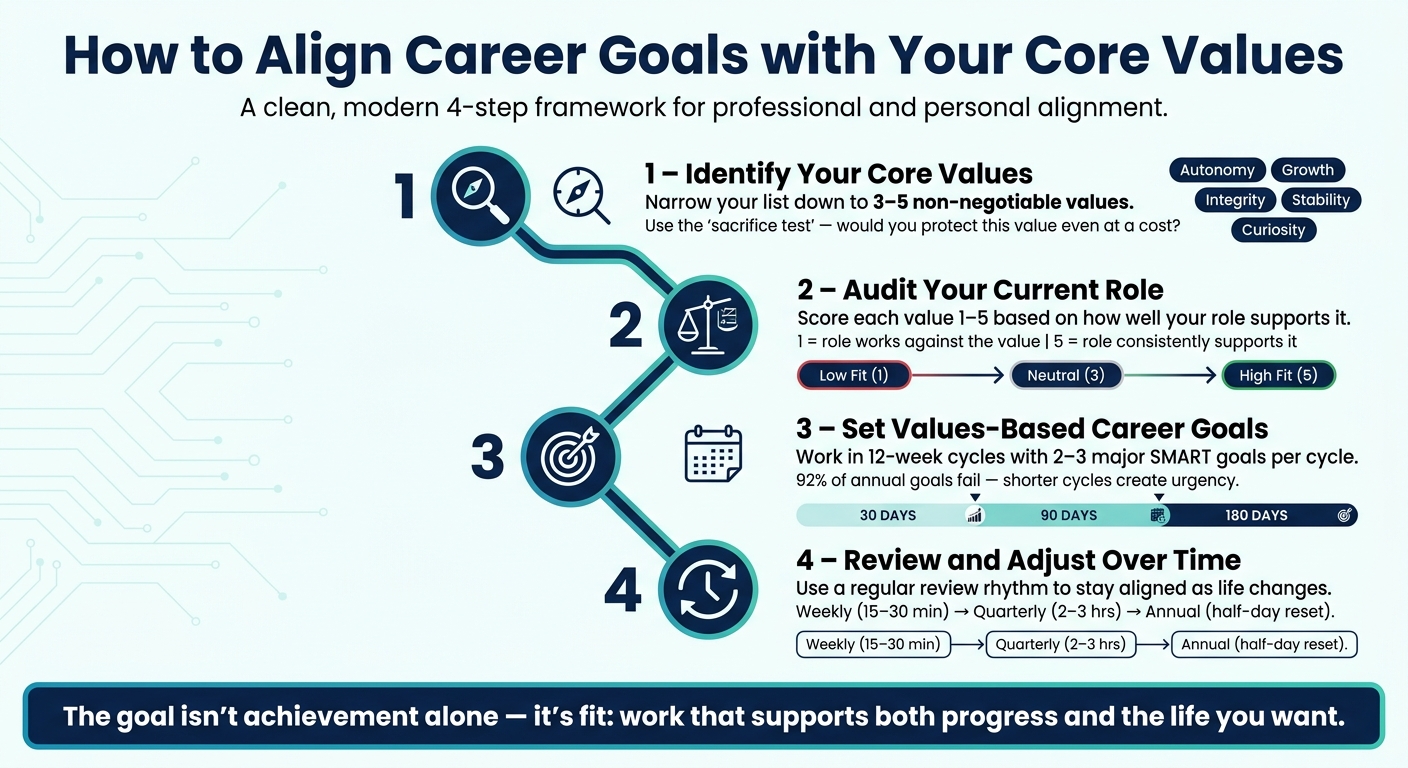
How to Align Career Goals with Your Core Values: A 4-Step Framework
How to Align Your Professional Goals with Your Values
sbb-itb-3d8e4fc
Step 1: Identify Your Core Values
Most people have a decent sense of what matters to them. The tricky part is telling the difference between values you chose and values you picked up from family, culture, or plain old pressure.
A good place to look is the discomfort from the last step. It often points straight at the issue. Pay attention to the things that keep lighting you up or wearing you down. Start with moments that felt energizing, made you proud, or felt deeply right, not just moments that looked good on paper. On the flip side, notice when you felt disappointed in yourself or seriously frustrated by a situation. Those reactions mean something.
If dishonesty from a colleague makes you unusually angry, integrity may sit near the center of your value system. If being micromanaged drains you fast, autonomy may matter more than you thought.
Rank Your Values and Pick Your Top Non-Negotiables
Write down every value that clicks with you. Don't edit the list yet. Words like growth, connection, contribution, autonomy, stability, curiosity, and kindness all belong here.
Once your list is on paper, look for overlap. Sometimes different words are getting at the same idea. For example, "kindness", "empathy", and "generosity" may all point in one direction. Group those together under a single label and treat that cluster as one value.
Then use the sacrifice test. Ask yourself what you'd give up to protect each value. Time? Money? Status? Comfort? If you'd defend it even when there's a real cost, it's probably a core value. If not, it's more likely a preference.
Try to narrow the list to 3 to 5 non-negotiables. That's enough to guide your choices without turning the whole thing into a giant spreadsheet in your head.
Turn Abstract Values into Concrete Work Behaviors
A value only helps if you can see how it shows up at work.
Take "autonomy." On its own, it's a bit vague. But "control over my own schedule and the ability to choose which projects I take on" is clear. You can use that in a job search, a role review, or a talk with your manager.
The same idea works with other values. "Stability" can mean predictable income, consistent benefits, and reliable working hours. "Curiosity" can mean asking questions before assuming and actively seeking out new learning opportunities.
Before you compare your role to your values, translate each one into behavior you can spot.
| Abstract Value | Concrete Work Behavior |
|---|---|
| Autonomy | Control over daily schedule and task prioritization |
| Stability | Predictable income, benefits, and consistent hours |
| Curiosity | Ask questions before assuming; seek new learning opportunities |
| Growth | Step outside your comfort zone even when it feels risky |
| Kindness | Pause before judging and offer help first |
With your values on the table, you're ready to look at your current role and see where it lines up and where it falls short.
Step 2: Audit How Well Your Current Role Fits Your Values
Judge your role by what happens in your day-to-day work, not by the title on your LinkedIn profile. The goal here is simple: look at the actual behavior your job rewards or blocks. That’s how you find the biggest mismatch before you set career goals.
Use a Values-Versus-Role Scoring Grid
Rate each of your top values on a scale from 1 to 5:
- 1 = the role works against that value
- 5 = the role supports that value on a steady basis
For each score, add one clear example. Then mark the gap as High, Medium, or Low based on how central that value is to you.
| Core Value | Current Role Rating (1–5) | Evidence | Gap Level |
|---|---|---|---|
| Autonomy | 2 | Micromanagement on daily reports; fixed 9–5 schedule | High |
| Growth | 4 | Access to annual training budget; mentorship from senior lead | Low |
| Stability | 5 | Consistent compensation; clear long-term company roadmap | Low |
| Integrity | 1 | Pressure to exaggerate product capabilities in sales calls | High |
Put your focus on the biggest gaps tied to your non-negotiables.
Spot the Biggest Gaps and Trade-Offs
Next, figure out where the mismatch comes from. Is it tied to your tasks? Your pay? Your schedule? Your manager? The company’s mission?
That part matters. A short stretch of pressure can make a decent role feel off. But if the mismatch sticks around after the pressure fades, that usually points to something deeper: your priorities have shifted, and your role no longer fits.
Look back over the last six months and note how often each top value shaped your choices versus got pushed aside. [1] That pattern gives you the raw material for your next career goals.
Step 3: Set Values-Based Career Goals and Build a Plan
Once you spot the biggest gaps, use them to pick your next goals. That's where this starts to get practical.
Turn Value Gaps into SMART Career Goals
Begin with the values that show the biggest gap, then turn each one into a SMART goal: Specific, Measurable, Achievable, Relevant, and Time-bound.
If Growth ranks high for you, a loose goal like "learn more" probably won't change much. A SMART version is much better: "Commit to learning one new skill this quarter, with weekly progress checkpoints and a clear success criterion by the end of the 12-week cycle." The point is simple: make each goal specific, measurable, achievable, relevant, and time-bound.
Work in 12-week cycles so every goal has a deadline that feels close enough to matter. Keep it to 2–3 major goals per cycle. That gives you room to go deep instead of trying to do everything at once. Annual goals often drift because they don't feel urgent, which helps explain why 92% of goals fail. [4]
What You Can Change Now vs. What Requires a Bigger Move
Not every gap means you need a new job. Some can be fixed by changing how you work in your current role.
For each gap, ask yourself: Can I fix this from where I am, or does it call for a bigger move?
You may be able to shift your tasks, the way your work is framed, or even key working relationships so they line up better with your values. That alone can change how your role feels, even if your title stays the same. [5] For example, if Growth is non-negotiable and your current work doesn't use it, volunteering for a cross-functional project or a stretch assignment can be a low-risk way to test new ground. [3]
Some gaps run deeper. If your organization's mission or day-to-day practices clash with your core non-negotiables, no amount of boundary-setting will solve it. When the mismatch sits at the mission level, it's time to plan for a transfer or an exit. [2]
Use this grid to sort quick fixes from structural mismatches:
| Gap Type | Example | Response |
|---|---|---|
| Task-level | Too much admin, not enough creative work | Adjust tasks; propose role redesign |
| Schedule/flexibility | Fixed hours conflict with personal priorities | Negotiate a pilot arrangement |
| Skill stagnation | No growth opportunities in current team | Seek stretch projects or internal transfers |
| Mission conflict | Company practices contradict core values | Plan for a transfer or exit |
Map Your Next 30, 90, and 180 Days
Break each goal into three short phases. That keeps it grounded in action instead of turning into wishful thinking.
In the first 30 days, focus on watching patterns and trying small tests. Keep a simple daily log of your fulfillment and stress levels on a 1–10 scale. [2] If autonomy is the issue, make one small change right away, such as protecting two 90-minute blocks each week for high-meaning work. [5]
By day 90, you should be testing at least one concrete change. If growth is the gap, this is a good time to talk with your manager. Frame the request around the value you deliver: "I want to ensure consistent delivery; to do that, I propose a schedule adjustment for 60 days with clear checkpoints." [2] If you're thinking about a bigger move, use this phase to connect with a mentor who has made a similar shift. [2]
At the 180-day mark, do a simple review. Go back through your fulfillment-and-stress log and look for patterns. Which values held up? Which ones still fell short? [1] Then use what you found to update your next goals and set your next 12-week cycle.
Step 4: Review Your Alignment and Adjust Over Time
After you’ve tested fit, keep checking it as your life changes. A health scare, a caregiving shift, a promotion, or a money change can all reshape what matters most. That’s why alignment needs a regular review. It’s not a one-time call.
Set a Regular Check-In for Reflection and Adjustment
A simple rhythm works well here: a 15–30 minute weekly tactical review, a 2–3 hour quarterly strategic review, and a half-day annual vision reset. [4] Quarterly reviews help keep your goals current instead of letting them drift.
Every six months, go a bit deeper with a values audit. Look back at your reflection notes and ask: which values still guide your decisions, and which ones have started to fade?
One tool that helps is a Values Conflict Log. It’s just a simple record of moments when two values clash in a work decision. After six months, look back and note which value guided each choice. The values that win most often are usually your core values. The others are secondary. [1] Then use those notes to update your value ranking before the next planning cycle.
Don’t wait for a scheduled review if something big changes. A move, a health event, a change in family duties, or a new money goal are all signs to reassess sooner. If you’re trying to figure out whether a value shift is lasting or just tied to the moment, ask:
"Would I still make this change if my situation returned to what it was six months ago?"
If the answer is no, the shift is probably temporary. Mark it that way and revisit it at your next quarterly review. [1] And if the same conflict keeps showing up, treat that as a sign to revisit your priorities.
Conclusion: Focus on Fit, Not Just Achievement
This process only helps if you return to it. Careers change. People change too.
The goal isn’t achievement by itself. It’s fit - work that supports both progress and the life you want.
FAQs
How do I know if a value is core or just a preference?
Look at how you act when a decision matters. Pay attention to your emotional reactions too. Core values are your non-negotiables. They guide what you do, and when you live by them, you tend to feel more energy, fulfillment, and resilience.
Preferences are different. They’re often tied to the situation or shaped by outside pressure and other people’s expectations. If a principle keeps shaping your choices, even when things get hard, it’s probably a core value.
What if my job conflicts with my values, but I can’t leave yet?
Focus on small-scale alignment and clear boundaries. Pick the value that matters most right now, then treat your limits - work hours, energy, or emotional bandwidth - as design parameters, not proof that you’re falling short.
From there, look for small shifts that protect your energy. That might mean negotiating duties, changing your hours, or simply reframing how you see the situation. Sometimes the fix isn’t dramatic. It’s a few smart guardrails.
The 10-10-10 lens can help here: how will this choice feel in 10 minutes, 10 months, and 10 years? It’s a simple way to zoom out when everything feels urgent.
Also pay attention to patterns. Which tasks leave you feeling switched on, and which ones drain the life out of you? That kind of honest read gives you something concrete to work with when you suggest strengths-based adjustments.
How often should I review my career goals and values?
Use a layered review schedule so your career goals stay in step with your values.
- Daily: Check in with your actions, then reflect in the evening. A short pause at the end of the day can show whether your time matched what matters to you.
- Every six months: Review your value hierarchy in a more formal way. This is a good time to look for drift, pressure from outside voices, or goals that no longer fit.
- Every few years or during major life transitions: Revisit your broader life direction. Big moments - like a move, a new job, burnout, parenthood, or a loss - can shift what you want from work and from life.


