

The Complete Guide to Longevity: Live Healthier Longer
Small daily habits—movement, diet, sleep, stress control, and social bonds—are the real keys to living longer and healthier.


Want to live longer and healthier? It's all about your daily habits. While genetics only determine 10–30% of your lifespan, the rest is shaped by choices you make every day. This guide focuses on five key areas proven to close the gap between lifespan (total years alive) and healthspan (years lived in good health): movement, nutrition, sleep, stress management, and social connection.
Key Takeaways:
- Movement: Regular cardio and strength training can cut mortality risk by 40%.
- Nutrition: Whole foods, high fiber, and adequate protein fight inflammation and aging.
- Sleep: 7–9 hours nightly supports tissue repair and clears brain waste.
- Stress: Mindfulness and emotional health reduce harmful effects of chronic stress.
- Social Connection: Strong relationships improve survival rates by 50%.
Aging starts at the cellular level. Factors like DNA damage, telomere shortening, and "zombie" cells drive aging, but lifestyle changes can slow these processes. Biological age (how your body functions) matters more than chronological age (years lived) - and it’s modifiable with exercise, diet, and stress management.
Simple habits like walking 7,000 steps daily, eating Mediterranean-style meals, and staying socially engaged can add years of vitality to your life. By making small, consistent changes, you can take control of your health and longevity today.
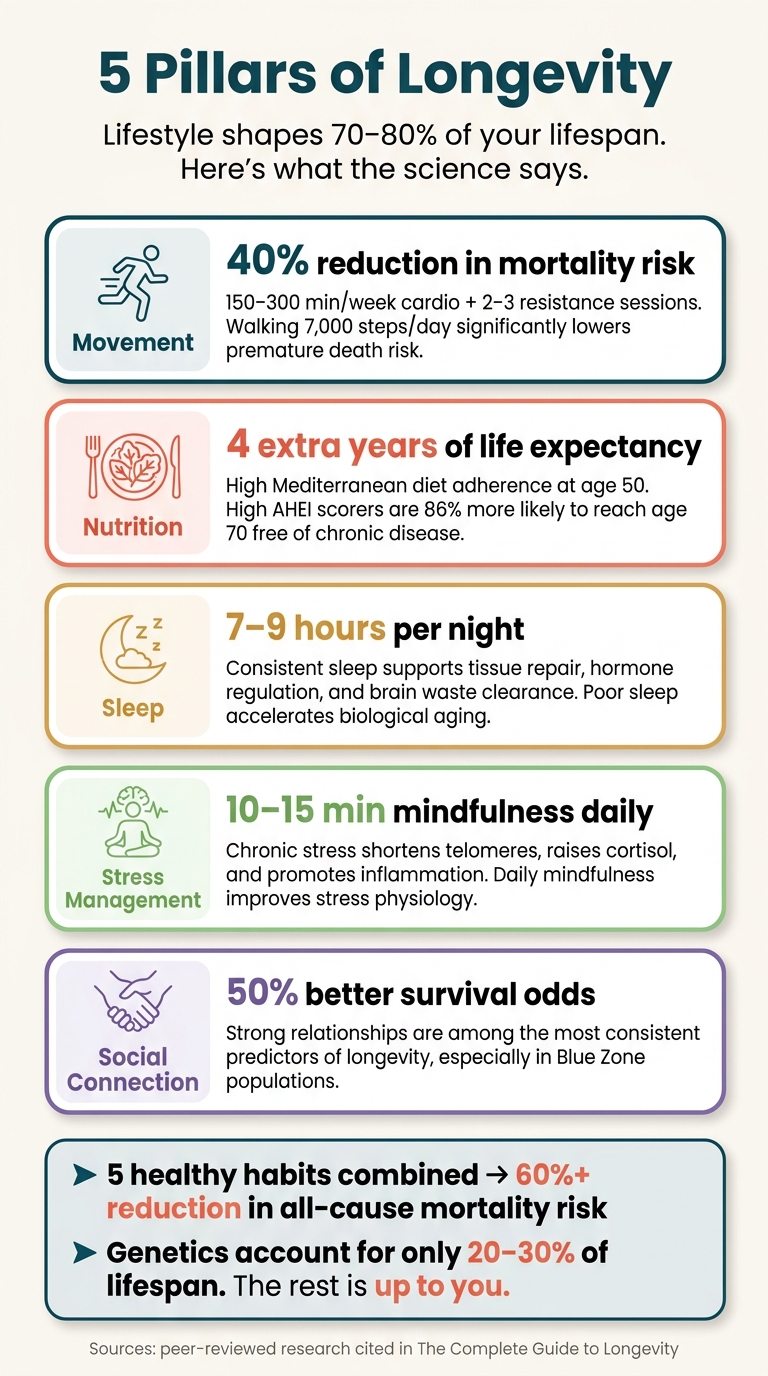
5 Pillars of Longevity: Key Stats for a Longer, Healthier Life
The Longevity Toolkit: Peter Attia’s 5 Tactics to Improve Longevity
sbb-itb-3d8e4fc
How Aging Works: The Science Behind Longevity
Understanding the mechanisms behind aging helps us make informed decisions to slow the process and maintain health.
Cellular Aging and What Drives It
Aging begins at the cellular level, involving processes that gradually weaken the body’s ability to repair and maintain itself.
Every day, your DNA faces an estimated 100,000 damage events [7]. While most of this damage is repaired, small errors accumulate over time, leading to mutations and cellular dysfunction. These changes are key contributors to aging and age-related diseases.
Another factor is telomere attrition. Telomeres - those protective caps at the ends of chromosomes - shorten with each cell division. When they become too short, the cell either stops dividing or dies [7].
Then, there are senescent cells, often called "zombie cells." These cells no longer divide but remain active, releasing inflammatory signals known as the Senescence-Associated Secretory Phenotype (SASP). This inflammation damages nearby healthy cells and contributes to conditions like Alzheimer's disease and atherosclerosis [7][9].
"Aging is a complex and multifaceted process involving a variety of interrelated molecular mechanisms and cellular systems." - Springer Nature [7]
Other contributors include mitochondrial dysfunction, which affects energy production, and loss of proteostasis, where the body struggles to clear damaged proteins [7][8]. Epigenetic changes - alterations in gene expression without changes to the DNA sequence - also play a role [7][10].
Chronological Age vs. Biological Age
Your age in years doesn’t fully reflect your body’s condition. Two people who are both 55 can have vastly different health profiles. One might feel and function like a 45-year-old, while the other experiences health issues typically seen in someone much older. This difference comes down to chronological age versus biological age.
| Feature | Chronological Age | Biological Age |
|---|---|---|
| Definition | Years since birth | Functional state of the body |
| Nature | Fixed and unchangeable | Modifiable with lifestyle choices |
| Measurement | Calendar years | Biomarkers, epigenetic clocks, physiological tests [13][14] |
| Predictive Value | General life-stage indicator | Better predictor of disease risk and longevity [13] |
Biological age is often assessed using tools like epigenetic clocks (e.g., GrimAge, Horvath clock), which analyze DNA methylation patterns to evaluate how well your body is functioning [10]. Interestingly, genetics only account for about 20–30% of lifespan variability [14], leaving lifestyle choices as the dominant factor.
For example, a 12-week supervised exercise program was shown to reduce biological age by an average of 10 months [13]. Small, consistent changes can make a noticeable difference.
These findings emphasize how much control we have over aligning our biological age with our health aspirations.
Lifestyle Factors That Speed Up Aging
While cellular mechanisms drive aging, lifestyle choices can accelerate - or slow - this process. Smoking, chronic stress, lack of exercise, and poor diet are some of the biggest culprits that can age your body faster than your years.
For instance, consuming ultra-processed foods lowers the odds of healthy aging by 32% [11]. On the flip side, improving adherence to the DASH diet by just 10 points is linked to a 1.7-year reduction in biological age acceleration [12]. Clearly, diet influences more than just weight - it directly impacts cellular aging.
Chronic stress also wreaks havoc by disrupting sleep, promoting inflammation, and impairing the body’s ability to repair itself. Poor sleep alone speeds up biological aging and increases the risk of neurodegenerative diseases [9][10]. Since these factors often overlap, addressing them collectively yields more noticeable results.
"Diet emerges as a decisive modifiable determinant of lifespan and health span." - Journal of Translational Medicine [9]
This article is for informational purposes only and is not medical, health, fitness, or wellness advice. Always consult a qualified healthcare professional before making decisions about your health, starting a new routine, changing your diet, or using supplements.
Daily Habits That Support a Longer, Healthier Life
The choices you make every day can have a powerful impact on how long - and how well - you live. Science shows that small, intentional habits can help close the gap between lifespan and healthspan, giving you more years of vitality.
Exercise and Physical Activity
Your fitness level is one of the most influential factors in determining longevity, and the good news is that you don’t need to be a marathon runner to experience the benefits. Research highlights that cardiorespiratory fitness is a key predictor of how long you’ll live [1][15].
A practical starting point? Aim for 150–300 minutes of moderate-intensity aerobic activity each week (think Zone 2 cardio, where you can still hold a conversation) paired with 2–3 resistance training sessions targeting all major muscle groups [3][15]. For cardio, following the 80/20 rule - spending 80% of your time in Zone 2 and 20% at higher intensities - can help build both mitochondrial health and cardiovascular strength [15]. This combination of aerobic and resistance training is linked to a 40% reduction in mortality risk [3][15][16].
"Our objective is to be able to maintain optionality around being physical for as long as possible, and that is tantamount to having as high a VO2 max as possible, in addition to being as strong as possible." - Peter Attia, MD [17]
Everyday movement also matters. Walking 7,000 steps a day has been shown to significantly lower the risk of premature death compared to walking just 2,000 steps [3]. If you’re sitting for long stretches, take short "exercise snacks" throughout the day - like a quick walk, climbing stairs, or a few stretches - to keep your metabolism active [3].
| Exercise Type | Longevity Benefit | Recommended Dose |
|---|---|---|
| Zone 2 Cardio | Mitochondrial health, fat metabolism | 150–300 min/week [15] |
| Resistance Training | Muscle mass, bone density, insulin sensitivity | 2–3 sessions/week [3] |
| VO2 Max Intervals | Cardiovascular peak capacity | 1–2 sessions/week [15] |
| Stability/Balance | Fall prevention, coordination | 2–3 sessions/week [15] |
| Daily Walking | Reduced risk of premature death | 7,000–10,000 steps/day [15] |
For those over 50, adding balance-focused exercises like tai chi or single-leg stands 2–3 times per week is critical, as falls are one of the leading causes of injury-related deaths in older adults [3][15].
Eating for Longevity
Your overall dietary pattern plays a significant role in healthy aging. The Alternative Healthy Eating Index (AHEI) shows that people with high adherence are 86% more likely to reach age 70 free of chronic diseases and 124% more likely to do so by age 75 [11].
One of the most researched diets is the Mediterranean diet, which emphasizes extra-virgin olive oil, vegetables, fruits, whole grains, legumes, nuts, and fatty fish. Following this diet at age 50 could add an average of four extra years to your life expectancy compared to low adherence [5]. Practical tips include using at least 4 tablespoons of olive oil daily, eating legumes three times per week, and including fatty fish like salmon or trout 2–3 times per week [18].
Populations in Blue Zones, such as Okinawa, Japan, and Ikaria, Greece, follow diets that are about 95% plant-based, high in legumes, and naturally moderate in calories [6][9]. The Okinawan practice of hara hachi bu - eating until you’re 80% full - creates a natural caloric restriction that may help reduce oxidative stress over time [6].
Sleep and Circadian Health
Sleep isn’t just about rest - it’s when your body repairs itself, consolidates memory, clears waste, and regulates hormones. Poor sleep has been tied to faster biological aging [9]. Adults generally need 7–9 hours of quality sleep per night. Just as important as the amount is consistency: going to bed and waking up at the same time every day helps regulate your circadian rhythm, which influences metabolism, immune function, and cellular repair.
A simple 30–60 minute wind-down routine - such as reading or light stretching - can help lower cortisol and prepare your body for sleep [21]. Avoiding bright screens, heavy meals, and caffeine in the evening also supports better sleep quality.
Stress Management and Emotional Well-Being
Managing stress is just as important as getting good sleep. Chronic stress can speed up aging by increasing cortisol levels, promoting inflammation, and interfering with sleep, which may even shorten telomeres [6][21]. Incorporating stress-reducing techniques into your daily routine can bolster your resilience. For example, 10–15 minutes of mindfulness practice each day has been shown to improve stress physiology [21]. Other simple activities - like breathing exercises, spending time outdoors, or yoga - can also make a difference.
"Since avoidance of stress is inevitable, managing chronic stress and improving resilience towards stressful situations may present more tangible goals." - American Journal of Lifestyle Medicine [6]
Interestingly, research suggests that people who believe they’ll live longer are more likely to adopt health-promoting behaviors [19].
Social Connection and Sense of Purpose
Strong relationships and a clear sense of purpose are consistent predictors of a longer life. In Blue Zones, daily communal activities strengthen social bonds and foster a sense of purpose, both of which contribute to longevity [6][20]. A strong sense of purpose can encourage healthier habits and help buffer against stress. Whether it’s spending time with family and friends, joining community groups, or volunteering, investing in relationships can enhance both the length and quality of your life.
This article is for informational purposes only and is not medical, health, fitness, or wellness advice. Always consult a qualified healthcare, medical, fitness, or wellness professional before making decisions, starting a new routine, changing your diet, or using supplements.
Preventive Health: Reducing Your Risk Over Time
Prevention is all about staying ahead of potential health issues. The sooner you identify a problem - or better yet, stop it from happening - the more control you have over your future well-being.
Health Risks Worth Avoiding
Certain habits can drastically affect how long and how well you live. For instance, tobacco use can reduce life expectancy by about 10 years [4]. However, the good news is that quitting smoking significantly improves your outlook. Within 20 years, former smokers often see their risk drop close to the levels of someone who has never smoked [25].
Alcohol is another area where caution is key. As of 2026, experts agree there’s no “safe” amount of alcohol when it comes to cancer risk [27]. For heart health, it’s best to keep alcohol consumption to a minimum - or avoid it altogether. Weight management also plays a big role in long-term health. Even a small weight gain after your 20s can increase the likelihood of developing heart disease, type 2 diabetes, or high blood pressure [25].
Beyond steering clear of these risks, regular health screenings are essential for catching potential problems early.
Routine Screenings and Check-Ups
Routine blood tests are a standard part of annual check-ups, but they often focus on detecting existing diseases. If you’re aiming to prioritize longevity, consider testing for additional biomarkers that can reveal early warning signs [24].
"Standard annual bloodwork ordered by primary care physicians is calibrated to detect established disease - not to optimize for longevity." - Derek Giordano, Founder & Editor, IQ Healthspan [24]
Ask your doctor about a "Minimum Viable Longevity Panel", which includes tests for markers like ApoB, fasting insulin, hsCRP, homocysteine, Omega-3 index, and Vitamin D [24]. These tests typically cost less than $200 [24]. For a deeper dive into your biological aging, epigenetic age testing (such as TruDiagnostic's TruAge Complete, priced at $300–$400) offers insights into how fast your body is aging biologically [24].
Cancer screenings have also advanced in recent years. For example, colorectal cancer screening now begins at age 45 for those at average risk, and a primary HPV test every five years is now the preferred method for cervical cancer screening [23]. Below is a quick guide to recommended cancer screenings:
| Cancer Type | Age to Start | Frequency |
|---|---|---|
| Cervical | 25 | HPV test every 5 years (preferred) or Pap test every 3 years [23] |
| Breast | 40–45 | Annually (45–54); every 1–2 years (55+) [23] |
| Colorectal | 45 | Varies by test (e.g., colonoscopy every 10 years) [22][23] |
| Lung | 50 | Annually (only for those with 20+ pack-year smoking history) [23] |
| Prostate | 50 | Discuss with provider; frequency based on PSA levels [23] |
Pairing these screenings with healthy lifestyle habits creates a strong defense against aging and disease.
Simple Steps to Lower Everyday Risk
You don’t always need a doctor’s visit to reduce your risk. Everyday actions can make a big difference. For example, keeping your waist circumference below 40 inches for men or 35 inches for women is linked to a lower risk of obesity-related conditions [25]. Small changes in your environment, like using daily sunscreen, testing for radon, and switching to non-toxic cleaning products, can also reduce exposure to harmful substances over time [28].
Protecting your hearing with noise-canceling headphones and increasing your daily steps by just 1,000 can have a measurable impact. Adding those extra steps could lower your overall risk of death by 23% [2]. Even small, consistent efforts like this show how prevention can be part of your daily routine.
This article is for informational purposes only and is not medical, health, fitness, or wellness advice. Always consult a qualified healthcare, medical, fitness, or wellness professional before making decisions, starting a new routine, changing your diet, using supplements, or acting on any health-related information.
Making Longevity Part of Your Everyday Life
Living a long, healthy life isn’t just about knowing what to do - it’s about making those actions part of your daily routine. The real challenge is turning good intentions into habits that stick.
How to Build Habits That Last
Creating systems is the key to making longevity-focused habits a permanent part of your life. Motivation alone won’t cut it, especially when you're tired or stressed. That’s exactly when these habits matter most. The people who consistently maintain healthy lifestyles don’t rely on fleeting bursts of motivation - they rely on systems.
"Discipline beats motivation because discipline is a system, and systems run whether you feel like it or not." - Axl Gonzalez, Author [1]
Environment design is a simple yet powerful tool. It’s about making healthy choices easier and less healthy ones harder. For example, keep fruit visible on your counter instead of hidden in a drawer. Lay out your gym clothes the night before. Treat workout time like an unmissable meeting by blocking it off on your calendar. These small changes reduce the mental effort needed to make better choices.
Another effective strategy is habit stacking - linking a new habit to something you already do. For instance, taking a 20-minute walk after lunch not only adds movement to your day but also helps regulate blood sugar levels [1][21]. By building on an existing routine, the new habit becomes easier to maintain.
Tracking your progress is crucial too. Establish a baseline with tools like annual blood work, a DEXA scan for body composition, or a VO2 max test. These benchmarks give you concrete data to measure your improvements. Over time, as your body changes, you can adjust your habits to stay effective.
Adjusting Your Approach at Different Life Stages
Longevity isn’t a one-size-fits-all plan - it evolves as your body and priorities change. Research shows that biological aging tends to accelerate around ages 44 and 60, making these critical times to reassess your approach [32].
Starting around age 40, the body naturally begins losing about 1% of muscle mass per year unless you actively engage in resistance training [31]. To counteract this, protein intake becomes increasingly important. The table below outlines how protein needs shift with age:
| Life Stage | Recommended Protein Intake | Why It Matters |
|---|---|---|
| 20s–30s | 1.4–1.8g per kg bodyweight/day | Supports muscle building and metabolic health |
| 40s–50s | 1.6–2.0g per kg bodyweight/day | Helps combat early muscle loss (sarcopenia) |
| 60s+ | 2.0–2.4g per kg bodyweight/day | Essential as muscle loss accelerates |
| Post-illness | 2.4–3.0g per kg bodyweight/day | Aids in faster tissue repair |
Source: [30]
In your 50s, the focus often shifts to metabolic health and preventive screenings. Monitoring markers like fasting insulin and ApoB can help catch early signs of cardiovascular issues [26][29]. By your 60s and beyond, maintaining cognitive health and social connections becomes just as important as physical fitness. Mental stimulation and meaningful relationships can be as protective as medical interventions [31][26].
The good news? It’s never too late to begin. As Abby King, PhD, from Stanford Medicine, says: "It's never too late to start." [31]
Designing a Daily Routine Around Your Long-Term Goals
A well-structured morning routine can set the tone for a longevity-focused day. It doesn’t need to be complicated - a few key activities can make all the difference. Aligning your habits with your body’s natural rhythms helps lay the groundwork for long-term health.
For example, getting outside for 10–15 minutes within the first hour of waking helps reset your circadian rhythm. Morning workouts not only improve adherence but also maximize benefits over time. Delaying caffeine until 90–120 minutes after waking can optimize your alertness [33]. Additionally, finishing meals at least three hours before bedtime supports better sleep and cellular repair [33][21].
Here’s an example of how you can structure your morning for longevity:
| Timeframe | Activity | Primary Benefit |
|---|---|---|
| 0–5 min | Drink 16–20 oz of water | Kickstarts metabolism |
| 5–20 min | Get morning sunlight | Resets circadian rhythm and boosts mood |
| 20–40 min | Light movement or Zone 2 cardio | Enhances metabolic health |
| 90–120 min after waking | Have your first cup of coffee | Improves alertness |
| 3 hrs before bed | Finish last meal | Supports sleep and cellular repair |
Source: [33]
"The longevity lifestyle is not about chasing immortality... It is about weaving simple, evidence-based habits into the fabric of your everyday life." - Amie Harpe, Founder, Peacefully Proven [21]
Focus on the fundamentals rather than chasing advanced techniques. Cardiovascular fitness, resistance training, adequate protein intake, and quality sleep (7–9 hours) are the cornerstones of long-term health. These basics have a far greater impact than any cutting-edge intervention [1][4].
This article is for informational purposes only and is not medical, health, fitness, or wellness advice. Always consult a qualified healthcare, medical, fitness, or wellness professional before making decisions, starting a new routine, changing your diet, using supplements, or acting on any health-related information.
Conclusion: Taking Charge of Your Health for the Long Run
Throughout this guide, we’ve looked at ways to boost daily energy and focus on preventive care. The key takeaway? Turning these strategies into lifelong habits is what truly makes the difference.
Living longer and healthier comes down to consistent, everyday choices. Studies show that sticking to just five basic healthy habits can reduce your risk of dying from any cause by over 60% [34]. It’s not about making sweeping changes overnight - it’s about committing to small, manageable steps each day.
There’s no single magic solution here. Instead, it’s the cumulative effect of daily decisions that shapes your overall well-being.
These habits don’t work in isolation - they reinforce one another. For example, better sleep can improve physical performance, meaningful relationships can help reduce stress, and eating enough protein supports muscle strength to maintain independence as you age. Focusing on one area often leads to improvements in others. This interconnected approach captures the practical tips shared throughout this guide.
Right now, there’s a 17-year gap between the average lifespan and the years spent in good health [30]. But this gap isn’t set in stone. Your daily actions play a huge role in closing it.
By weaving these practices into your routine, you create a strong foundation for a longer, healthier life.
This article is for informational purposes only and is not medical, health, fitness, or wellness advice. Always consult a qualified healthcare, medical, fitness, or wellness professional before making decisions, starting a new routine, changing your diet, using supplements, or acting on any health-related information.
FAQs
Which longevity habits matter most if I can only start with one?
Improving your cardiorespiratory fitness is one of the best habits you can adopt for your health. Research indicates that VO2 max - a critical measure of cardiovascular fitness - is the most reliable predictor of overall mortality risk. To boost this, incorporate Zone 2 cardio into your routine. Aim for 45–60 minutes, 3–4 times a week.
While habits like strength training, quality sleep, and balanced nutrition are crucial, prioritizing aerobic fitness delivers the greatest benefits for long-term health.
How can I estimate my biological age at home or with my doctor?
You can figure out your biological age using three key approaches:
- Molecular testing: This includes epigenetic clocks, which analyze blood or saliva samples to assess age-related changes at the molecular level.
- Blood biomarker algorithms: These involve evaluating test results such as glucose levels, cholesterol, and inflammation markers to estimate biological age.
- Physical performance tests: Simple assessments like measuring how long you can balance on one leg can also provide insights.
Each method has its own level of precision, but the real value comes from observing how these measurements change over time rather than fixating on a single result.
What should I do if my sleep, stress, and workouts keep interfering with each other?
When sleep, stress, and workouts overlap, trying to tackle everything simultaneously can feel overwhelming. These areas are closely linked, so improving one often creates a positive ripple effect on the others. Start by addressing your biggest hurdle. Struggling with sleep? Focus on going to bed earlier or creating healthier bedtime routines. Feeling overwhelmed by stress? Start small with practices like deep breathing or mindfulness exercises. Building a solid foundation in one area can make it easier to maintain and improve habits in the others.


